Virtual reality has long promised fully immersive digital worlds, yet for years the technology struggled to overcome a fundamental limitation: the inability for users to move naturally inside those environments. Early VR experiences relied heavily on handheld controllers, teleportation mechanics, or stationary play, often breaking immersion and limiting real-world usefulness. Against this backdrop, a company emerged with a singular focus on solving the locomotion problem in virtual reality, building its foundation around the belief that true immersion only happens when the body is fully engaged, not just the eyes and hands.
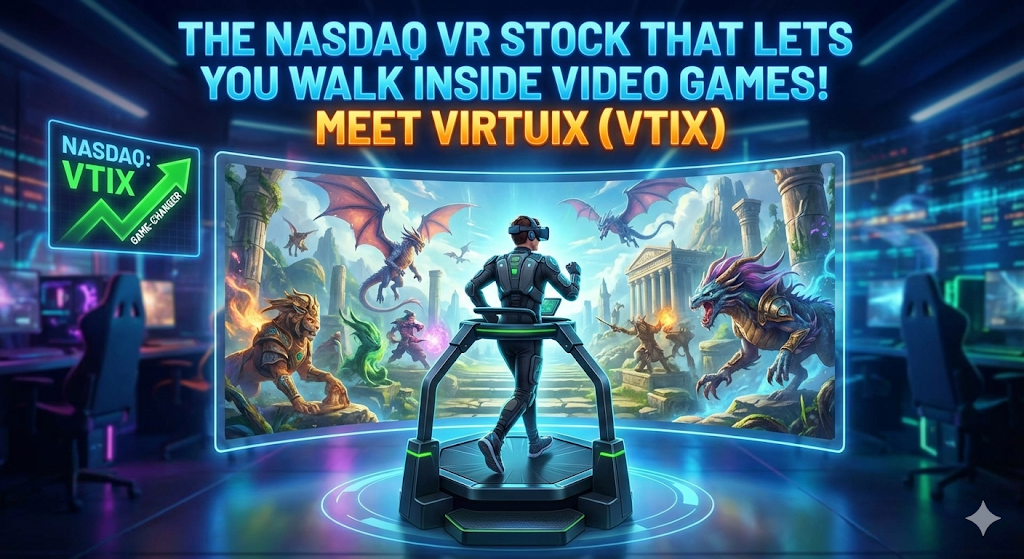
Virtuix Holding Inc (NASDAQ:VTIX) was founded with the explicit goal of enabling natural, full-body movement in virtual reality. From its earliest development stages, the company concentrated on designing hardware and software that would allow users to walk, run, and turn freely in 360 degrees while remaining safely in one physical location. This vision led to the creation of the Omni technology, a proprietary VR locomotion platform engineered to translate real-world physical movement into virtual environments. Rather than treating movement as an afterthought, the company placed locomotion at the center of its virtual reality ecosystem, shaping every subsequent product decision.
As Virtuix refined its technology, it became clear that solving movement in VR unlocked far more than gaming applications. The company’s background reflects a steady evolution from experimental prototypes to commercial-grade systems capable of serving multiple markets. Early Omni systems gained traction in location-based entertainment venues, where immersive experiences and physical engagement were key differentiators. These deployments provided real-world validation of the technology, helping Virtuix iterate on safety, durability, and user comfort while building operational expertise in deploying VR hardware at scale.
Building on this foundation, Virtuix expanded its focus toward broader consumer adoption. The company recognized that for virtual reality to reach mass-market relevance, immersive movement needed to move out of arcades and into homes. This insight shaped the development of Omni One, a home-focused VR system designed to deliver full physical immersion without requiring large spaces or complex installations. The background of Virtuix is closely tied to this transition, as the company shifted from niche deployments to scalable consumer hardware while maintaining its core emphasis on realism and safety.
Virtuix Holding Inc has consistently positioned itself as a virtual reality company focused on embodiment rather than spectacle. Its approach differs from many VR firms that concentrate primarily on headsets or software content. Instead, the company’s identity is rooted in enabling the human body to become an active interface within digital worlds. This perspective has influenced how Virtuix integrates with existing VR headsets, gaming platforms, and content ecosystems, allowing its technology to complement rather than compete with other parts of the virtual reality stack.
Over time, the company’s background expanded beyond entertainment as its locomotion technology proved valuable for practical, high-stakes applications. Virtuix began adapting its core platform for enterprise and defense use cases, recognizing that realistic movement and spatial awareness are critical for training, simulation, and mission rehearsal. This led to the development of solutions designed for military and professional environments, where accuracy, repeatability, and immersion directly impact performance outcomes. These initiatives reflect Virtuix’s broader philosophy that virtual reality should enhance real-world readiness, not just provide escapism.
A defining aspect of Virtuix’s evolution has been its integration of advanced software techniques to enhance realism. By incorporating artificial intelligence and modern 3D reconstruction methods, the company improved its ability to create lifelike virtual terrains based on real-world locations. This capability allowed Virtuix to generate immersive environments rapidly, supporting training scenarios that mirror actual operational conditions. The background of the company is therefore closely linked to the convergence of virtual reality, artificial intelligence, and simulation technology.
Throughout its growth, Virtuix Holding Inc has maintained a long-term view of the virtual reality market. Rather than chasing short-lived trends, the company focused on building durable technology that addresses fundamental user needs: movement, immersion, and physical engagement. This strategy positioned Virtuix to benefit as the VR industry gradually shifted from novelty-driven experiences toward applications with sustained value, including fitness, training, and professional simulation.
As the company entered the public markets under the ticker symbol VTIX, its background provided investors with a clearer picture of a business shaped by years of focused development rather than rapid experimentation. Virtuix’s history reflects a methodical approach to innovation, combining hardware engineering, software integration, and market validation across consumer and institutional settings. This background context is essential for understanding how the company fits into the broader virtual reality landscape and why its emphasis on full-body immersion continues to differentiate it within an increasingly crowded VR market.
Virtuix Holding Inc Enters the Public Markets at a Defining Moment for Virtual Reality Adoption
Virtuix Holding Inc’s debut on the Nasdaq under the ticker symbol VTIX represents far more than a routine public listing. It marks the arrival of a virtual reality company that has spent years refining proprietary hardware and software designed to solve one of VR’s most persistent problems: true physical immersion. As virtual reality adoption expands beyond novelty and into mainstream consumer, fitness, and defense applications, Virtuix finds itself entering the public markets at a moment when immersive technology is finally converging with real-world demand.
The company’s Nasdaq listing comes as the virtual reality market evolves from stationary, controller-based experiences into physically active, movement-driven platforms. Virtuix’s long-term focus on full-body motion, safety, and realism places it in a distinct category within the broader VR ecosystem. Unlike many virtual reality companies that rely primarily on software content or headset innovation alone, Virtuix has built its identity around a proprietary locomotion platform that enables natural movement inside virtual environments.
CHECK THIS OUT: Why Governments Are Betting on Secure Chips Instead of Software — SEALSQ Corp (LAES) Explained and Why QuantumScape (QS) Keeps Disappointing Traders but Fascinating Long-Term EV Investors.
The Origins of Omni Technology and the Quest for True VR Movement
Virtuix is best known for its Omni technology, a system engineered to allow users to walk, run, and move freely in 360 degrees while remaining safely in place. This concept addresses one of the most fundamental limitations of traditional virtual reality systems, which often rely on thumbsticks or teleportation mechanics that break immersion and reduce realism.
From its earliest development stages, Virtuix focused on the belief that virtual reality would only reach its full potential once physical movement became a core component of the experience. Omni technology was designed to replicate natural locomotion, allowing users to engage their entire body rather than remain stationary. This approach aligns with broader trends in immersive computing, where realism, embodiment, and physical engagement are increasingly viewed as essential for long-term user adoption.
Over time, the Omni platform evolved from arcade-based installations into a scalable ecosystem that could address multiple markets. This progression laid the foundation for Virtuix’s expansion beyond location-based entertainment and into both consumer and enterprise-grade applications.
Omni One Signals a Major Step Toward Consumer-Scale Virtual Reality
The launch of Omni One represents a pivotal chapter in Virtuix’s background, as it marks the company’s most direct push into the home virtual reality market. Designed specifically for consumer use, Omni One brings full-body VR locomotion into residential settings without sacrificing safety or usability.
In its S-1 filing, Virtuix reported 138 percent year-over-year growth, a figure that underscores strong early traction for the platform and rising demand for immersive VR experiences. This growth is particularly notable given the broader consumer electronics environment, where discretionary spending has been selective and competition for attention is intense.
Omni One delivers physical immersion by allowing users to move naturally while remaining centered on the device. This creates a more engaging and intuitive experience for gaming, exploration, and interactive entertainment. By emphasizing physical movement, Virtuix positions Omni One not merely as a gaming accessory, but as a new category of interactive technology that blends entertainment, exercise, and immersion.
Virtual Reality Meets Fitness Through Gamified Movement
One of the most compelling elements of Virtuix’s background is the unexpected but powerful intersection between virtual reality and fitness. Omni One transforms physical activity into a gamified experience, encouraging users to move more without the traditional psychological barriers associated with exercise.
According to company leadership, some users have reported dramatic fitness outcomes, including significant weight loss achieved through regular Omni One use. These anecdotes highlight the platform’s potential as a fitness-oriented VR solution, an area of growing interest as consumers seek engaging alternatives to conventional workouts.
This fitness dimension adds an additional layer to Virtuix’s addressable market. Instead of competing solely within the crowded VR gaming segment, the company taps into wellness, active lifestyle, and health-conscious consumer trends. As gamified fitness continues to gain traction, Omni One’s ability to combine immersive gameplay with sustained physical activity may become a meaningful differentiator.
Expanding Beyond Entertainment Into Defense and Military Training
While Omni One anchors Virtuix’s consumer strategy, the company’s background also includes a growing presence in defense and military training applications. The introduction of the Virtual Terrain Walk system demonstrates how Virtuix has adapted its core locomotion technology to meet the needs of high-stakes, real-world environments.
Virtual Terrain Walk leverages artificial intelligence and Gaussian splatting technology to create highly realistic virtual environments based on real-world locations. This allows military personnel to rehearse missions in immersive digital replicas of actual terrain, often generated within hours. The ability to conduct repeatable, customizable training scenarios provides a powerful tool for preparation and readiness.
Virtuix has already deployed Virtual Terrain Walk units at major military institutions, including the U.S. Air Force Academy and Yokota Air Force Base. These deployments signal early adoption within defense training environments and validate the platform’s relevance beyond consumer entertainment. Defense-focused VR applications tend to carry longer sales cycles but higher contract values, adding a strategic layer of diversification to Virtuix’s business model.
Artificial Intelligence Enhances the Realism of Virtual Environments
A key aspect of Virtuix’s technology evolution is its integration of artificial intelligence into virtual reality training systems. By combining AI-driven environment generation with advanced spatial rendering techniques such as Gaussian splatting, the company accelerates the creation of realistic virtual terrains.
This capability positions Virtuix within the broader trend of AI-enhanced immersive technologies, where machine learning is used to automate content creation and increase realism. For defense and enterprise customers, this reduces the time and cost associated with building training environments while increasing fidelity and adaptability.
The fusion of AI and VR reflects Virtuix’s long-standing focus on realism and practicality. Rather than relying solely on pre-built environments, the company’s platforms enable dynamic scenario generation that mirrors real operational conditions.
Nasdaq Listing Strengthens Financial Flexibility and Visibility
Virtuix’s debut on the Nasdaq under VTIX provides the company with increased visibility, credibility, and access to capital at a critical growth stage. Following the listing, Virtuix strengthened its financial position by securing $11 million in funding from Chicago Venture Partners and establishing a $50 million equity line.
These resources are expected to support the company’s plans to scale manufacturing, expand product development, and accelerate growth across both consumer and defense markets. For a hardware-enabled VR company, access to capital is particularly important, as it supports inventory management, supply chain optimization, and continued innovation.
The Nasdaq listing also places Virtuix in front of a broader base of institutional and retail investors seeking exposure to virtual reality stocks, immersive technology companies, and emerging defense tech platforms. As public market interest in applied VR solutions grows, Virtuix’s dual-market strategy may become increasingly attractive.
Virtuix’s Position in the Evolving Virtual Reality Market
The virtual reality market is transitioning from early experimentation to practical, use-case-driven adoption. Consumers are demanding deeper immersion, enterprises are exploring training efficiency, and defense organizations are seeking safer, more adaptable rehearsal environments. Virtuix’s background reflects years of preparation for this shift.
By focusing on full-body movement, safety, and realism, Virtuix has carved out a niche that addresses multiple high-growth segments simultaneously. Its technology stack supports gaming, fitness, and military training without requiring a complete reinvention for each market. This platform-driven approach increases scalability and creates opportunities for cross-market innovation.
Long-Term Outlook for Virtuix Holding Inc Stock
As Virtuix begins its life as a publicly traded company, its background provides important context for evaluating its long-term potential. The combination of proprietary Omni technology, growing consumer adoption through Omni One, expanding defense deployments via Virtual Terrain Walk, and a strengthened financial position following its Nasdaq debut creates a foundation for sustained growth.
While execution risk remains, particularly in scaling hardware-based platforms, Virtuix enters the public markets with tangible products, real customers, and demonstrated traction. As virtual reality continues to move toward physically immersive, AI-enhanced experiences, Virtuix Holding Inc stands positioned as a company built not for short-term hype, but for the next phase of VR adoption across entertainment, fitness, and defense.
READ ALSO: The Quiet Semiconductor Disruptor You’ve Never Heard Of: Aeluma Inc (ALMU) and Air Industries Group (AIRI) Narrows Losses to Just $44K — Is This Aerospace Microcap Entering a Turnaround Phase?