We recently published our article Top 5 Best Cybersecurity Micro-Caps to Watch in 2026. This article looks at where PagerDuty Inc. (NYSE:PD) fits as cloud and SaaS data security demand rises and investors hunt for sub-$5B cybersecurity winners.
Valuation has quietly reentered the market conversation at a time when many investors least expected it. After several years in which price momentum, thematic investing, and speculative growth dominated headlines, a growing number of market participants are once again screening for cheap stocks and low P/E stocks that trade at meaningful discounts to their underlying earnings power. This shift has not been driven by panic or crisis, but rather by fatigue with stretched valuations and an increasing emphasis on cash flow, balance sheet discipline, and durable business models. In many portfolios, the “multiple you pay” is starting to matter again, especially when the margin for error is thin and investors are demanding proof rather than promises.
What makes this period unusual is that the market is not behaving like a single unified story. Instead, it has become a collection of mini-markets. A small cluster of high-multiple names continues to attract outsized attention, while a much larger portion of the investable universe trades as if growth is permanently capped. That divergence has created a widening lane for undervalued stocks, particularly those with steady earnings, tangible cash generation, and the kind of predictability that tends to regain popularity when investors become more selective.
Why Cheap Stocks Are Showing Up in More Screens Again
Strategists following sector rotation trends have pointed out that valuation dispersion remains unusually wide. Capital has continued to chase a narrow group of high-multiple names tied to emerging technologies and narrative-driven growth, but this has left behind many profitable businesses that are still executing in the real economy. The result is that cheap P/E ratios are no longer limited to distressed companies or structurally broken industries. More frequently, low forward P/E stocks now include firms with recurring revenue streams, stable end markets, or clear capital return policies that have simply fallen out of favor.
This is the type of setup that tends to trigger broader screening behavior. When investors notice that quality companies are trading at discounted multiples, the next step is usually to ask whether the market is mispricing risk or simply ignoring improvement. That question alone is often enough to bring “best cheap stocks to buy right now” back into the research pipeline, especially for managers who need exposure outside the most crowded trades.
The Interest Rate Lens That Keeps Repricing Multiples
Interest rate expectations have played a central role in this dynamic, and they continue to shape how investors interpret valuation. As inflation pressures show signs of moderation and productivity improvements become more visible across the economy, analysts have increasingly discussed the possibility that restrictive monetary policy may not remain in place indefinitely. Even modest shifts in rate expectations can have an outsized impact on valuation models, particularly for companies with steady earnings and predictable cash flows.
When discount rates stabilize or drift lower, the market often becomes more willing to assign higher multiples to cash flows that appear durable. At the same time, when rates remain elevated, investors often prefer stocks that are already priced conservatively. Either way, low forward earnings multiples can act as a buffer, because they require less “multiple expansion” to generate respectable returns. This is one reason forward P/E has become a popular shortcut for identifying cheap stocks, especially when the market is still debating the path of rates.
Sector Rotation Is Quietly Shifting the Hunting Grounds
Sector by sector, this valuation reset has manifested in different ways, and the differences matter. In healthcare, portions of the sector continue to benefit from non-cyclical demand and pricing resilience, yet still trade at earnings multiples more commonly associated with mature or declining industries. In communications and infrastructure-heavy sectors, high capital intensity and regulatory overhangs can weigh on sentiment even when cash generation is steady. In software and digital services, the market’s skepticism around growth normalization can overshadow improving margins and free cash flow conversion. In industrial and consumer-linked sectors, macro uncertainty can mask company-level execution, operational improvement, and shareholder return programs.
What ties these sectors together is not that they are collapsing. It is that their valuations often reflect an assumption that good news will not last or that improvement will not translate into durable earnings. When sectors fall out of favor, the market sometimes prices in a permanent handicap. That is where valuation gaps can form, and where low P/E stocks can begin to stand out again.
Perception Versus Performance Is Creating Price Gaps
What stands out in the current market is how often price movements reflect perception rather than performance. Many companies now classified as cheap stocks have continued to meet or exceed earnings expectations, strengthen balance sheets, and return capital to shareholders, yet their valuations imply limited future upside. This kind of disconnect tends to happen when investors are focused on what could go wrong rather than what has been going right.
Professional investors, especially those with longer time horizons, often treat valuation as a margin of safety rather than a timing tool. When they see durable earnings trading at compressed multiples, the natural question becomes whether the stock is priced for a downturn that may already be reflected in fundamentals, or whether the business is quietly improving while the market remains distracted. This is why forward P/E ratios and earnings durability have become increasingly important screening criteria. They do not guarantee outperformance, but they help narrow the field to companies where expectations appear unusually low relative to current results.
What “Cheap” Actually Means in This Market
In practice, “cheap” does not simply mean low price. It usually means the market is offering an earnings stream at a discounted multiple compared with peers, history, or the broader index. That is why forward earnings multiples tend to be used more than trailing multiples in screening work. Forward P/E is a shorthand for how the market is pricing the next year of expected profitability, and it can reveal where skepticism is embedded.
It also helps explain why cheap stocks often come in clusters. If an entire sector is viewed as out of favor, multiples compress broadly, even for the strongest operators. If a business is executing but the market is still anchored to an older narrative, the valuation may lag. When the story changes faster than the market’s perception, the valuation gap becomes the opportunity.
Why This Leads Naturally to a “Best Cheap Stocks” Shortlist
Against this backdrop, compiling a list of the 5 Best Cheap Stocks to Buy Right Now is less about making bold predictions and more about identifying where valuation, fundamentals, and market expectations are misaligned. These opportunities tend to emerge when sectors fall out of favor not because of structural decline, but because attention has shifted elsewhere. History suggests that such periods often precede meaningful re-rating cycles, especially when broader market conditions begin to stabilize.
This is also why a shortlist approach matters. Not every low multiple stock is undervalued, and not every discounted company is cheap for the right reasons. The goal is to isolate situations where the business has measurable earnings power, credible cash flow generation, and enough visibility for forward expectations to be judged rationally. When those boxes are checked, a low forward multiple becomes more meaningful as a signal rather than a warning.
Setting the Stage for the 5 Best Cheap Stocks to Buy Right Now
In an environment where uncertainty remains elevated but fundamentals continue to assert themselves, cheap stocks with proven earnings power stand out as a distinct segment of the market worth close examination. With valuation once again playing a central role in portfolio construction, the focus naturally turns to identifying which names offer the most compelling combination of low forward multiples, financial resilience, and potential upside if expectations normalize.
That framework sets the stage for reviewing the 5 Best Cheap Stocks to Buy Right Now, a group defined not by hype or narrative momentum, but by the simple reality that the market is still offering some earnings streams at prices that look unusually conservative relative to their fundamentals.
CHECK THIS OUT: Why Governments Are Betting on Secure Chips Instead of Software — SEALSQ Corp (LAES) Explained and Why QuantumScape (QS) Keeps Disappointing Traders but Fascinating Long-Term EV Investors.
Our Framework
To identify the 5 Best Cheap Stocks to Buy Right Now, the analysis focused on publicly traded companies listed in the United States that meet a clear set of quantitative and coverage based criteria. The initial screen required a minimum market capitalization of approximately $2 billion to ensure sufficient liquidity and institutional relevance. Companies were also required to be covered by at least three sell-side analysts, providing a baseline level of market scrutiny and earnings visibility. Finally, the shortlist was narrowed to stocks trading at forward price to earnings multiples below 15x, reflecting a valuation profile that is meaningfully below broader market averages while still supported by ongoing profitability.
YOU MUST READ THIS!!! – 5 Best Cheap Stocks to Buy Right Now
Top 1: PagerDuty Inc. (NYSE:PD)
Market Cap: $500 M
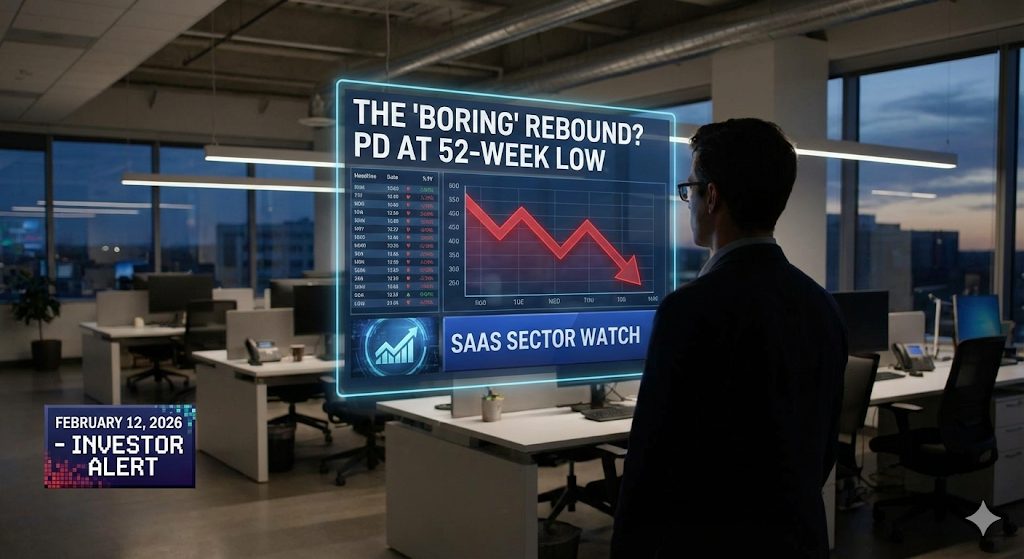
PagerDuty has the kind of chart that scares people away: PD stock slid into a fresh 52-week low zone around the low-$7 range with heavy volume, trading well below key moving averages and reflecting a market that has largely “given up” on the name in the short term. That matters because price action shapes sentiment, and sentiment often shapes valuation. But it also creates the exact type of setup long-term investors look for: a high-quality SaaS business in a mission-critical category getting repriced as if the fundamentals are deteriorating—even as operating performance is pointing in the opposite direction.
The bullish thesis starts with a simple mismatch. PagerDuty is being treated like a broken growth story, but the company is increasingly behaving like a disciplined, cash-generative software platform. When a market over-penalizes decelerating revenue growth while under-appreciating expanding profitability and durable customer need, you can get a “valuation reset” opportunity. For a digital operations management platform tied to incident management, IT operations, DevOps, and on-call reliability, the long-term demand driver is not a nice-to-have. It’s downtime, customer experience, and operational risk—things enterprises can’t ignore just because the macro tape gets ugly.
What PagerDuty Actually Does in Digital Operations Management
PagerDuty is not just “alerts.” It’s a real-time incident response and operations cloud that sits between observability tools (that generate signals) and the humans and workflows that actually resolve issues. The company positions its platform as a digital operations management layer that collects signals from across a software-enabled stack, uses machine learning and automation to reduce noise, routes incidents to the right responders, and helps teams resolve and learn faster.
This matters because the modern enterprise is drowning in telemetry. Cloud monitoring, microservices, APIs, security events, and customer-facing reliability signals all create a firehose of alerts. The painful truth for most organizations is that the “hard part” isn’t seeing the signal—it’s turning that signal into coordinated action at speed, under stress, with clear ownership. PagerDuty’s platform is built specifically for that messy middle: incident management, AIOps signal correlation, process automation, and customer service operations that bridge support and engineering teams when something breaks.
Even better for the bull case, PagerDuty has been leaning hard into the AI-first operations platform narrative—meaning AI and automation aren’t bolt-ons; they’re increasingly core to how customers triage, orchestrate, and execute operational work. The company explicitly markets AIOps and automation outcomes like reducing alert noise and accelerating resolution. In a market increasingly obsessed with “AI software,” PagerDuty sits in a practical use case where automation has immediate economic value: fewer false alarms, faster resolution, better uptime, and fewer expensive incidents that hit revenue and reputation.
The Tailwind People Miss: AI Increases Operational Complexity
Here’s the counterintuitive angle: in a world where companies adopt more AI and ship faster, the operational burden usually rises first. More systems. More integrations. More deployments. More moving parts. More things that can break. That means the value of incident management software, on-call management, IT operations workflows, and reliability engineering goes up—not down.
If you believe enterprises are going to keep modernizing their tech stacks (cloud, distributed systems, automation, security), then digital operations management becomes a “non-negotiable category.” PagerDuty’s role is to reduce downtime, shrink mean-time-to-resolution, improve customer experience, and create operational resilience. These outcomes are tied to revenue protection and brand trust. In practical terms, the CFO may slow hiring, but they rarely celebrate longer outages.
That’s why PagerDuty can be viewed less like discretionary SaaS and more like an operational insurance policy with measurable ROI. When the platform becomes embedded in incident response, escalation policies, workflows, and cross-team coordination, switching costs can be more real than the market gives credit for—because switching isn’t just migrating a tool; it’s rewriting how the company responds to crisis.
The Numbers Behind the Thesis: Profitability and Guidance vs. a Bearish Chart
One reason the market reaction looks extreme is that PagerDuty’s reported results and outlook don’t read like a company falling apart. In its fiscal Q3 2026 period, the company delivered roughly $125 million in revenue, about mid-single-digit year-over-year growth, while continuing to emphasize a profitability profile that stands out in the SaaS mid-cap and small-cap universe. This is important because the market typically punishes slowing growth, but it also tends to reward software businesses that prove they can generate sustainable earnings and cash flow.
The more important signal for a re-rating thesis is what management did with guidance. For the full fiscal year 2026, PagerDuty guided around $490–$492 million in revenue and raised non-GAAP EPS guidance to approximately $1.11–$1.12. That combination tells you what the company is emphasizing: operating leverage, margin discipline, and earnings power, even while growth is muted.
For fiscal Q4 2026, PagerDuty guided revenue around $122–$124 million with non-GAAP EPS around $0.24–$0.25. The market sees that as “low growth,” and it’s why you can get violent downside moves when sentiment breaks. But this also clarifies the bullish opportunity: if the company stabilizes growth while keeping profitability elevated, the market can quickly shift from treating PD stock as a “value trap” to viewing it as an “undervalued SaaS stock” with a durable niche.
In other words, the stock is being repriced like a low-confidence name, while the company is trying to prove it can be a profitable, durable software platform. When those narratives diverge, the upside can be large if execution persists.
Wall Street’s Hold Rating and $16.64 Target: Why Mixed Sentiment Can Be Fuel
The consensus picture you shared shows a “Hold” rating with an average price target around $16.64, built from a mix of Buys, Holds, and Sells. A split like that is common near bottoms because analysts are reacting to the same tension investors feel: decelerating growth on one hand, improving profitability and platform importance on the other. The headline looks lukewarm, but the math underneath is notable: the implied upside from depressed levels is massive if the business simply proves it can hold the line and keep improving the earnings profile.
A “Hold” consensus can flip faster than people expect if two things happen at once: growth stops deteriorating and operating leverage remains. Software stocks don’t need hypergrowth forever—but they do need believable durability. If PagerDuty proves it has that durability, a re-rating becomes plausible.
Insider Selling and Institutional Ownership: How to Interpret the Signal
The insider activity you highlighted looks dramatic at first glance because it’s a large share count. But context matters: the sale was a roughly 10% reduction in that director’s stake, not a full exit, and such sales are often executed under pre-arranged plans. The bigger ownership story is the broader structure: insiders collectively own about 8% while institutional investors reportedly own over 97% of the float. That setup can amplify both downside and upside. When funds rotate out of small-cap software, the selling pressure can snowball. But when fundamentals stabilize, the rebound can be sharp because the same institutions can move quickly to rebuild positions.
Why PagerDuty Can Be a Re-Rating Story Instead of a Falling Knife
A lot of stocks hit 52-week lows for good reasons. The bullish thesis here is that PagerDuty’s drawdown is being driven more by narrative compression and growth disappointment than by a collapse in product relevance. If anything, the long-term demand for incident response, AIOps, process automation, and operational resilience is strengthening as enterprises run more complex digital infrastructure.
So the bet becomes clearer: PD stock doesn’t need to return to peak optimism to win. It simply needs to prove that it can be a stable, profitable operations platform with a sticky footprint inside enterprise IT operations and DevOps. If that happens, the market can justify paying more than “distress” multiples for a business that’s producing real earnings and has a large recurring revenue base. The fact that management raised EPS guidance while acknowledging slower revenue growth supports the idea that the company is transitioning into a more disciplined operating model.
The 2026 Catalyst Path: What Could Change the Market’s Mind
The near-term debate is simple: is PagerDuty’s slower growth a temporary digestion phase or the start of longer stagnation? That’s why upcoming results and forward guidance matter so much. If forward commentary shows stabilization—better customer expansion, improved net retention, stronger enterprise conversion, or clearer monetization of AI-driven operations capabilities—then the market can stop treating the stock like a melting ice cube.
At the same time, the platform narrative can become a catalyst in itself. PagerDuty is not pitching a single point product; it’s pitching an operations cloud spanning incident management, AIOps, automation workflows, and customer service operations. Platform perception matters because it supports cross-sell, deeper integration, and higher strategic importance inside the customer’s tech stack. When that strategic importance becomes clearer in financial metrics, the market can reprice the stock quickly.
The Real Risks: Competition, Growth, and the Small-Cap SaaS Tape
A bullish thesis is stronger when it admits the hard parts. The biggest risk is that revenue growth slows further and never re-accelerates, turning PagerDuty into a mature, low-growth vendor that struggles to defend pricing and expansion. Another risk is competition: incident response, IT operations workflows, and adjacent IT service management categories are crowded, and larger platforms can bundle features or compress pricing. There’s also market structure risk: sub-$1B software names can remain volatile for long periods, and when a stock is below major moving averages, rallies can fail until there is a clear fundamental inflection.
But this is also why the asymmetry exists. The market is already pricing in a lot of fear. When a stock trades like a problem, even “not getting worse” can be a catalyst. If PagerDuty sustains profitability, demonstrates durable recurring revenue characteristics, and shows signs of growth stabilization, the upside can be driven by sentiment and valuation normalization rather than heroic forecasts.
Bottom Line: PagerDuty’s Bull Case Is a Quality SaaS Reset With Asymmetric Upside
PagerDuty’s bullish thesis is built on operational reality. The world is not getting simpler. Digital operations are not getting quieter. AI adoption is not reducing incidents; it often increases the complexity that causes them. In that world, a platform focused on incident management, AIOps, automation, and operational resilience stays strategically important. PagerDuty is guiding toward strong non-GAAP earnings even as it works through a slower growth patch, while Wall Street remains cautious but still publishes target levels far above the current quote.
If you want the cleanest version of the bet: PD stock is priced like confidence is gone, but the business is trying to earn confidence through profitability, discipline, and platform depth. If PagerDuty sustains that execution and shows any signs that growth is stabilizing, the upside doesn’t require a miracle—just a shift from “broken” to “durable.” That type of shift is exactly what drives powerful re-ratings in undervalued SaaS stocks when the tape finally stops punishing them for yesterday’s narrative.
READ ALSO: The Quiet Semiconductor Disruptor You’ve Never Heard Of: Aeluma Inc (ALMU) and Air Industries Group (AIRI) Narrows Losses to Just $44K — Is This Aerospace Microcap Entering a Turnaround Phase?
Disclosure: No material interests to disclose. This article was originally published on Global Market Bulletin.