We recently published our article Top 5 Best Cybersecurity Micro-Caps to Watch in 2026. This article looks at where NetScout Systems Inc. (NASDAQ:NTCT) fits as cloud and SaaS data security demand rises and investors hunt for sub-$5B cybersecurity winners.
Valuation has quietly reentered the market conversation at a time when many investors least expected it. After several years in which price momentum, thematic investing, and speculative growth dominated headlines, a growing number of market participants are once again screening for cheap stocks and low P/E stocks that trade at meaningful discounts to their underlying earnings power. This shift has not been driven by panic or crisis, but rather by fatigue with stretched valuations and an increasing emphasis on cash flow, balance sheet discipline, and durable business models. In many portfolios, the “multiple you pay” is starting to matter again, especially when the margin for error is thin and investors are demanding proof rather than promises.
What makes this period unusual is that the market is not behaving like a single unified story. Instead, it has become a collection of mini-markets. A small cluster of high-multiple names continues to attract outsized attention, while a much larger portion of the investable universe trades as if growth is permanently capped. That divergence has created a widening lane for undervalued stocks, particularly those with steady earnings, tangible cash generation, and the kind of predictability that tends to regain popularity when investors become more selective.
Why Cheap Stocks Are Showing Up in More Screens Again
Strategists following sector rotation trends have pointed out that valuation dispersion remains unusually wide. Capital has continued to chase a narrow group of high-multiple names tied to emerging technologies and narrative-driven growth, but this has left behind many profitable businesses that are still executing in the real economy. The result is that cheap P/E ratios are no longer limited to distressed companies or structurally broken industries. More frequently, low forward P/E stocks now include firms with recurring revenue streams, stable end markets, or clear capital return policies that have simply fallen out of favor.
This is the type of setup that tends to trigger broader screening behavior. When investors notice that quality companies are trading at discounted multiples, the next step is usually to ask whether the market is mispricing risk or simply ignoring improvement. That question alone is often enough to bring “best cheap stocks to buy right now” back into the research pipeline, especially for managers who need exposure outside the most crowded trades.
The Interest Rate Lens That Keeps Repricing Multiples
Interest rate expectations have played a central role in this dynamic, and they continue to shape how investors interpret valuation. As inflation pressures show signs of moderation and productivity improvements become more visible across the economy, analysts have increasingly discussed the possibility that restrictive monetary policy may not remain in place indefinitely. Even modest shifts in rate expectations can have an outsized impact on valuation models, particularly for companies with steady earnings and predictable cash flows.
When discount rates stabilize or drift lower, the market often becomes more willing to assign higher multiples to cash flows that appear durable. At the same time, when rates remain elevated, investors often prefer stocks that are already priced conservatively. Either way, low forward earnings multiples can act as a buffer, because they require less “multiple expansion” to generate respectable returns. This is one reason forward P/E has become a popular shortcut for identifying cheap stocks, especially when the market is still debating the path of rates.
Sector Rotation Is Quietly Shifting the Hunting Grounds
Sector by sector, this valuation reset has manifested in different ways, and the differences matter. In healthcare, portions of the sector continue to benefit from non-cyclical demand and pricing resilience, yet still trade at earnings multiples more commonly associated with mature or declining industries. In communications and infrastructure-heavy sectors, high capital intensity and regulatory overhangs can weigh on sentiment even when cash generation is steady. In software and digital services, the market’s skepticism around growth normalization can overshadow improving margins and free cash flow conversion. In industrial and consumer-linked sectors, macro uncertainty can mask company-level execution, operational improvement, and shareholder return programs.
What ties these sectors together is not that they are collapsing. It is that their valuations often reflect an assumption that good news will not last or that improvement will not translate into durable earnings. When sectors fall out of favor, the market sometimes prices in a permanent handicap. That is where valuation gaps can form, and where low P/E stocks can begin to stand out again.
Perception Versus Performance Is Creating Price Gaps
What stands out in the current market is how often price movements reflect perception rather than performance. Many companies now classified as cheap stocks have continued to meet or exceed earnings expectations, strengthen balance sheets, and return capital to shareholders, yet their valuations imply limited future upside. This kind of disconnect tends to happen when investors are focused on what could go wrong rather than what has been going right.
Professional investors, especially those with longer time horizons, often treat valuation as a margin of safety rather than a timing tool. When they see durable earnings trading at compressed multiples, the natural question becomes whether the stock is priced for a downturn that may already be reflected in fundamentals, or whether the business is quietly improving while the market remains distracted. This is why forward P/E ratios and earnings durability have become increasingly important screening criteria. They do not guarantee outperformance, but they help narrow the field to companies where expectations appear unusually low relative to current results.
What “Cheap” Actually Means in This Market
In practice, “cheap” does not simply mean low price. It usually means the market is offering an earnings stream at a discounted multiple compared with peers, history, or the broader index. That is why forward earnings multiples tend to be used more than trailing multiples in screening work. Forward P/E is a shorthand for how the market is pricing the next year of expected profitability, and it can reveal where skepticism is embedded.
It also helps explain why cheap stocks often come in clusters. If an entire sector is viewed as out of favor, multiples compress broadly, even for the strongest operators. If a business is executing but the market is still anchored to an older narrative, the valuation may lag. When the story changes faster than the market’s perception, the valuation gap becomes the opportunity.
Why This Leads Naturally to a “Best Cheap Stocks” Shortlist
Against this backdrop, compiling a list of the 5 Best Cheap Stocks to Buy Right Now is less about making bold predictions and more about identifying where valuation, fundamentals, and market expectations are misaligned. These opportunities tend to emerge when sectors fall out of favor not because of structural decline, but because attention has shifted elsewhere. History suggests that such periods often precede meaningful re-rating cycles, especially when broader market conditions begin to stabilize.
This is also why a shortlist approach matters. Not every low multiple stock is undervalued, and not every discounted company is cheap for the right reasons. The goal is to isolate situations where the business has measurable earnings power, credible cash flow generation, and enough visibility for forward expectations to be judged rationally. When those boxes are checked, a low forward multiple becomes more meaningful as a signal rather than a warning.
Setting the Stage for the 5 Best Cheap Stocks to Buy Right Now
In an environment where uncertainty remains elevated but fundamentals continue to assert themselves, cheap stocks with proven earnings power stand out as a distinct segment of the market worth close examination. With valuation once again playing a central role in portfolio construction, the focus naturally turns to identifying which names offer the most compelling combination of low forward multiples, financial resilience, and potential upside if expectations normalize.
That framework sets the stage for reviewing the 5 Best Cheap Stocks to Buy Right Now, a group defined not by hype or narrative momentum, but by the simple reality that the market is still offering some earnings streams at prices that look unusually conservative relative to their fundamentals.
CHECK THIS OUT: Why Governments Are Betting on Secure Chips Instead of Software — SEALSQ Corp (LAES) Explained and Why QuantumScape (QS) Keeps Disappointing Traders but Fascinating Long-Term EV Investors.
Our Framework
To identify the 5 Best Cheap Stocks to Buy Right Now, the analysis focused on publicly traded companies listed in the United States that meet a clear set of quantitative and coverage based criteria. The initial screen required a minimum market capitalization of approximately $2 billion to ensure sufficient liquidity and institutional relevance. Companies were also required to be covered by at least three sell-side analysts, providing a baseline level of market scrutiny and earnings visibility. Finally, the shortlist was narrowed to stocks trading at forward price to earnings multiples below 15x, reflecting a valuation profile that is meaningfully below broader market averages while still supported by ongoing profitability.
YOU MUST READ THIS!!! – 5 Best Cheap Stocks to Buy Right Now
Top 3: NetScout Systems Inc. (NASDAQ:NTCT)
Market Cap: $2 B
NetScout Systems, Inc. (NASDAQ:NTCT) is the kind of company the market often overlooks because it isn’t pitching a flashy hypergrowth story. But that’s exactly why the setup can be attractive for investors who care about what actually compounds value over time: durable demand tied to network visibility, network performance, and cybersecurity, paired with strong margins, disciplined execution, and a balance sheet that gives management real flexibility. The latest quarterly print reinforced that thesis in a way that matters for long-term holders. NetScout reported fiscal Q3 2026 results with clear profitability strength, and it followed that by raising the midpoint of its full-year outlook—two signals that point to a business that’s stabilizing and optimizing, not deteriorating.
What makes the recent earnings season especially important for NTCT is that it’s not just about “a beat.” It’s about what a beat implies: operating leverage, improving mix, better cost control, and the ability to grow earnings even when revenue is only modestly improving. In a market where many tech names are priced for perfection, a company that can deliver consistent cash generation and upgrade its earnings outlook without needing a dramatic top-line acceleration can become a stealth outperformer once sentiment catches up.
The quarter that matters: profit engine stays strong while guidance improves
NetScout’s fiscal Q3 2026 results showed the core engine is working. Non-GAAP income from operations came in at about $89.9 million and produced a non-GAAP operating margin of 35.9%, slightly higher than the same quarter a year ago. Non-GAAP net income rose to roughly $73.7 million, or $1.00 per diluted share, up from $0.94 in the prior-year quarter. That’s exactly what investors want to see in a mature network and cybersecurity software-and-services business: steady execution, high incremental profitability, and consistency in turning revenue into earnings.
The guidance update is just as important as the quarterly snapshot. Based on year-to-date performance and an acceleration of orders, NetScout raised the midpoint of its fiscal 2026 outlook. Revenue is now expected to be in the range of $835 million to $870 million, and non-GAAP EPS is expected to be $2.37 to $2.45. In plain terms, management is telling you that the year is tracking better than expected, and it’s doing so in a way that preserves margin strength rather than buying growth at any cost.
The bullish takeaway here is simple: NetScout is not “hoping” for a turnaround. It is demonstrating operational control. In markets where enterprise IT budgets can tighten quickly, companies that protect margins and still manage to lift earnings expectations often end up being the survivors that investors rotate into when volatility returns.
Why network observability and deep packet inspection aren’t optional anymore
The strongest long-term bull case for NetScout is that it sits in the middle of a problem that keeps getting more urgent: modern networks are too complex to manage blindly. Enterprises and service providers are dealing with hybrid cloud architectures, remote sites, edge deployments, Wi-Fi transitions, encrypted traffic, and growing user expectations for always-on digital services. When something breaks, the cost isn’t just inconvenience—it can mean downtime, lost revenue, compliance headaches, reputational damage, and cascading operational disruptions.
NetScout’s positioning is built around network observability, real-time visibility, deep packet inspection, and service assurance—capabilities that help organizations detect performance issues early, pinpoint root causes, and keep mission-critical applications stable. That’s the type of spend that tends to hold up better than discretionary “nice-to-have” software, because the alternative is flying blind while digital operations become more critical.
And NetScout is not standing still on product. In late January 2026, the company announced new observability capabilities designed to close gaps in remote site management and reduce risks from expired SSL/TLS certificates—two issues that can cause serious outages and security exposures. Those enhancements include nGeniusONE updates supporting real-time deep packet inspection over Ethernet and Wi-Fi 7, plus improved SSL/TLS certificate monitoring to reduce the chance of outages caused by missed expirations. This isn’t marketing fluff; these are very practical pain points that IT teams are actively trying to solve.
When you combine those product directions with NetScout’s broader messaging around observability and AIOps, the strategic implication is that NTCT is aligning itself with the “visibility + automation” trend that large enterprises increasingly demand.
Cybersecurity tailwinds: DDoS protection is a durable demand driver
NetScout’s cybersecurity angle—especially DDoS protection—adds another layer to the bull thesis because the threat environment doesn’t take breaks. DDoS attacks are not just headline events; they’re constant operational risks for service providers, large enterprises, and public-sector organizations. NetScout’s Arbor portfolio is positioned around DDoS detection, automated mitigation, and threat intelligence, which makes it relevant to buyers who care about availability and resiliency.
The important investing point is that this category tends to be sticky. Once an organization builds its mitigation playbooks, monitoring workflows, and incident response around a platform, it’s less likely to rip and replace unless something truly breaks. That’s the kind of competitive dynamic that supports recurring services, renewals, and steady long-term revenue.
NetScout also emphasizes threat intelligence resources, including global DDoS threat intelligence, which helps strengthen the overall value proposition and can support upsell opportunities across the base.
In a world where “cybersecurity” is often used as a vague buzzword, DDoS defense is a concrete spend category tied to business continuity. That’s exactly the kind of fundamentals-backed theme that can keep NetScout relevant across market cycles.
A quieter positive: the services mix keeps improving
One of the most underappreciated bullish signals in NetScout’s latest report is the continued weight of services revenue. In fiscal Q3 2026, services revenue was $129.0 million, representing about 51% of total revenue, compared to 49% in the prior-year quarter. That may look like a small shift, but it matters because services revenue often means steadier cash flows, higher visibility, and less dependence on lumpy product cycles.
When a company in network performance management and cybersecurity leans more into services, it typically benefits from recurring contracts, renewal dynamics, and embedded customer relationships. In other words, the business becomes more “annuity-like,” which tends to support valuation stability and reduce downside risk when markets get nervous. That’s a big deal for a stock that has historically been discounted due to modest growth.
The company also disclosed product backlog levels as of December 31, 2025, which provides another data point for near-term visibility. While backlog moved lower versus the year-ago period, the context in management commentary about order acceleration and the full-year guidance raise matters more: what investors should focus on is the fact that execution is strong enough to justify higher guidance at the midpoint.
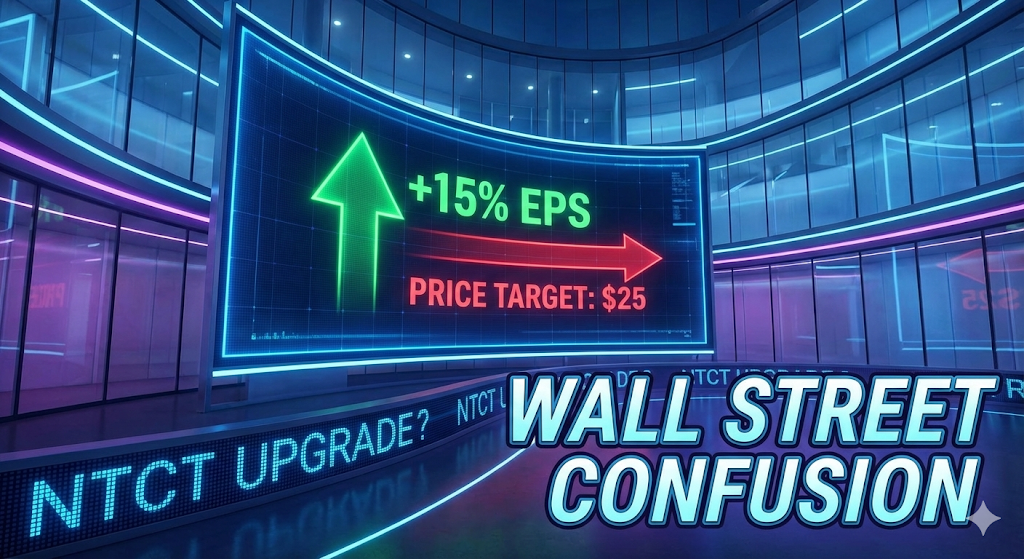
Analysts got more bullish on earnings—yet the price target didn’t move
This is the part where the opportunity can form. After the latest results, analyst forecasts showed a notable change: the three analysts covering NetScout maintained their 2027 revenue expectation at around $875.1 million, but they meaningfully raised EPS expectations for 2027 compared with prior forecasts. In other words, the Street is becoming more bullish on profitability and earnings power even if they don’t expect revenue to suddenly inflect upward.
At the same time, the consensus price target stayed around $30.42. On the surface, that looks neutral. But for investors, it can actually be a useful signal: if earnings power is improving and the market has not fully repriced the stock’s long-term value creation potential, you can get a window where fundamentals improve faster than sentiment.
It also helps that the target dispersion is tight, with the more optimistic analyst around $35 and the more pessimistic around $27.27. That narrow spread suggests analysts believe the business is relatively straightforward to model, with fewer “wild” outcomes compared to early-stage tech names.
This setup can become especially bullish if NetScout continues delivering what it just delivered: stable-to-modestly improving revenue and strong profitability. Over time, the market often rewards that combination with a valuation that creeps upward—especially when buyers start valuing predictability again.
The balance sheet and cash position support shareholder-friendly optionality
NetScout’s financial position is another major pillar of the bull thesis. As of December 31, 2025, the company reported cash, cash equivalents, and marketable securities/investments of about $586.2 million, up from $492.5 million as of March 31, 2025. It also reported no debt outstanding under its $600 million revolving credit facility, which runs through October 2029.
That’s not just a “nice-to-have.” In practical terms, it means NetScout can keep investing in product innovation, support go-to-market execution, and handle macro uncertainty without diluting shareholders just to fund operations. It also gives optionality for capital returns or strategic moves. Companies with weaker balance sheets often have to prioritize survival; companies with NetScout’s profile can prioritize value creation.
This matters even more in the cybersecurity and observability space, where the competitive landscape is always evolving. The winners are not always the ones with the flashiest branding—they’re often the ones who can fund development consistently, deepen integrations, and keep customers locked into workflows that are hard to replicate.
Growth skepticism is real—so the bull case focuses on the rerating trigger
A fair critique is that NetScout is still expected to grow slower than parts of its broader industry. Analysts don’t see a dramatic revenue breakout through 2027; they see stabilization and modest performance relative to faster-growing peers.
That’s why the bull case has to be framed correctly. This is not a “revenue rocket.” The better argument is that NetScout can win as a high-margin, cash-rich network observability and cybersecurity provider in a world where visibility, resiliency, and DDoS protection remain non-negotiable. If a company can sustain strong margins, improve its services mix, and keep product capabilities relevant—like the recent moves around remote site observability, Wi-Fi 7 deep packet inspection, and SSL/TLS certificate monitoring—then value can compound even without rapid top-line growth.
The rerating trigger, if it happens, likely comes from a combination of factors: continued earnings delivery, proof that guidance can be met or exceeded, and a market regime where investors rotate toward quality cash generators instead of purely chasing growth narratives. In that environment, even a modest improvement in sentiment can push valuation higher, because the underlying business already throws off real profitability.
Valuation: why “not cheap” doesn’t automatically mean “not attractive”
Depending on the data source and the date you check, NTCT’s valuation may not screen as “dirt cheap.” But valuation isn’t just a number—it’s a narrative about durability. If NetScout keeps proving that it can generate high operating margins, protect earnings, and support steady services revenue while remaining central to enterprise network monitoring, observability, and cybersecurity workflows, then the market can rationalize a higher multiple than it historically gave the name when revenue was drifting down. And the company itself is guiding to non-GAAP EPS in the $2.37–$2.45 range for fiscal 2026, which anchors the “earnings power” story in a concrete near-term target.
The more interesting angle is that analysts raised earnings expectations yet didn’t raise the price target. That mismatch can resolve in two ways: either analysts eventually concede the stock deserves more value if execution stays strong, or the market itself reprices the stock as earnings compounding becomes harder to ignore.
The bullish thesis in one coherent long-term view
NetScout Systems is building a credible “high-quality earnings” story at the exact time when enterprise network complexity and cybersecurity risks keep increasing. The company’s latest quarter reinforced that it can deliver strong profitability, with non-GAAP operating margin near 36% and non-GAAP EPS at $1.00 for the quarter, while also raising the midpoint of its fiscal 2026 guidance for both revenue and earnings.
Its strategic positioning fits durable demand themes that are not going away: network observability, deep packet inspection, service assurance, AIOps-ready workflows, cybersecurity resilience, and DDoS protection through its Arbor capabilities. The company is also pushing product innovation that maps directly to real enterprise pain points, including remote site observability gaps, Wi-Fi 7 visibility, and SSL/TLS certificate expiration monitoring—practical features that reduce outages and support better uptime.
Meanwhile, the business mix continues shifting in a favorable direction, with services representing about 51% of revenue in the most recent quarter, supporting stability and visibility. Analysts have responded by upgrading EPS expectations into 2027, even though revenue forecasts are largely unchanged—an important sign that sentiment around profitability is improving. Add in a strong cash position of roughly $586 million and no debt outstanding on the revolver, and you have a company with financial resilience and optionality that many mid-cap tech names don’t have.
If NetScout keeps executing, the upside doesn’t require a miracle. It simply requires the market to recognize that “steady observability and cybersecurity cash flow” is more valuable than it looks on a quick growth screen. In a world where digital performance and service availability are mission-critical, a disciplined operator with real earnings power can end up being the kind of stock that quietly compounds—until it isn’t quiet anymore.
READ ALSO: The Quiet Semiconductor Disruptor You’ve Never Heard Of: Aeluma Inc (ALMU) and Air Industries Group (AIRI) Narrows Losses to Just $44K — Is This Aerospace Microcap Entering a Turnaround Phase?
Disclosure: No material interests to disclose. This article was originally published on Global Market Bulletin.