Established out of Europe’s long-standing ambition to lead in advanced manufacturing, this company has evolved from a niche equipment supplier into one of the most strategically important players in the global semiconductor industry. What began as a joint venture in the 1980s has since transformed into a technological cornerstone of modern computing, enabling the production of increasingly smaller, faster, and more powerful chips that underpin everything from smartphones and cloud data centers to artificial intelligence systems and high-performance computing.
ASML Holding (NASDAQ:ASML) traces its roots to the Netherlands, where it was founded with the goal of developing lithography systems used to transfer circuit patterns onto silicon wafers. Over decades of relentless engineering, research, and collaboration with chipmakers, the company carved out a dominant position in the semiconductor equipment market. ASML Holding NV gradually distinguished itself by focusing on optical lithography innovation at a time when chip complexity was accelerating and manufacturing tolerances were shrinking to near-atomic levels.
As the semiconductor industry moved from deep ultraviolet to extreme ultraviolet lithography, ASML Holding NV made one of the most consequential strategic bets in modern industrial history. The company invested billions of euros and spent years refining EUV lithography technology, overcoming immense scientific and engineering challenges that competitors struggled to match. This long-term commitment ultimately positioned ASML Holding NV as the sole supplier of EUV lithography systems, a status that would later define its competitive moat and global relevance.
The rise of advanced logic chips, particularly those used in artificial intelligence, machine learning, and data-intensive applications, further cemented ASML Holding NV’s role at the center of the semiconductor value chain. Its lithography machines became indispensable for leading-edge chip production, used by the world’s largest foundries and integrated device manufacturers. As chipmakers raced toward smaller process nodes, the company’s tools became critical enablers of technological progress, tying ASML Holding NV’s fortunes closely to global semiconductor demand.
Over time, ASML Holding NV expanded beyond a pure equipment supplier into a deeply embedded ecosystem partner. Its business model evolved to include not only system sales but also long-term service agreements, upgrades, and software, creating recurring revenue streams and tighter integration with customer manufacturing processes. This evolution reinforced the company’s influence across the semiconductor equipment landscape while increasing switching costs for customers.
Geographically, ASML Holding NV’s background reflects the globalization of the semiconductor industry itself. While headquartered in Europe, the company built extensive relationships across Asia and North America, aligning its growth with major semiconductor hubs such as Taiwan, South Korea, and the United States. This global footprint allowed ASML Holding NV to scale alongside the rapid expansion of chip manufacturing capacity, particularly during periods of heightened demand driven by mobile computing, cloud infrastructure, and more recently, artificial intelligence.
The company’s ascent also coincided with rising geopolitical awareness around semiconductor supply chains. As advanced chips became strategically vital assets, ASML Holding NV found itself operating at the intersection of technology, trade policy, and national security. Export controls, regulatory oversight, and international coordination increasingly became part of the company’s operating environment, shaping how and where its most advanced systems could be deployed.
From a financial perspective, ASML Holding NV’s background is marked by steady revenue growth punctuated by sharp upcycles tied to semiconductor capital expenditure booms. Its performance became closely linked to the investment cycles of a concentrated group of major customers, reflecting both the strength and the inherent cyclicality of the semiconductor equipment sector. As demand for cutting-edge chips surged, ASML Holding NV’s scale, pricing power, and backlog expanded in tandem.
Today, ASML Holding NV stands as one of the most valuable technology companies in Europe and a symbol of how deep specialization can yield global dominance. Its background is defined by patience, technical ambition, and a willingness to pursue high-risk, long-horizon innovation in an industry where barriers to entry are immense. At the same time, its evolution mirrors the broader semiconductor industry’s shift toward complexity, concentration, and strategic importance in the global economy.
In understanding the company’s background, it becomes clear that ASML Holding NV is not merely a manufacturer of semiconductor equipment, but a central architect of the modern digital era. Its history provides critical context for evaluating ASML stock, the sustainability of its growth, and the risks and opportunities embedded in its position at the heart of the global semiconductor ecosystem.
The Paradox of ASML’s Record Highs in an AI-Driven Market
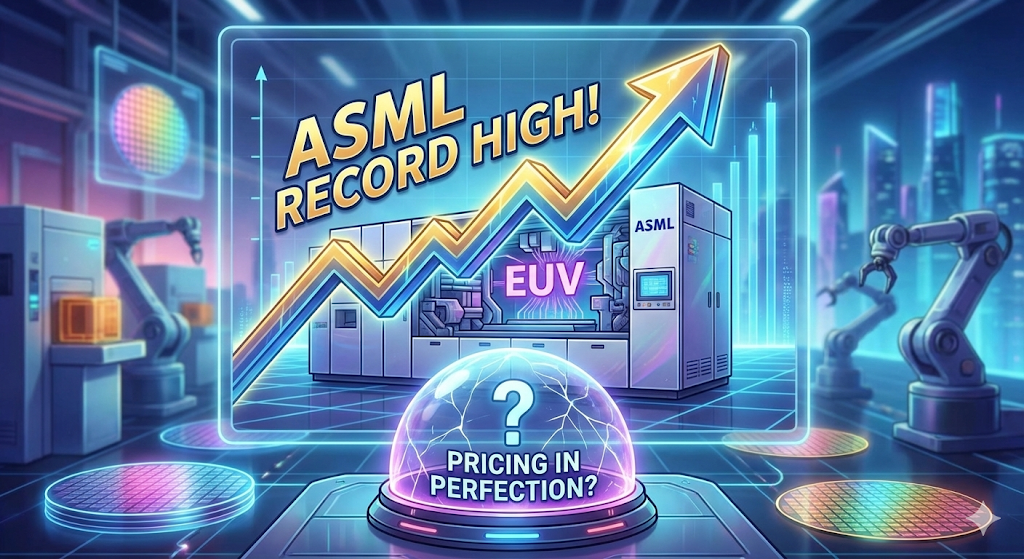
ASML Holding N.V. has become one of the most celebrated stocks in global markets, with ASML shares hitting record highs as artificial intelligence demand fuels orders for advanced semiconductor equipment. The Dutch semiconductor equipment giant now stands as Europe’s most valuable company, driven by its near-monopoly in extreme ultraviolet lithography systems and its central role in producing cutting-edge AI chips. Yet history shows that moments of peak optimism often coincide with peak risk, and the current surge in ASML stock may represent precisely that inflection point.
Despite bullish headlines surrounding AI infrastructure spending, record net bookings, and upgraded sales forecasts, the downside risks embedded in ASML’s valuation, revenue concentration, geopolitical exposure, and cyclical positioning are increasingly difficult to ignore. A closer look reveals that the AI narrative supporting ASML Holding NV may already be fully priced into the stock, leaving limited margin for error and substantial downside if expectations slip even slightly.
CHECK THIS OUT: Why Governments Are Betting on Secure Chips Instead of Software — SEALSQ Corp (LAES) Explained and Why QuantumScape (QS) Keeps Disappointing Traders but Fascinating Long-Term EV Investors.
When ASML Valuation Becomes the Primary Risk
One of the most pressing bearish factors for ASML stock today is valuation. ASML shares have surged more than 20 percent year-to-date and trade near all-time highs, pushing the company’s market capitalization toward the €500 billion mark. This valuation implies not just continued growth, but sustained execution at near-perfect levels across multiple years in an industry known for violent cyclicality.
The current ASML valuation reflects an assumption that AI-driven semiconductor demand will expand uninterrupted through 2026 and beyond, with customers aggressively adding capacity and absorbing some of the most expensive machines ever built. Any slowdown in AI infrastructure spending, any pause in capital expenditure, or any delay in customer roadmaps could trigger rapid multiple compression. At this stage, ASML stock behaves less like a defensive monopoly and more like a momentum trade tied to AI exuberance.
AI Demand Optimism Versus Semiconductor Cycle Reality
The core bullish argument for ASML Holding NV rests on the belief that the AI boom represents a once-in-a-generation infrastructure build-out. Executives across the semiconductor ecosystem have reinforced this view, citing unprecedented demand for GPUs, memory chips, and advanced logic nodes. However, semiconductor history is littered with similar narratives that collapsed under their own weight.
AI chip demand may be real, but the timing and durability of spending remain uncertain. Semiconductor capital expenditure cycles often overshoot before correcting sharply. When customers like TSMC, Samsung, Intel, and memory manufacturers invest heavily at the same time, the result has historically been periods of overcapacity, pricing pressure, and delayed tool deliveries. ASML’s dependence on these customers means that any capex pause could disproportionately impact future bookings and revenue growth.
Net Bookings Strength May Signal a Peak, Not a Floor
Recent quarters showed net bookings more than doubling, dramatically exceeding analyst expectations and fueling the rally in ASML shares. While this headline number appears bullish, it may also indicate demand front-loading rather than sustainable long-term growth. Customers anticipating export restrictions, supply constraints, or future price increases may be pulling orders forward, inflating short-term metrics at the expense of future quarters.
In past semiconductor cycles, surges in orders often preceded downturns rather than prevented them. When order books become bloated and delivery timelines stretch, customers eventually reassess their actual needs. A normalization of bookings would likely disappoint investors accustomed to upside surprises, particularly at current valuation levels.
Extreme Ultraviolet Lithography Is a Double-Edged Sword
ASML’s dominance in EUV lithography is undeniable, but the very technology that underpins its moat also introduces unique execution risks. EUV machines are extraordinarily complex, expensive, and difficult to install and maintain. The push toward High-NA EUV systems raises costs further while increasing technological risk for both ASML and its customers.
If adoption of next-generation EUV systems proceeds slower than expected, or if customers struggle to extract sufficient economic value from these tools, revenue recognition could be delayed and margins pressured. ASML’s future growth is now deeply tied to customers’ willingness to deploy machines costing hundreds of millions of euros each, leaving little room for macro or operational missteps.
Customer Concentration Exposes ASML to Strategic Whiplash
ASML Holding NV derives a significant portion of its revenue from a small number of global semiconductor leaders. While these customers are financially strong, their investment decisions are highly sensitive to macro conditions, geopolitical risk, and end-market demand. A change in strategy by even one major customer can materially alter ASML’s growth trajectory.
Statements about aggressive capacity expansion over the next three years have fueled optimism, but these plans are not contractual guarantees. Semiconductor giants have repeatedly revised investment plans in response to market conditions, and ASML stock offers little protection if those revisions arrive sooner than expected.
China Exposure Remains a Structural Headwind
Although China’s share of ASML revenue is projected to decline significantly, the impact of export restrictions remains a long-term risk. Restrictions imposed by U.S. and Dutch authorities have already limited sales of advanced EUV tools, forcing ASML to rely more heavily on other regions to offset lost demand.
While near-term numbers suggest ASML can compensate for reduced China exposure, the strategic implications are more complex. China continues investing aggressively in domestic semiconductor capabilities, including extending the life of older lithography tools and developing alternative technologies. Over time, this could erode ASML’s influence in one of the world’s largest semiconductor markets, reducing optionality and long-term growth potential.
Organizational Streamlining Signals Cost Pressure
Recent announcements about internal restructuring and workforce reductions highlight another underappreciated risk. While management frames these changes as efficiency improvements, they also suggest mounting cost pressures and the need to protect margins amid rising complexity. For a company operating at the technological frontier, organizational disruption carries execution risk, particularly when demand expectations are sky-high.
At record valuations, investors expect flawless delivery. Any operational hiccup, delayed shipment, or margin surprise could trigger outsized market reactions.
Shareholder Returns May Mask Underlying Risk
Dividend increases and share buyback programs have further supported ASML shares, reinforcing the perception of financial strength. However, capital returns at valuation peaks can sometimes signal limited internal reinvestment opportunities rather than sustainable growth acceleration. Buybacks executed near all-time highs may destroy shareholder value if the stock re-rates downward in a cyclical downturn.
Why ASML Stock Could Underperform From Here
The bearish thesis for ASML Holding NV does not dispute the company’s technological leadership or strategic importance. Instead, it questions whether the current stock price leaves room for error in an industry where error is inevitable. ASML shares now reflect near-perfect execution, uninterrupted AI demand, smooth geopolitical navigation, and sustained capital spending by customers.
If AI infrastructure spending slows, if semiconductor cycles reassert themselves, if export controls tighten further, or if customers delay investments, ASML stock could face meaningful downside. In this context, the very factors driving ASML’s recent rally may become the catalysts for future underperformance.
Final Bearish View on ASML Holding NV
ASML may be a phenomenal company, but great companies can still be poor investments when expectations become extreme. With ASML shares trading at record highs, valuation risk dominates the investment equation. The AI narrative is compelling, yet crowded, and semiconductor history suggests caution when optimism reaches its peak.
For investors evaluating ASML stock today, the question is no longer whether ASML will remain important to the semiconductor industry, but whether its future success has already been fully priced in. From a bearish perspective, the balance of risk and reward appears increasingly skewed to the downside.
READ ALSO: The Quiet Semiconductor Disruptor You’ve Never Heard Of: Aeluma Inc (ALMU) and Air Industries Group (AIRI) Narrows Losses to Just $44K — Is This Aerospace Microcap Entering a Turnaround Phase?