The rapid evolution of artificial intelligence has reached a turning point where software is no longer confined to screens or cloud servers, but instead lives inside machines that must see, decide, and act in the real world. This shift toward embodied intelligence is redefining how autonomy is deployed across defense, aerospace, robotics, and industrial automation, creating demand for AI systems that can operate independently, securely, and collaboratively in complex physical environments. At the intersection of these trends stands a new generation of defense-grade AI companies focused on real-time decision-making at the edge rather than centralized computation.
Palladyne AI (NASDAQ:PDYN) was founded to address exactly this challenge by developing advanced embodied AI software designed for robotic platforms operating in mission-critical environments. The company is U.S.-based and purpose-built to serve both defense and commercial markets that require high levels of security, resilience, and autonomy. From its earliest development stages, Palladyne AI focused on enabling machines not merely to execute pre-programmed instructions, but to perceive their surroundings, learn from experience, and adapt dynamically to changing conditions. This foundational philosophy distinguishes the company from traditional robotics software providers and positions it squarely within the emerging category of collaborative autonomy.
Unlike conventional artificial intelligence solutions that rely heavily on cloud connectivity, Palladyne AI architected its platforms for edge AI deployment, allowing autonomous systems to operate effectively even in contested or disconnected environments. This design choice reflects the realities of modern defense operations, where bandwidth is limited, latency can be fatal, and adversarial interference is expected. By embedding intelligence directly into robotic platforms, the company enables real-time reasoning and coordination across unmanned aerial vehicles, ground systems, maritime assets, and increasingly, space-based platforms. This approach aligns with growing military and industrial demand for autonomous systems capable of functioning independently while still collaborating as part of a broader network.
Central to Palladyne AI’s background is its development of patented collaborative autonomy software that allows multiple autonomous systems to operate as a coordinated team rather than as isolated units. This capability is foundational for drone swarming, distributed ISR operations, and multi-domain missions where speed and adaptability are decisive advantages. Over time, the company refined this technology into a scalable software framework that could be integrated across different platforms without extensive custom coding. This platform-agnostic strategy significantly lowers deployment friction and enhances the long-term commercial viability of the company’s technology.
Palladyne AI’s evolution has also been shaped by its commitment to meeting the stringent requirements of U.S. government and public-sector customers. The company develops and operates its platforms domestically, emphasizing data sovereignty, cybersecurity, and regulatory compliance. This focus has made its software particularly attractive to defense agencies and contractors seeking secure AI solutions that can be trusted in sensitive environments. Rather than prioritizing rapid consumer-scale adoption, Palladyne AI deliberately positioned itself within high-barrier markets where reliability, certification, and long-term partnerships matter more than short-term scale.
As autonomous warfare and defense AI became strategic priorities, Palladyne AI expanded its capabilities beyond software into advanced avionics, autonomous systems engineering, and precision-manufactured components. This vertical integration reflects the company’s understanding that embodied AI must work seamlessly with hardware to deliver operational value. By combining software intelligence with deep system-level expertise, the company built a reputation as a solutions provider rather than a narrow technology vendor. This holistic approach has allowed Palladyne AI to support complex programs involving unmanned aircraft, robotic platforms, and integrated sensing systems.
Over time, Palladyne AI’s background increasingly aligned with the U.S. Department of Defense’s shift toward multi-domain operations, where air, land, sea, space, and cyber assets must function as a unified force. The company’s embodied AI and collaborative autonomy frameworks naturally support this doctrine by enabling autonomous systems to share intelligence, adapt collectively, and respond to evolving threats in real time. This strategic alignment has been instrumental in positioning Palladyne AI as a credible partner for advanced defense research initiatives focused on next-generation ISR, autonomous swarming, and cross-domain coordination.
While defense remains a core pillar of its identity, Palladyne AI has always maintained a dual-use perspective, recognizing that the same autonomous intelligence required on the battlefield can unlock significant value in industrial and commercial settings. Applications such as infrastructure inspection, logistics automation, energy operations, and advanced manufacturing all demand intelligent machines capable of operating safely and efficiently in unstructured environments. By designing its software with flexibility and scalability in mind, the company ensured that its technology could extend beyond defense without compromising its original mission-critical focus.
Today, Palladyne AI’s background reflects years of deliberate positioning at the convergence of embodied AI, autonomous systems, and defense-grade software engineering. Rather than chasing consumer AI trends or short-lived automation cycles, the company built its foundation around long-term shifts in how machines interact with the physical world. As artificial intelligence continues to move from virtual models into real-world autonomy, Palladyne AI stands as a company whose origins, architecture, and strategic focus were aligned with that future from the beginning.
Palladyne AI Corp. (NASDAQ:PDYN) Is Emerging as a Cornerstone Player in Embodied AI and Multi-Domain Autonomous Warfare
Palladyne AI Corp. is positioning itself at the center of one of the most critical technological shifts in both modern warfare and advanced industrial automation: the rise of embodied artificial intelligence and collaborative autonomy. Unlike traditional artificial intelligence models that remain trapped in cloud servers or static software environments, embodied AI enables machines to perceive, learn, reason, and act directly in the physical world. This distinction is foundational to understanding why Palladyne AI’s technology stack is increasingly resonating with U.S. defense agencies and why its long-term growth opportunity extends far beyond near-term revenue figures.
At its core, Palladyne AI develops advanced AI software platforms designed to run at the edge, where decisions must be made instantly and independently of cloud connectivity. This edge-based autonomy is essential for mission-critical environments such as contested battlefields, space operations, and industrial settings where latency, bandwidth, or security constraints make centralized computing impractical. As geopolitical tensions rise and defense modernization accelerates, companies capable of delivering secure, adaptive, and scalable autonomous systems are becoming strategic assets rather than optional vendors.
CHECK THIS OUT: Why Governments Are Betting on Secure Chips Instead of Software — SEALSQ Corp (LAES) Explained and Why QuantumScape (QS) Keeps Disappointing Traders but Fascinating Long-Term EV Investors.
The Strategic Importance of the U.S. Air Force HANGTIME Contract
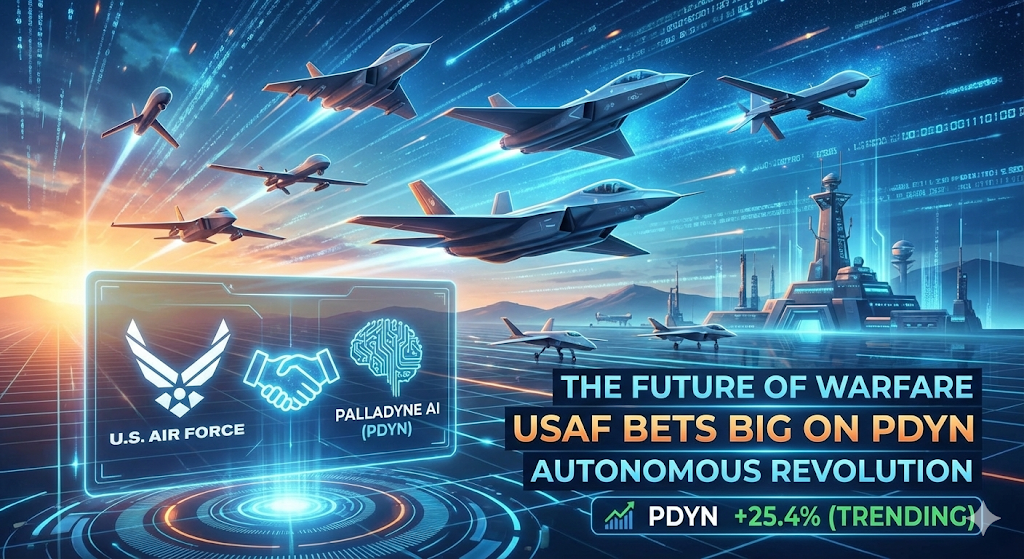
The recent award of the HANGTIME contract by the Air Force Research Laboratory marks a pivotal validation moment for Palladyne AI. The contract directly addresses one of the most complex and unsolved challenges in modern defense operations: enabling autonomous systems across different domains to operate not as isolated units, but as a coordinated, intelligent team. Historically, drones, satellites, maritime assets, and ground systems have functioned in silos, creating delays in intelligence sharing and limiting situational awareness for commanders. HANGTIME seeks to break down those silos entirely.
Under this program, Palladyne AI’s patented SwarmOS™ platform is being used as the baseline technology to orchestrate coordination across space, air, maritime, and land assets. This is not a marginal upgrade. It represents a fundamental evolution toward integrated cross-domain operations, where information collected by one asset instantly informs and adapts the behavior of others. In practical terms, this means satellites, unmanned aerial vehicles, surface vessels, and ground robots can share intelligence, respond dynamically to threats, and collectively optimize mission outcomes in real time.
SwarmOS™ and the Expansion of Embodied AI into Space Operations
One of the most underappreciated aspects of the HANGTIME project is its extension of Palladyne AI’s technology into orbit. By integrating satellites into its collaborative autonomy framework, Palladyne AI is expanding embodied AI beyond terrestrial and atmospheric domains into space. This capability is strategically significant because space-based ISR assets play a central role in modern military operations, yet they have historically been loosely coupled with tactical unmanned systems.
SwarmOS™ enables these disparate assets to function as a unified sensor and decision network. Instead of satellites merely relaying static data back to command centers, they become active participants in a learning, adaptive system that informs and responds to real-world conditions. This evolution transforms tactical commanders into strategic decision-makers by giving them unprecedented cross-domain visibility and responsiveness. From an investment perspective, this dramatically expands Palladyne AI’s total addressable market by positioning the company within the rapidly growing space defense and satellite autonomy ecosystem.
Why Multi-Domain Autonomy Is a Structural Growth Trend
The shift toward multi-domain operations is not a temporary defense fad; it is a structural transformation driven by the increasing complexity of modern threats. Adversaries now operate across cyber, space, air, land, and maritime domains simultaneously, forcing military planners to rethink how intelligence, surveillance, and reconnaissance are conducted. Autonomous systems capable of operating collaboratively across these domains are no longer optional enhancements but operational necessities.
Palladyne AI’s embodied AI software architecture is purpose-built for this environment. Rather than relying on brittle, pre-programmed behaviors, its systems learn from experience, adapt to changing conditions, and optimize decision-making at the edge. This adaptability is particularly valuable in contested or degraded environments where communications may be disrupted or adversaries may actively attempt to confuse autonomous systems. The company’s focus on collaborative autonomy gives it a competitive edge over traditional defense contractors that still rely on platform-specific, siloed software solutions.
Leadership Vision and Alignment with Warfighter Needs
Statements from Palladyne AI’s leadership underscore a disciplined focus on augmentation rather than replacement of human decision-makers. President and CEO Ben Wolff has repeatedly emphasized that the company’s mission is not to remove humans from the loop, but to provide sharper, faster insight that enables better real-time decisions. This philosophy aligns closely with U.S. Department of Defense doctrine, which prioritizes human-machine teaming rather than fully autonomous lethal decision-making.
Chief Technology Officer Dr. Denis Garagic’s emphasis on a single AI framework capable of coordinating assets across multiple domains highlights another critical differentiator. Instead of developing bespoke solutions for each platform, Palladyne AI is building a scalable, reusable autonomy layer that can be deployed across a wide range of systems. This approach lowers integration costs, accelerates deployment timelines, and increases the likelihood of long-term adoption by defense customers seeking standardized solutions.
Commercial and Dual-Use Expansion Opportunities
While defense contracts represent a powerful validation and revenue opportunity, Palladyne AI’s technology is inherently dual-use. The same embodied AI and collaborative autonomy principles that enable military swarming and ISR coordination are equally applicable to commercial robotics, industrial automation, logistics, energy infrastructure inspection, and advanced manufacturing. This dual-market exposure provides diversification and optionality that many pure-play defense contractors lack.
In industrial environments, edge AI systems capable of learning and adapting in real time can dramatically reduce downtime, improve safety, and increase productivity. Palladyne AI’s software-centric model allows it to integrate with existing robotic platforms, lowering adoption barriers and accelerating time-to-value for enterprise customers. Over time, this creates the potential for recurring software revenue streams that complement episodic government contracts.
Financial Inflection and Long-Term Valuation Upside
Although Palladyne AI remains in an early commercialization phase, recent increases in revenue guidance and expanding defense engagements suggest the company may be approaching an operational inflection point. Defense contracts like HANGTIME often serve as gateways to follow-on programs, larger production awards, and multi-year funding commitments. As the company proves its technology in real-world, mission-critical deployments, the probability of expanded scope and additional contracts increases materially.
From a valuation standpoint, markets often undervalue early-stage defense AI companies until revenue visibility improves and institutional awareness increases. Inclusion in major indices, participation in defense innovation programs, and continued contract wins can act as catalysts for re-rating. If Palladyne AI successfully transitions from pilot programs to scaled deployments across multiple domains, its valuation multiple could begin to reflect that of a strategic defense technology provider rather than a speculative AI developer.
The Bullish Long-Term Narrative for Palladyne AI
The HANGTIME contract is more than a single revenue opportunity; it is a signal that Palladyne AI’s embodied AI and collaborative autonomy platform addresses a mission-critical need for the future of defense and autonomous systems. By enabling satellites, drones, maritime assets, and ground systems to think and act together, the company is helping define the architecture of next-generation multi-domain operations.
As defense spending increasingly prioritizes AI-enabled autonomy, ISR integration, and resilient edge computing, Palladyne AI stands to benefit from powerful secular tailwinds. Its patented SwarmOS™ platform, focus on secure American-developed technology, and alignment with U.S. government requirements position it as a credible long-term player in military AI and autonomous systems. For investors willing to tolerate early-stage volatility, Palladyne AI represents a high-conviction bet on the convergence of embodied AI, defense modernization, and multi-domain autonomy.
READ ALSO: The Quiet Semiconductor Disruptor You’ve Never Heard Of: Aeluma Inc (ALMU) and Air Industries Group (AIRI) Narrows Losses to Just $44K — Is This Aerospace Microcap Entering a Turnaround Phase?