We recently published our article Wall Street Can’t Ignore These 4 Energy-Adjacent Giants Anymore. This article takes a closer look at where Lockheed Martin (NYSE:LMT) stands within a resilient, fast-evolving industrial sector shaped by automation, energy efficiency, and advanced manufacturing.
The Industrial sector has long been one of the foundational pillars of the global economy, evolving alongside industrialization, technological progress, and national development priorities. From the early days of mechanized manufacturing and large-scale infrastructure projects to today’s advanced automation systems and aerospace technologies, industrial companies have played a central role in shaping how goods are produced, transported, and protected. The sector encompasses businesses that design, manufacture, and maintain the physical systems that power economies, including machinery, equipment, aircraft, defense systems, and industrial services. Its history is deeply tied to economic cycles, but its relevance has remained constant as societies continue to invest in productivity, security, and modernization.
Over time, the Industrial sector expanded through waves of innovation and consolidation, giving rise to large-scale manufacturers with global footprints and deep engineering expertise. As economies grew more complex, demand shifted from basic machinery toward highly specialized capital goods capable of improving efficiency, precision, and output. Companies operating in this space developed long-standing relationships with governments, corporations, and infrastructure operators, embedding themselves into multi-decade investment cycles. This background explains why industrial businesses are often characterized by high barriers to entry, long product lifecycles, and recurring revenue streams tied to maintenance, upgrades, and aftermarket services.
General Electric (NYSE:GE) emerged as one of the earliest examples of an industrial conglomerate, reflecting how capital goods companies historically combined manufacturing, engineering, and technological innovation under one roof. Over decades, similar firms built reputations around reliability, scale, and the ability to execute large, complex projects. Caterpillar (NYSE:CAT) later became synonymous with heavy machinery and construction equipment, mirroring the rise of global infrastructure development and urbanization. These companies illustrate how the capital goods segment grew in parallel with public works, energy systems, and industrial expansion across both developed and emerging markets.
The aerospace and defense side of the Industrial sector developed through a different but equally influential path. As aviation technology advanced and geopolitical dynamics evolved, governments increasingly relied on specialized contractors to design and manufacture aircraft, defense platforms, and advanced weapons systems. Boeing (NYSE:BA) became a central figure in commercial aviation, reflecting the explosive growth of global air travel and the need for efficient, long-range aircraft. Lockheed Martin (NYSE:LMT), on the other hand, represents the defense-oriented evolution of the sector, built around long-term government contracts, technological secrecy, and mission-critical systems designed to operate at the highest levels of complexity.
Across both capital goods and aerospace and defense, industrial companies refined business models that emphasize scale, precision engineering, and long-term planning. These firms learned to operate within regulated environments, manage extended production timelines, and invest heavily in research and development to stay competitive. As a result, the Industrial sector developed a unique blend of cyclical sensitivity and structural durability, capable of weathering economic downturns while remaining essential to national infrastructure and security.
In more recent decades, the sector has continued to adapt as automation, digitalization, and advanced manufacturing reshaped industrial processes. Companies integrated software, sensors, and data analytics into traditional machinery and systems, expanding their role from equipment suppliers to long-term solution providers. This evolution reinforced the sector’s importance in improving productivity, addressing labor shortages, and supporting modern supply chains. Despite shifts in technology and policy, the Industrial sector’s core mission has remained unchanged: to build, move, and protect the physical foundations of the global economy.
Understanding this background provides critical context for evaluating today’s industrial landscape. The companies that define the sector are not short-term operators but institutions shaped by decades of investment, innovation, and strategic relevance. Their history explains why the Industrial sector continues to command influence in global markets and why its role remains central as governments and corporations enter a new phase of infrastructure renewal, defense modernization, and industrial transformation.
Why the Industrial Sector Is Entering a Multi-Year Expansion Phase
The Industrial sector is increasingly emerging as one of the most structurally supported areas of the global equity market, driven by a powerful convergence of infrastructure investment, manufacturing reshoring, defense modernization, and technological automation. After years of uneven capital spending and supply chain disruptions, industrial demand is now being reinforced by long-term policy commitments, corporate reinvestment cycles, and geopolitical realities that prioritize resilience over cost efficiency.
Unlike past cyclical rebounds that relied heavily on short-term stimulus, the current industrial upswing is grounded in multi-year spending programs. Governments are committing significant resources toward infrastructure renewal, energy systems, transportation networks, and national security, while corporations are accelerating investments in productivity, automation, and capacity expansion. This environment creates sustained demand visibility for industrial companies that supply the equipment, systems, and services required to execute these projects.
Industrial stocks also offer an attractive combination of earnings durability and operating leverage. Many companies in the sector have streamlined operations, improved cost structures, and adopted more disciplined capital allocation strategies following prior downturns. As volumes recover and pricing power improves, incremental revenue growth increasingly flows through to margins, setting the stage for earnings expansion and potential valuation re-rating.
CHECK THIS OUT: Why Governments Are Betting on Secure Chips Instead of Software — SEALSQ Corp (LAES) Explained and Why QuantumScape (QS) Keeps Disappointing Traders but Fascinating Long-Term EV Investors.
Lockheed Martin (NYSE:LMT)
Market Cap: $146.76 Billion
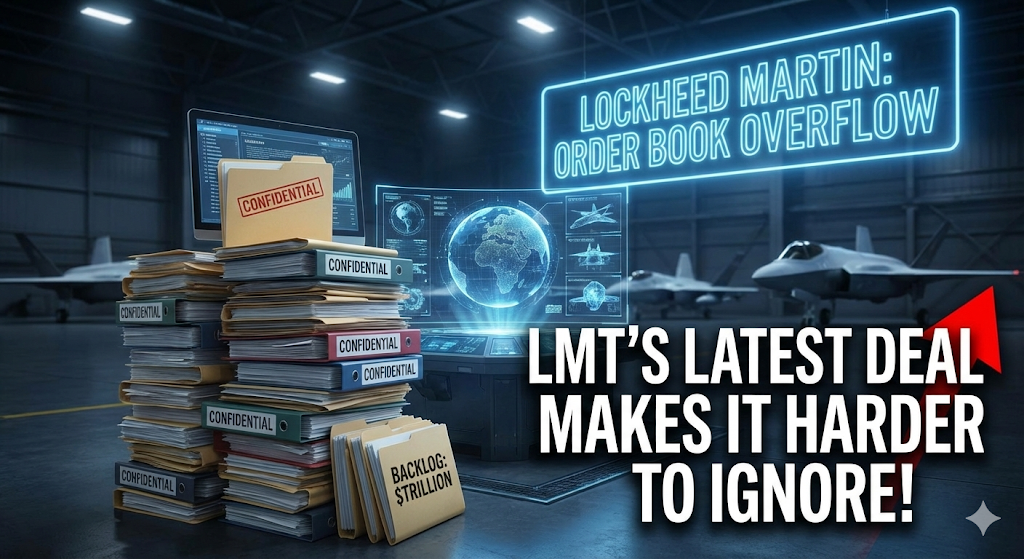
Lockheed Martin is entering what may prove to be one of the most structurally advantageous periods in its modern history, as recent developments underscore a rare combination of demand certainty, capital-backed execution, and long-duration visibility that few industrial companies can match. The company’s newly announced framework agreement with the U.S. Department of War to dramatically expand production of THAAD interceptors—from roughly 96 units annually to as many as 400 per year over the next seven years—represents far more than a single contract win. For Lockheed Martin, it signals a deepening role at the core of U.S. and allied missile defense strategy, with funding expectations extending into fiscal 2026 and well beyond.
This agreement builds on earlier efforts to accelerate production of PAC-3 MSE interceptors, reinforcing Lockheed Martin’s position as the backbone supplier for advanced missile defense systems. In practical terms, this means the company is not simply benefiting from a temporary surge in defense spending, but is becoming embedded in long-term force planning. Missile defense programs are uniquely sticky; once systems are deployed, they require decades of sustainment, upgrades, replenishment, and interoperability improvements. That dynamic transforms today’s production ramp into tomorrow’s recurring revenue streams, creating a compounding effect on backlog and cash flow visibility.
What strengthens the bullish case further is that Lockheed Martin is not waiting for demand to materialize—it is actively building the capacity to meet it. Since 2016, the company has invested more than $7 billion to expand and modernize its production footprint, and management has already outlined plans for additional multibillion-dollar investments over the next three years. These funds are being directed toward facility expansion, digital manufacturing, robotics, and advanced production technologies across multiple U.S. states. The construction of a new Munitions Acceleration Center in Arkansas is emblematic of this strategy, positioning Lockheed to scale output faster, more efficiently, and with greater precision than legacy manufacturing models allow.
This proactive capital deployment matters because it reduces execution risk at precisely the moment when global demand is rising. Many defense peers face bottlenecks in labor, tooling, or supply chains. Lockheed Martin, by contrast, is aligning capacity years in advance, which not only supports higher volumes but also strengthens its negotiating position with government customers. As production scales, fixed costs are absorbed more efficiently, creating opportunities for margin stability even as output increases. That operating leverage is often overlooked in defense discussions but can meaningfully enhance long-term profitability.
The expansion is also translating into tangible economic impact, with Lockheed Martin’s manufacturing employment already up more than 60% since 2016. This matters politically as well as operationally. A growing domestic workforce strengthens the company’s standing with policymakers, reinforces its role in national security infrastructure, and increases the likelihood of continued program support across budget cycles. In an era of heightened geopolitical tension, industrial capacity itself has become a strategic asset, and Lockheed Martin is positioning itself as a critical enabler rather than a passive contractor.
For investors, the appeal lies in the alignment of multiple reinforcing forces. Lockheed Martin combines a massive and growing backlog with contracts that span years, not quarters. Its programs are funded by government priorities that have proven resilient across administrations and economic cycles. At the same time, the company is investing ahead of demand to ensure it can deliver at scale, reducing the risk of missed opportunities or margin erosion. Few large-cap equities offer this degree of earnings visibility paired with strategic relevance.
Crucially, this is not a story of speculative growth or unproven technology. Missile defense systems like THAAD and PAC-3 MSE are already deployed, tested, and integrated into allied defense networks. The current production ramp reflects escalation and replenishment, not experimentation. That distinction lowers risk while extending duration, a combination that long-term capital increasingly favors in uncertain macro environments.
Taken together, Lockheed Martin’s recent agreements, capital investments, and production expansion point to a multi-year runway that is both visible and defensible. As global defense spending remains elevated and governments prioritize readiness and deterrence, Lockheed Martin stands positioned not merely to participate, but to lead. For investors seeking exposure to durable demand, long-cycle contracts, and a company actively shaping the future capacity of the defense industrial base, Lockheed Martin presents a compelling bullish case grounded in execution, scale, and strategic necessity.
READ ALSO: The Quiet Semiconductor Disruptor You’ve Never Heard Of: Aeluma Inc (ALMU) and Air Industries Group (AIRI) Narrows Losses to Just $44K — Is This Aerospace Microcap Entering a Turnaround Phase?
Disclosure: No material interests to disclose. This article was originally published on Global Market Bulletin.