The global energy industry sits at the center of the modern economy, supplying the fuel, power, and raw materials that keep transportation networks moving, factories running, data centers online, and cities illuminated. Long before energy became a financial sector or a trading theme, it was the backbone of industrialization, shaping geopolitics, global trade, and economic growth for more than a century. From the early days of oil exploration and refining to the development of massive integrated energy conglomerates, the sector has evolved alongside technological progress, population growth, and rising standards of living. Today, despite constant headlines around renewables and decarbonization, energy remains one of the most indispensable and capital-intensive industries in the world, with oil and gas continuing to play a dominant role in meeting global demand.
The modern energy sector is largely defined by companies that grew through decades of exploration, mergers, and infrastructure buildouts, creating vast upstream, midstream, and downstream networks that span continents. Exxon Mobil, for example, traces its roots back to the breakup of Standard Oil, eventually becoming one of the most influential corporations in the global economy. Over time, the company built a vertically integrated model that combined exploration, production, refining, chemicals, and logistics, allowing it to operate at scale and withstand commodity cycles. Its long history of technological development, from deepwater drilling to unconventional shale extraction, reflects how legacy energy companies have continually adapted to shifting market conditions while maintaining their central role in global supply.
Chevron followed a similar path, growing from early California oil operations into a global energy major with assets across North America, Asia, and other key regions. Through decades of consolidation and strategic expansion, Chevron established itself as a company known for operational discipline and long-life resource development. Its involvement in large-scale projects, particularly in oil, natural gas, and liquefied natural gas, highlights how energy companies evolved beyond simple oil producers into sophisticated operators managing complex, capital-heavy assets designed to deliver steady output over many years.
Outside the United States, the energy sector’s development was equally shaped by multinational expansion and state-backed resource strategies. Shell emerged from a series of European trading and exploration businesses to become one of the world’s most recognizable energy brands. Its global footprint spans upstream production, refining, chemicals, shipping, and retail fuel distribution, giving it exposure to nearly every segment of the energy value chain. This breadth reflects the historical need for scale and diversification in an industry where supply shocks, geopolitical events, and regulatory changes can dramatically reshape markets.
TotalEnergies represents another evolution of the sector, growing from a traditional oil and gas company into a diversified energy group with exposure across hydrocarbons, liquefied natural gas, power generation, and renewable energy assets. Its transformation mirrors a broader industry trend where established energy companies leverage decades of cash flow, technical expertise, and project management experience to expand into new energy solutions while continuing to rely on their core oil and gas businesses as the primary earnings engine.
Across all of these companies, common themes define the sector’s background: massive upfront capital investment, long development timelines, and an enduring reliance on physical assets that cannot be easily replicated. Energy companies historically built competitive advantages through access to reserves, infrastructure ownership, engineering expertise, and global logistics networks. These foundations allowed them to survive multiple commodity cycles, regulatory shifts, and technological changes, reinforcing the sector’s reputation as one of the most resilient corners of the market.
In recent years, the energy sector has once again drawn investor attention as supply discipline, geopolitical tensions, and years of underinvestment have tightened global markets. Yet its relevance is not new. The companies that dominate today’s energy landscape are the result of decades of expansion, consolidation, and adaptation, making the sector a unique blend of industrial history and modern financial relevance. Understanding this background is essential for evaluating why energy stocks continue to command influence in global markets and why their role remains critical despite ongoing debates about the future of energy.
Why the Energy Sector Is Entering a Durable Upswing
The Energy sector is quietly re-emerging as one of the most structurally attractive areas of the global equity market, supported by a rare combination of tight supply, disciplined capital allocation, persistent demand growth, and rising geopolitical risk premiums. After nearly a decade of underinvestment following the last commodity supercycle, global energy markets are now operating with little margin for error. This imbalance strongly favors producers, particularly those with scale, integrated operations, and access to long-life reserves.
Unlike past cycles driven purely by speculative excess, the current energy uptrend is rooted in fundamentals. Capital expenditures remain constrained, ESG pressures have limited new project approvals, and replacement ratios are below historical norms. At the same time, global energy demand continues to rise, driven by population growth, industrialization in emerging markets, electrification, data center expansion, and energy-intensive technologies such as AI and cloud computing. The result is a structurally tight market where pricing power has shifted back to producers.
Energy equities also stand out in a market dominated by expensive growth stocks. Valuations across much of the sector remain below historical averages despite record free cash flow generation, strong balance sheets, and aggressive shareholder returns through dividends and buybacks. This creates an asymmetric setup where downside is supported by cash flows while upside is amplified by commodity price strength.
Oil, Gas & Consumable Fuels: Supply Scarcity Meets Relentless Demand
The Oil, Gas & Consumable Fuels subsector sits at the heart of the bullish energy thesis. This segment benefits most directly from commodity price exposure and reflects the growing scarcity of reliable hydrocarbon supply.
Global oil demand continues to climb, driven by transportation, petrochemicals, aviation, and industrial use. Even as renewable energy adoption increases, oil and gas remain irreplaceable for large parts of the global economy. Electric vehicles reduce gasoline demand at the margin, but petrochemical feedstocks, shipping fuel, aviation fuel, and industrial heating still rely overwhelmingly on hydrocarbons. Natural gas, in particular, has become a cornerstone of energy security, acting as both a transition fuel and a baseload power source.
On the supply side, years of underinvestment are now fully visible. Many producers cut exploration budgets dramatically in the 2015–2020 period, and new discoveries have failed to keep pace with depletion. Decline rates in mature fields mean that simply maintaining current production requires continuous capital, yet investors now demand capital discipline instead of volume growth. This tension structurally supports higher commodity prices.
Producers in this subsector are generating substantial free cash flow even at conservative price assumptions. Many have shifted away from growth-at-any-cost strategies toward maximizing returns on invested capital. This has led to stronger balance sheets, reduced debt, and shareholder-friendly capital return programs. In an inflationary or geopolitically unstable environment, these cash-generating businesses become increasingly valuable as real-asset hedges.
CHECK THIS OUT: Why Governments Are Betting on Secure Chips Instead of Software — SEALSQ Corp (LAES) Explained and Why QuantumScape (QS) Keeps Disappointing Traders but Fascinating Long-Term EV Investors.
Integrated Oil & Gas: Resilience, Scale, and Cash Flow Dominance
The Integrated Oil & Gas subsector represents the most defensive and durable expression of the energy bull case. These companies operate across the entire value chain, from upstream exploration and production to downstream refining, chemicals, and marketing. This diversification creates natural hedges that smooth earnings volatility across commodity cycles.
When oil prices are high, upstream profits surge. When prices fall, downstream and refining margins often expand, offsetting upstream weakness. This integrated model allows these companies to generate consistent cash flows across market environments, making them especially attractive for long-term investors seeking income and capital preservation.
Integrated majors also possess unmatched scale, technical expertise, and access to capital. This positions them to develop complex, long-cycle projects that smaller producers cannot pursue, such as deepwater fields and liquefied natural gas infrastructure. LNG demand is accelerating as countries seek energy security and alternatives to coal, and integrated players dominate this space.
Importantly, many integrated oil and gas companies are also positioning themselves as energy transition beneficiaries rather than victims. They are investing in carbon capture, hydrogen, biofuels, and lower-carbon technologies while continuing to monetize their legacy assets. This dual-track strategy allows them to fund transition investments with hydrocarbon cash flows, rather than relying on external financing.
Valuations in this subsector remain compelling. Despite strong profitability and fortress balance sheets, many integrated players trade at modest earnings multiples and offer dividend yields that significantly exceed those of the broader market. Share buybacks further enhance per-share value, reinforcing the long-term compounding potential.
Macro Tailwinds Strengthening the Energy Bull Case
Several macroeconomic and geopolitical forces further reinforce the bullish outlook for energy stocks. Rising geopolitical tensions increase the risk premium embedded in oil and gas prices, especially when supply routes or producing regions are threatened. Energy security has re-emerged as a national priority, leading governments to favor domestic and allied producers.
Inflation also benefits energy companies disproportionately. As commodity prices rise, revenues adjust quickly, while much of the cost base remains relatively fixed in the short term. This operating leverage drives margin expansion and earnings growth, making energy equities effective inflation hedges.
At the same time, global capital markets are slowly rotating back toward value, cash flow, and profitability after years of growth stock dominance. The energy sector fits squarely within this rotation, offering tangible assets, strong returns on capital, and immediate shareholder rewards.
Conclusion: A Sector Built for the Next Market Phase
The Energy sector, particularly Oil, Gas & Consumable Fuels and Integrated Oil & Gas, is positioned for a sustained period of outperformance driven by structural supply constraints, resilient demand, disciplined capital allocation, and attractive valuations. These are not speculative narratives but fundamental realities supported by years of underinvestment and changing global priorities.
For investors seeking exposure to real assets, strong cash flows, inflation protection, and geopolitical hedging, energy stocks offer a compelling risk-reward profile. As markets increasingly reward profitability over promise, the energy sector stands out as one of the most underappreciated opportunities in the current cycle.
ARTICLE HIGHLIGHT – MUST READ!!!: Brand Engagement Network (BNAI) Could Be the Anti-Hype AI Stock Investors Overlook
KEY STOCKS TO WATCH
As this bullish setup for the Energy sector continues to unfold, a small group of companies stand out as key stocks to watch that best reflect the structural advantages discussed across each subsector.
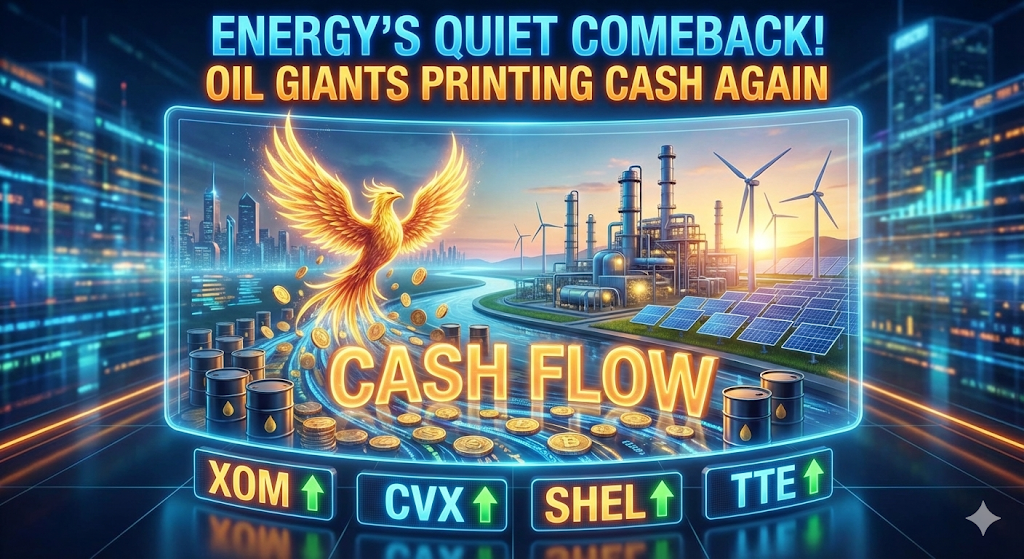
Within Oil, Gas & Consumable Fuels, Exxon Mobil (NYSE:XOM) remains one of the clearest expressions of this thesis. The company’s low-cost upstream portfolio, anchored by world-class Guyana and Permian assets, allows it to generate substantial free cash flow across commodity cycles. Exxon Mobil’s scale, disciplined capital allocation, and integrated logistics provide downside protection while still offering meaningful upside leverage to higher oil prices, making it a core name to watch as supply tightness persists.
Chevron (NYSE:CVX) further reinforces the bullish outlook for this subsector through its conservative balance sheet and shareholder-focused strategy. With strong exposure to the Permian Basin and liquefied natural gas, Chevron produces reliable cash flows while maintaining one of the strongest dividend profiles in the sector. Its disciplined spending approach and emphasis on high-margin projects position the company to perform well during both commodity upcycles and periods of volatility, solidifying its place among the top consumable fuels stocks to watch.
In Integrated Oil & Gas, Shell plc (NYSE:SHEL) stands out as a diversified global energy leader with meaningful exposure across LNG, refining, chemicals, and emerging low-carbon initiatives. Shell’s integrated model enables it to capture value across the energy chain, reducing reliance on any single commodity price environment. With improving cost efficiency, rising free cash flow, and an increased focus on shareholder returns, Shell remains a key integrated stock to watch as global energy demand and LNG usage continue to expand.
TotalEnergies SE (NYSE:TTE) adds another compelling dimension to the integrated energy thesis by combining traditional oil and gas strength with one of the most advanced renewable and power generation strategies among global majors. The company benefits from disciplined upstream investments and a strong LNG position while simultaneously scaling solar and electricity assets. This balanced approach allows TotalEnergies to participate in near-term hydrocarbon profitability while building long-term relevance in a transitioning energy landscape, making it a standout integrated name to watch within the sector.
Together, these companies represent some of the most direct and fundamentally grounded ways to gain exposure to the Energy sector’s ongoing structural tailwinds, offering a blend of cash flow durability, capital discipline, and long-term strategic positioning.
READ ALSO: The Quiet Semiconductor Disruptor You’ve Never Heard Of: Aeluma Inc (ALMU) and Air Industries Group (AIRI) Narrows Losses to Just $44K — Is This Aerospace Microcap Entering a Turnaround Phase?