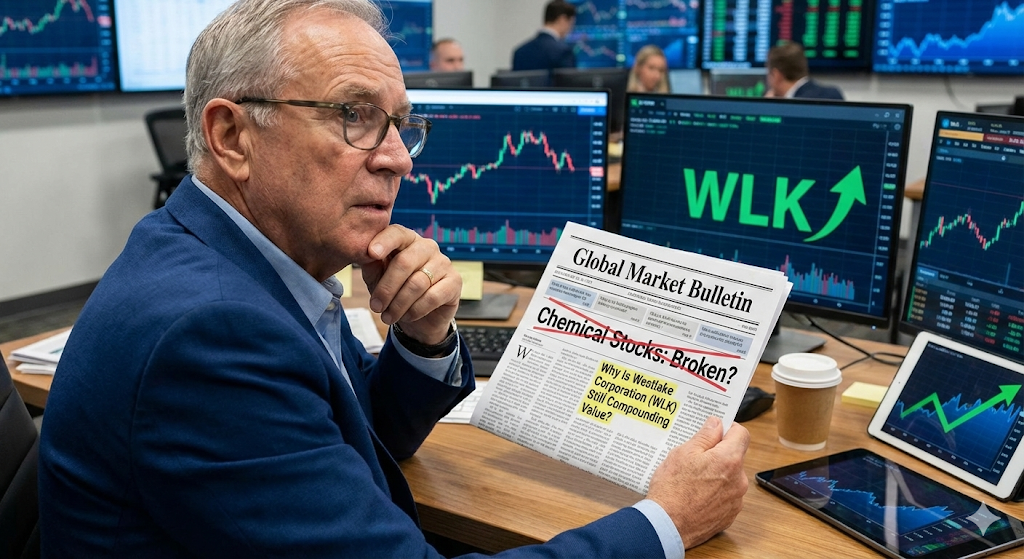
We recently published our article These NYSE Chemical Stocks Look Ugly on the Chart — That’s Exactly Why Smart Money Is Watching DOW, LYB, WLK, and OLN. This article examines where Westlake Corporation (WLK) stands in a deeply out-of-favor chemicals sector, where washed-out sentiment and depressed valuations are quietly drawing smart-money attention ahead of a potential cycle turn.
The Materials sector has long been one of the most essential yet misunderstood pillars of the global economy, supplying the raw inputs that enable nearly every form of modern production. Within this sector, commodity chemicals play a foundational role by providing high-volume, standardized materials that feed directly into packaging, construction, automotive manufacturing, electronics, agriculture, water treatment, and consumer goods. These products are rarely visible to end consumers, but without them, global supply chains would grind to a halt. Because of this deep integration into industrial activity, commodity chemicals tend to move in powerful cycles, expanding rapidly during economic upswings and facing sharp margin compression during downturns.
Over the past several years, the commodity chemicals industry has experienced a prolonged and painful downcycle. Oversupply, elevated energy and feedstock costs, geopolitical disruptions, and uneven demand recovery across regions have weighed heavily on profitability. Investor sentiment toward the Materials sector has reflected this pressure, with chemical stocks often trading at depressed valuation multiples and facing skepticism about near-term earnings visibility. However, this same period of weakness has forced the industry to adapt. Cost structures have been scrutinized, operating models simplified, and capital allocation made more disciplined, laying the groundwork for potential operating leverage once demand conditions stabilize.
As inflation trends ease and global manufacturing indicators begin to show tentative signs of bottoming, attention is slowly returning to the fundamentals of commodity chemicals. Unlike high-growth sectors that rely on rapid innovation cycles, chemical producers compete on scale, efficiency, asset integration, and cash flow durability. Free cash flow generation, EBITDA resilience, balance sheet strength, and cost leadership have become increasingly important differentiators. This shift has made valuation metrics such as price-to-sales ratios, discounted cash flow models, and normalized earnings power especially relevant for investors seeking mispriced opportunities within cyclical industries.
Another defining feature of the current environment is the growing use of digitalization, automation, and artificial intelligence across industrial operations. Productivity improvements, process optimization, and smarter asset utilization are no longer optional but central to maintaining competitiveness. These structural changes are reshaping how commodity chemical businesses operate, allowing them to remain profitable at lower utilization rates and positioning them for sharper margin expansion when volumes recover. As a result, the sector is no longer purely a bet on macroeconomic acceleration, but increasingly a test of execution, discipline, and long-term strategic planning.
Commodity chemicals also sit at the crossroads of several long-term themes, including infrastructure modernization, housing demand, supply chain localization, and sustainability initiatives. While short-term pricing remains volatile, demand for basic chemical inputs tied to population growth, urbanization, and industrial replacement cycles has proven resilient over decades. This creates a backdrop where temporary pessimism can coexist with enduring relevance, a dynamic that often produces opportunity for investors willing to look beyond near-term headlines.
Taken together, the Materials sector’s commodity chemicals segment is transitioning from survival mode toward selective recovery. While challenges such as global capacity rationalization and uneven regional demand persist, the structural actions taken during the downturn may ultimately define the next phase of performance. For market participants focused on cyclicality, valuation compression, and operational leverage, the current setup underscores why commodity chemicals remain one of the most closely watched areas within the broader Materials sector as the next industrial cycle begins to take shape.
Chemicals: The Backbone of Industrial and Technological Progress
The Chemicals subsector represents the highest-value segment of the Materials sector, serving as a critical input across virtually every major industry, including construction, automotive, electronics, healthcare, agriculture, and consumer goods. Chemical products form the building blocks of modern manufacturing, enabling innovation through advanced materials, specialty compounds, and performance-enhancing solutions that improve efficiency, durability, and sustainability.
What makes the chemicals subsector particularly attractive in the current environment is its increasing focus on value-added products rather than pure volume growth. Many chemical producers have shifted toward specialty and performance chemicals that command higher margins, stronger customer relationships, and greater pricing power. This transition reduces earnings volatility and allows companies to pass through input cost inflation more effectively, protecting margins during periods of economic uncertainty.
Demand for chemical products is also being structurally supported by secular trends such as electrification, lightweight materials, semiconductor manufacturing, and environmental compliance. From battery components and insulation materials to coatings, adhesives, and electronic chemicals, the role of chemical producers continues to expand as global industries become more technologically complex. These trends provide long-term visibility that extends beyond traditional economic cycles, reinforcing the bullish outlook for the subsector.
CHECK THIS OUT: Why Governments Are Betting on Secure Chips Instead of Software — SEALSQ Corp (LAES) Explained and Why QuantumScape (QS) Keeps Disappointing Traders but Fascinating Long-Term EV Investors.
Westlake Corporation (NYSE:WLK)
Market Cap: $10.9 Billion
Westlake Corporation (NYSE:WLK) continues to stand out as one of the most structurally resilient and strategically disciplined companies within the commodity chemicals and building materials space, especially at a time when much of the sector remains under pressure from oversupply, volatile pricing, and uneven global demand. Unlike pure-play chemical producers that are heavily exposed to single-cycle dynamics, Westlake operates a deeply vertically integrated business model that spans upstream petrochemicals, intermediate polymers, and downstream building and infrastructure products. This integration allows the company to capture value across the full production chain, smooth earnings volatility, and maintain stronger margin control even during weaker industry conditions.
The importance of this integrated model becomes more apparent in challenging environments. When feedstock prices fluctuate or commodity pricing softens, Westlake is able to offset pressure through internal sourcing advantages, operational efficiencies, and downstream demand stability. This structural edge reduces reliance on spot market pricing and gives management greater flexibility in balancing volumes, pricing, and profitability. As a result, Westlake has historically demonstrated an ability to protect cash flow and preserve balance sheet strength when less diversified peers struggle.
Recent sell-side commentary has highlighted broader caution toward commodity chemicals, with concerns centered on global oversupply and slower near-term demand recovery. Against that backdrop, the decision by Bank of America to maintain a Buy rating on Westlake carries particular significance. It reflects confidence not just in cyclical recovery potential, but in the company’s execution discipline, strategic capital allocation, and ability to create value independent of short-term market sentiment. Westlake’s management has consistently emphasized return-focused growth rather than volume-driven expansion, a philosophy that supports long-term shareholder value creation.
A major pillar of Westlake’s evolving investment thesis is its deliberate shift toward higher-value, specialty-oriented products. The acquisition of the global compounding solutions businesses of the ACI/Perplastic Group represents a meaningful acceleration of this strategy. By expanding its presence across Europe, North Africa, and Mexico, Westlake enhances both geographic diversification and end-market exposure. More importantly, the acquisition adds advanced compounding technologies and specialty materials capabilities that move the company further up the value chain, particularly in wire and cable, infrastructure, and industrial applications where customization and performance matter.
These specialty markets tend to be less commoditized, offer more stable demand profiles, and support stronger margins compared to traditional bulk chemical products. Management has made it clear that the strategic rationale extends beyond simple expansion. The integration of ACI/Perplastic enables Westlake to introduce new specialty formulations, deepen relationships with existing customers, and increase switching costs through tailored solutions. Over time, this enhances pricing power and improves margin quality, gradually lifting the overall earnings profile of the business.
Westlake’s Housing and Infrastructure Products segment further strengthens its long-term outlook. Demand for PVC, building products, and infrastructure-related materials is supported by enduring structural drivers such as housing replacement cycles, population growth, public infrastructure investment, electrical grid modernization, and water system upgrades. While housing and construction activity can fluctuate in the short term, the long-duration nature of these needs provides a more predictable demand foundation over full economic cycles. Westlake’s exposure to these markets is diversified across residential, commercial, and public infrastructure applications, reducing dependence on any single demand driver.
Financial discipline remains another key component of the bullish case. Westlake has historically maintained a conservative approach to leverage and capital allocation, prioritizing balance sheet strength alongside strategic investments. This discipline gives the company the flexibility to pursue accretive acquisitions during industry downturns, invest in capacity or technology when returns justify it, and return capital to shareholders when conditions allow. As higher-margin specialty contributions grow and operating leverage improves, free cash flow generation is positioned to strengthen further.
Ultimately, what differentiates Westlake within a cyclical sector is its ability to compound value rather than merely survive downturns. The company blends commodity-scale efficiency with an expanding specialty portfolio, supported by vertical integration, disciplined management, and long-term end-market relevance. As the chemical cycle normalizes and global demand gradually improves, Westlake is positioned to deliver improving returns on invested capital, stronger cash flow visibility, and sustained shareholder value creation. In an industry often defined by volatility and short-term swings, Westlake represents a business built for resilience, execution, and long-term compounding rather than fleeting cyclical rallies.
READ ALSO: The Quiet Semiconductor Disruptor You’ve Never Heard Of: Aeluma Inc (ALMU) and Air Industries Group (AIRI) Narrows Losses to Just $44K — Is This Aerospace Microcap Entering a Turnaround Phase?
Disclosure: No material interests to disclose. This article was originally published on Global Market Bulletin.