We recently published our article 10 Best Semiconductor Equipment Stocks to Invest in Now. In this article, we take a closer look at ACM Research Inc. (NASDAQ:ACMR) and why the company has emerged as one of the semiconductor equipment stocks attracting investor attention as chipmakers expand manufacturing capacity and invest heavily in advanced semiconductor production.
When Geopolitics Shakes Markets, Technology Often Tells the Real Story
Anyone who has followed financial markets long enough learns a simple but often overlooked truth: markets may panic over headlines, but long-term capital tends to flow toward industries that shape the future. That pattern has repeated itself across multiple market cycles—from the early days of the internet boom to the rise of smartphones and, more recently, the explosive growth of artificial intelligence. In this article, we will take a closer look at the 10 Best Semiconductor Equipment Stocks to Invest In Now, a group of companies that quietly power the technological backbone of the global economy.
Semiconductors are often described as the “oil of the digital age,” yet the companies that manufacture the tools used to build these chips rarely receive the same level of attention as the chip designers themselves. Firms like NVIDIA, AMD, and Qualcomm typically dominate headlines, but seasoned investors know that the real engine of the semiconductor ecosystem lies earlier in the supply chain. Semiconductor equipment companies produce the highly specialized machines used to manufacture microchips, including lithography systems, wafer inspection tools, etching equipment, and deposition technology. Without these sophisticated tools, modern semiconductor manufacturing simply would not exist.
The importance of these companies has only grown as the world enters a new era of digital transformation. Artificial intelligence, cloud computing, electric vehicles, 5G infrastructure, and advanced robotics all require increasingly powerful semiconductors. As a result, chipmakers around the world are investing billions of dollars to expand manufacturing capacity. That investment inevitably flows toward the companies that design and manufacture the equipment used to produce chips.
The Global Race to Build Semiconductor Supply Chains
Over the past few years, semiconductor manufacturing has become one of the most strategically important industries in the global economy. Governments across the United States, Europe, and Asia are racing to strengthen domestic chip supply chains after the disruptions experienced during the pandemic exposed vulnerabilities in global technology production.
The United States, for instance, launched the CHIPS and Science Act, a landmark initiative allocating tens of billions of dollars in incentives for semiconductor manufacturing and research. Similar industrial strategies have been introduced in the European Union, Japan, South Korea, and Taiwan. These policies are designed not only to boost economic growth but also to secure technological leadership in an increasingly competitive geopolitical environment.
For investors, this massive wave of capital spending creates a powerful long-term tailwind for semiconductor equipment stocks. Every new chip fabrication plant—commonly referred to as a “fab”—requires billions of dollars’ worth of equipment before a single semiconductor can be produced. In other words, the expansion of semiconductor manufacturing automatically drives demand for the machines used to build those chips.
Markets, Geopolitics, and Investor Sentiment
While the semiconductor industry continues to benefit from powerful structural trends, financial markets are currently navigating a period of heightened geopolitical uncertainty. On March 2, Tom Lee, head of research at Fundstrat Global Advisors, appeared on CNBC’s Squawk Box to discuss the latest market dynamics and the potential impact of the escalating U.S.-Israel conflict with Iran.
Lee acknowledged that geopolitical tensions often create significant volatility in global markets, particularly when military conflicts dominate the news cycle. However, he emphasized that such events rarely alter the underlying fundamentals of the U.S. economy. In fact, history suggests that markets often react more strongly before conflicts escalate than after they begin.
Drawing on decades of market behavior, Lee noted that investors frequently sell off equities during the buildup to geopolitical confrontations due to uncertainty. Once events unfold and the scope of the situation becomes clearer, markets tend to stabilize and sometimes even rebound. In his view, the current environment may follow a similar pattern.
Of course, analysts remain cautious about the possibility that tensions between the United States, Israel, and Iran could escalate into a wider regional conflict. Some commentators have even raised concerns about the theoretical risk of a broader global confrontation. But absent such extreme scenarios, Lee believes the overall economic backdrop remains resilient. He suggested that the worst of the market’s recent sell-off could occur early in the month, with March ultimately turning into a positive period for equities.
Oil Prices and the Broader Economic Ripple Effect
One factor that continues to draw attention from economists and investors alike is the potential impact of rising oil prices. Energy markets often react quickly to geopolitical tensions, particularly when conflicts involve regions responsible for a significant portion of global oil supply.
Lee pointed out that oil price shocks can ripple across the entire economic system because energy costs influence everything from transportation and manufacturing to consumer goods and food prices. In previous decades, sudden spikes in oil prices occasionally pushed already fragile economies into recession.
However, Lee argues that the current economic landscape is very different from the conditions that existed during earlier oil crises. The U.S. economy today appears relatively strong, with healthy corporate balance sheets and resilient consumer spending. As a result, even if oil prices rise due to geopolitical tensions, the broader economic impact may be less severe than many fear.
Interestingly, such developments could also influence monetary policy. If higher oil prices begin to affect inflation expectations, the Federal Reserve may choose to adopt a more cautious stance rather than tightening policy aggressively. In Lee’s view, the central bank could ultimately lean toward a more dovish posture if energy-related shocks begin affecting financial conditions.
Why Semiconductor Equipment Companies Matter More Than Ever
Against this complex macroeconomic backdrop, long-term investors continue to focus on sectors driven by structural technological growth rather than short-term geopolitical noise. Few industries illustrate this dynamic more clearly than the semiconductor sector.
Semiconductors are essential to nearly every aspect of modern life. From smartphones and laptops to electric vehicles and industrial automation systems, microchips serve as the brains of the digital economy. Yet producing these chips requires extraordinarily sophisticated manufacturing technology.
That is where semiconductor equipment companies come into play. These firms supply the machinery that chip manufacturers rely on to produce increasingly smaller, faster, and more efficient processors. The equipment used in advanced semiconductor fabrication can cost hundreds of millions of dollars and requires decades of research and engineering expertise to develop.
Industry veterans often compare semiconductor equipment companies to the toolmakers of a technological gold rush. While chip designers and manufacturers compete for market share, the equipment providers supply the essential machinery that makes the entire ecosystem possible. As semiconductor demand grows, the need for advanced manufacturing equipment grows alongside it.
CHECK THIS OUT: Top 10 Best Cheap HVAC Stocks to Buy Now and Top 5 Copper Stocks to Buy Right Now.
Our Methodology
To identify the 10 best semiconductor equipment stocks to invest in now, we sifted through the Finviz stock screener to compile a list of companies operating within the semiconductor manufacturing equipment industry. From this universe, we selected the 10 stocks that are most widely held by elite hedge funds as of the third quarter of 2025, based on data sourced from an insider’s database.
These companies are ranked in ascending order according to hedge fund sentiment, offering insight into which semiconductor equipment stocks are attracting the strongest institutional interest. For investors seeking exposure to the technology supply chain that powers artificial intelligence, advanced computing, and next-generation electronics, the following companies represent some of the most closely watched names in the semiconductor equipment industry today.
10 Best Semiconductor Equipment Stocks to Invest in Now
8. ACM Research Inc. (NASDAQ:ACMR)
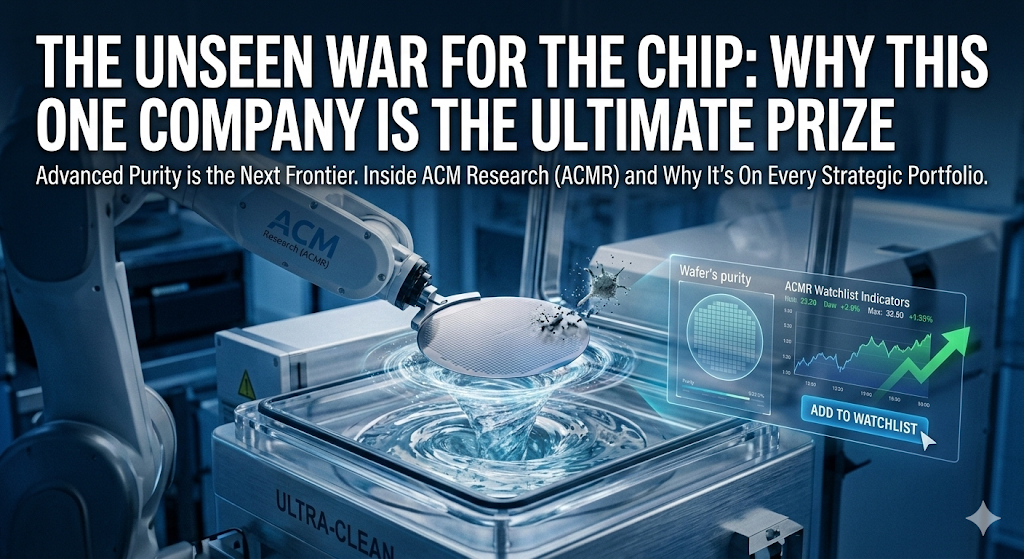
ACM Research, Inc. (NASDAQ: ACMR) ranks 8th in our list of the 10 best semiconductor equipment stocks to invest in now. ACM Research, Inc. (NASDAQ: ACMR) remains one of the more closely watched semiconductor equipment stocks in the wafer cleaning segment, an essential stage of the semiconductor manufacturing process where particles and contaminants must be removed from silicon wafers to ensure production yields remain high. As chip manufacturing nodes become smaller and more complex, cleaning technologies become increasingly important in preventing defects that could disrupt the entire fabrication process.
The company reported its fiscal fourth quarter and full-year 2025 financial results on February 26, providing investors with a clearer look at its operational trajectory. Total shipments for the year reached $854 million, reflecting a decline of 12.2% compared to the prior year, while shipments in the fourth quarter totaled $228 million. However, the company emphasized that several delivered tools remain pending customer acceptance and may contribute to future revenue recognition.
Despite the shipment fluctuations, ACM Research reported full-year revenue of $901.3 million, representing a 15.2% increase compared with the previous year. The growth was driven by strong demand for single-wafer cleaning equipment, Tahoe cleaning systems, semi-critical cleaning technologies, and increased sales of electrochemical plating, furnace technologies, and advanced packaging solutions.
Roth Capital responded to the results by raising its price target on ACMR stock to $70 from $40 while maintaining a Buy rating. The firm highlighted the company’s guidance pointing to strong double-digit revenue growth in 2026, supported by new customers, geographic expansion, and continued semiconductor demand from China’s manufacturing sector.
READ ALSO: Top 10 Cheap Robotics Stocks To Buy Now and Top 5 Best Cybersecurity Micro-Caps to Watch in 2026.
Disclosure: No material interests to disclose. This article was originally published on Global Market Bulletin.