Born out of a growing recognition that the global economy is entering a prolonged era of critical mineral scarcity, the company behind the ticker emerged with an ambition that immediately set it apart from traditional mining ventures. Instead of competing for increasingly constrained land-based deposits, it focused on one of the planet’s least developed resource frontiers: the deep ocean floor. From the beginning, the business was shaped by the idea that electrification, battery technology, renewable energy systems, and advanced manufacturing would require vastly more nickel, copper, cobalt, and manganese than existing supply chains could reliably deliver. This foundational belief continues to define the company’s identity as investors search for exposure to future-facing critical minerals and energy transition metals.
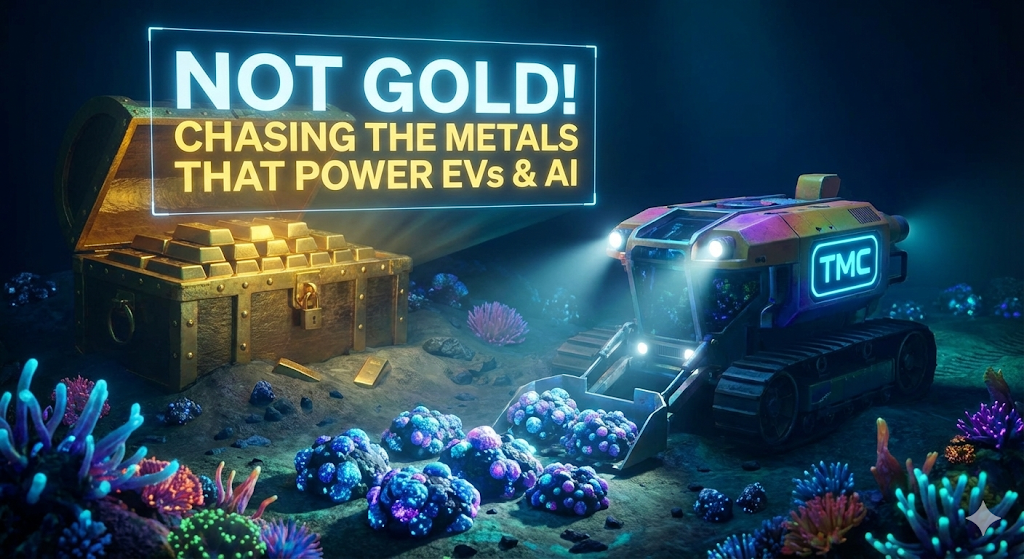
TMC The Metals Company (NASDAQ:TMC) was founded in 2011 under the name DeepGreen Metals, positioning itself early as a pioneer in deep-sea polymetallic nodule exploration. These nodules, scattered across the seabed of the Clarion-Clipperton Zone in the Pacific Ocean, contain multiple battery metals within a single rock, offering a unique geological profile compared with conventional terrestrial ores. From its earliest development stages, the company emphasized scientific research, environmental baseline studies, and long-term resource definition, aiming to establish credibility in an industry often viewed as speculative or controversial. This early investment in data and ocean science laid the groundwork for what would later become one of the most advanced deep-sea mineral datasets in the world.
As the global conversation around electric vehicles, lithium-ion batteries, and renewable energy accelerated, TMC The Metals Company steadily refined its strategic narrative. Rather than positioning itself as a short-term commodity play, it framed its mission around supplying critical minerals essential to decarbonization, grid-scale energy storage, and next-generation industrial technologies. The company’s focus on polymetallic nodules was central to this narrative, as these resources potentially allow the production of nickel, copper, cobalt, and manganese without many of the land-use, social displacement, and permitting challenges associated with traditional mining. Over time, this positioning helped TMC become closely associated with keywords such as critical minerals supply, battery metals, energy transition mining, and deep-sea mining innovation.
The company’s evolution accelerated when TMC The Metals Company entered the public markets, giving investors direct exposure to a highly unconventional resource development model. Public listing brought greater scrutiny, but it also expanded access to capital needed to advance engineering trials, environmental monitoring, and regulatory engagement. Throughout this period, the company maintained a consistent emphasis on long-term value creation rather than near-term revenue, reinforcing its identity as a development-stage critical minerals platform. This approach has made the stock particularly visible among investors seeking asymmetric opportunities tied to EV adoption, clean energy infrastructure, and supply chain diversification.
Today, TMC The Metals Company’s background is best understood as the product of more than a decade of preparation at the intersection of ocean science, mining technology, and global resource economics. Its history reflects a deliberate attempt to anticipate where demand for metals is heading rather than where it has been. As governments, automakers, and technology companies increasingly focus on securing long-term access to battery metals, the company’s early commitment to deep-sea polymetallic nodules has positioned it as one of the most closely watched names in the emerging deep-sea mining sector. This long arc, from exploration concept to potential future supplier of critical minerals, defines the foundation upon which today’s investment debates around TMC are built.
A Regulatory Shift That Rewrites the Playing Field for Deep-Sea Mining
In recent days, the long-debated future of deep-sea mining took a meaningful step forward after U.S. regulators finalized a new rule under the Deep Seabed Hard Mineral Resources Act. This updated framework consolidates and streamlines the application process for deep-sea mineral exploration licenses and commercial recovery permits, addressing one of the most persistent bottlenecks in the sector. For years, regulatory uncertainty has been one of the biggest overhangs on companies pursuing polymetallic nodule extraction, often overshadowing technical progress and resource potential. The new rule signals that the U.S. is no longer content to let critical mineral supply remain constrained by procedural inertia, especially at a time when electrification, artificial intelligence, and energy transition policies are driving unprecedented demand for nickel, copper, cobalt, and manganese.
What makes this framework especially relevant is its practical design. By allowing environmental and technical data gathered during the exploration phase to be reused in commercial recovery applications, regulators have effectively shortened the path from exploration to potential production. This change does not eliminate scrutiny or environmental review, but it does reduce duplication and friction, a detail that matters enormously in a capital-intensive, long-cycle industry like deep-sea mining. Against this backdrop, the rule change is not just a regulatory footnote, but a structural development that could reshape timelines, financing assumptions, and investor perception across the entire sector.
CHECK THIS OUT: The Quiet Semiconductor Disruptor You’ve Never Heard Of: Aeluma Inc (ALMU) and Air Industries Group (AIRI) Narrows Losses to Just $44K — Is This Aerospace Microcap Entering a Turnaround Phase?
Why This Rule Matters Specifically for TMC The Metals Company
For TMC The Metals Company Inc (NASDAQ: TMC), the significance of this regulatory development is difficult to overstate. TMC has spent years building one of the most extensive datasets on deep-sea polymetallic nodules in the Clarion-Clipperton Zone, investing heavily in environmental baseline studies, resource definition, and engineering trials. Under the prior regulatory paradigm, much of that work risked being partially siloed, with additional layers of data collection potentially required at the commercial permitting stage. The new U.S. seabed rule directly addresses this inefficiency by recognizing that high-quality exploration-phase data should not need to be recreated from scratch to support commercial recovery applications.
This alignment plays directly into TMC’s strategic positioning. The company has consistently framed itself not merely as an exploration venture, but as a long-term critical minerals supplier built around rigorous science, environmental transparency, and regulatory compliance. By smoothing one of the most complex transitions in its development pipeline, the new framework enhances the credibility of TMC’s stated roadmap from exploration to commercial production. For investors focused on catalysts rather than distant end states, this change sharpens the visibility of upcoming regulatory milestones that had previously been clouded by uncertainty.
Understanding TMC’s Broader Investment Narrative
To own TMC The Metals Company stock today, an investor must embrace a thesis that is fundamentally different from traditional mining investments. This is not a near-term cash flow story, nor is it a mature producer benefiting from commodity price cycles. Instead, TMC represents a long-dated option on the normalization and acceptance of deep-sea polymetallic nodules as a viable, permittable, and scalable source of critical minerals. The investment narrative hinges on two parallel beliefs: that global demand for battery metals will continue to outstrip conventional land-based supply, and that regulatory systems will eventually evolve to allow new sources of these materials to come online.
The new U.S. seabed permitting rule fits squarely into this narrative. By allowing exploration data to support commercial recovery applications, regulators are implicitly acknowledging that deep-sea mining is not a hypothetical concept but an activity that deserves a coherent, end-to-end licensing framework. For TMC, this could smooth one of its most important near-term catalysts, namely the submission and review of its U.S. exploration and commercial recovery applications. In doing so, it potentially reduces one layer of binary risk that has long weighed on the stock.
The Tension Between Regulatory Progress and Financial Reality
At the same time, a bullish regulatory signal does not erase the financial realities facing NASDAQ: TMC. The company currently generates no revenue, reports substantial operating losses, and carries negative equity. Like many early-stage resource developers, it relies on equity financing to fund operations, which introduces ongoing dilution risk for shareholders. The stock’s already substantial one-year total return suggests that a meaningful portion of regulatory optimism may already be reflected in the share price, raising questions about how much incremental upside remains from this development alone.
This is where the investment case becomes nuanced rather than purely promotional. Regulatory progress can accelerate timelines, but it does not eliminate the need for significant capital, nor does it resolve broader international legal and environmental debates surrounding mining in international waters. TMC’s projects still sit at the intersection of science, policy, and public opinion, a position that inherently carries volatility and long lead times. For investors, the key issue is whether the regulatory de-risking provided by the U.S. framework is enough to justify enduring further dilution and losses before any commercial production begins.
Financing Risk and Valuation Questions Beneath the Surface
One of the most easily overlooked risks in the TMC story lies in valuation rather than technology or regulation. Comprehensive valuation analyses increasingly suggest that TMC The Metals Company Inc may be trading at levels that assume a smoother and faster path to commercialization than history typically allows for frontier resource projects. While the streamlined permitting process improves the odds of progress, it does not guarantee approvals, nor does it compress the capital intensity of building out full-scale recovery systems.
Community-driven valuation estimates illustrate this uncertainty vividly. Fair value assessments for TMC currently span a wide range, from deeply conservative figures that imply material downside to more optimistic projections that see meaningful upside from current levels. This dispersion underscores the speculative nature of the investment and highlights how sensitive the stock is to changes in assumptions around timing, funding, and regulatory outcomes. The new U.S. rule narrows one dimension of uncertainty, but it simultaneously brings financing discipline and balance sheet sustainability into sharper focus.
How the New Permitting Framework Shapes the Risk-Reward Balance
Viewed holistically, the streamlined deep-sea mining permit process does not transform TMC overnight into a lower-risk investment, but it does subtly rebalance the risk-reward equation. By reducing redundancy and clarifying regulatory pathways, it increases the probability that TMC can reach definitive regulatory decisions without years of additional procedural delay. That matters because time is one of the most expensive variables for pre-revenue companies. Every year shaved off a development timeline reduces cumulative losses and capital needs, even if production remains years away.
At the same time, faster regulatory clarity also accelerates moments of truth. Investors will no longer be able to attribute delays solely to bureaucratic inertia; execution, funding strategy, and stakeholder engagement will increasingly define outcomes. In this sense, the new rule both helps TMC and raises the bar. It strengthens the long-term strategic case while compressing the window in which speculative narratives can exist without concrete progress.
A Long-Term Story With Sharper Near-Term Questions
In the end, the new U.S. seabed rule reinforces why TMC The Metals Company stock continues to polarize investors. For believers in deep-sea polymetallic nodules as a necessary pillar of future critical mineral supply, the rule is a tangible step toward legitimacy and eventual commercialization. For skeptics, it sharpens concerns about valuation, dilution, and the ability of a pre-revenue company to finance years of losses even under improved regulatory conditions.
What is clear is that regulatory momentum is no longer purely theoretical. The framework now exists, and companies like TMC are positioned to test it. Whether that translates into sustainable shareholder value will depend not just on permits, but on disciplined capital management, environmental credibility, and the ability to navigate a still-evolving global legal landscape. As a result, TMC remains a high-conviction, high-volatility bet, where regulatory progress improves the narrative but does not eliminate the fundamental questions investors must be willing to confront.
READ ALSO: Vuzix Corp (VUZI) Could Be the Dark Horse of Augmented Reality as Defense Contracts & Enterprise Adoption Accelerate and Almonty Industries (ALM) Is Quietly Becoming a Tungsten Powerhouse.