It began with a simple but radical idea: that the limitations holding back electric vehicles were not about software, design, or even motors, but about the battery itself. Long before solid-state batteries became a buzzword in EV investing circles, researchers in Silicon Valley were already working on a fundamentally different way to store and move energy, one that could overcome the safety, charging speed, and energy density constraints of conventional lithium-ion technology. That early research effort eventually evolved into what would become one of the most closely watched battery innovators in the public markets.
Founded in 2010 and spun out of Stanford University research, the company was built around a singular mission: to commercialize solid-state lithium-metal batteries capable of transforming electric transportation. From the outset, its focus was not incremental improvement but technological reinvention. Instead of relying on liquid electrolytes and graphite anodes, the company pursued a proprietary solid ceramic separator that would enable the use of lithium-metal anodes, a long-sought breakthrough in battery science. This foundational choice defined its identity and set it apart from nearly every other battery startup that followed.
QuantumScape (NYSE:QS) quickly distinguished itself as a deep-tech company rather than a fast-cycle consumer electronics play. Its early years were marked by intensive laboratory research, material science experimentation, and validation work aimed at solving problems that had frustrated battery scientists for decades, including dendrite formation, short circuiting, and thermal instability. The company attracted attention not because it promised quick commercialization, but because it claimed to be tackling the hardest problems in energy storage head-on.
As development progressed, QuantumScape Corp began to draw strategic interest from the automotive industry, culminating in a landmark partnership and investment from Volkswagen. This relationship elevated the company from an academic curiosity to a serious contender in the global EV supply chain. The backing of one of the world’s largest automakers provided not only capital, but manufacturing insight, long-term demand visibility, and credibility in an industry where scalability and reliability are non-negotiable. Over time, this partnership evolved into a broader collaboration focused on bringing solid-state battery technology out of the lab and into real vehicles.
The company’s journey to the public markets further amplified its profile. Going public during a period of intense enthusiasm for electric vehicles and clean energy innovation, QuantumScape Corp became a focal point for investors seeking exposure to next-generation battery technology. Its valuation at times reflected enormous optimism, driven by the belief that solid-state batteries could represent a step-change improvement over existing lithium-ion solutions. Energy density, charging speed, safety, and battery lifespan were no longer seen as trade-offs, but as variables that could improve simultaneously.
Despite its high profile, the company remained firmly in a development-stage posture. Rather than rushing products to market, QuantumScape Corp continued to emphasize validation, testing, and engineering discipline. Its communications centered on cell performance data, multilayer architecture progress, and manufacturing process refinement, reinforcing the message that commercialization would follow only after the technology met automotive-grade standards. This deliberate pace has shaped investor perception, positioning the company as a long-duration innovation play rather than a near-term revenue story.
Over the years, QuantumScape Corp has increasingly come to represent the broader promise and challenge of solid-state batteries themselves. On one hand, it symbolizes the potential for safer EV batteries, faster charging electric vehicles, higher energy density, and longer battery life, all of which are critical to mass EV adoption. On the other hand, it embodies the technical risk and capital intensity required to industrialize breakthrough energy technologies. This duality has defined its public narrative and contributed to persistent volatility in its stock price.
What remains consistent is the company’s origin story as a science-driven enterprise rooted in materials innovation and long-term thinking. Unlike battery manufacturers focused on marginal chemistry tweaks, QuantumScape Corp has built its identity around the belief that the future of electric vehicles depends on a fundamental battery architecture shift. Its background is not that of a traditional manufacturer, but of a research-led technology company attempting to unlock one of the most consequential advances in modern electrification.
Today, the company’s history continues to shape how investors evaluate its future. Its Stanford roots, decade-long development timeline, and close ties to global automakers all reinforce the idea that its success or failure will not be determined by quarterly earnings, but by whether solid-state batteries finally cross the threshold from laboratory promise to mass-market reality. For those studying the evolution of EV battery technology, the background of QuantumScape Corp offers a window into how transformative innovations are born, nurtured, and tested in the public eye.
Why Wall Street’s Short-Term Fear Could Be the Greatest Long-Term Opportunity in QuantumScape Corp (NYSE:QS)
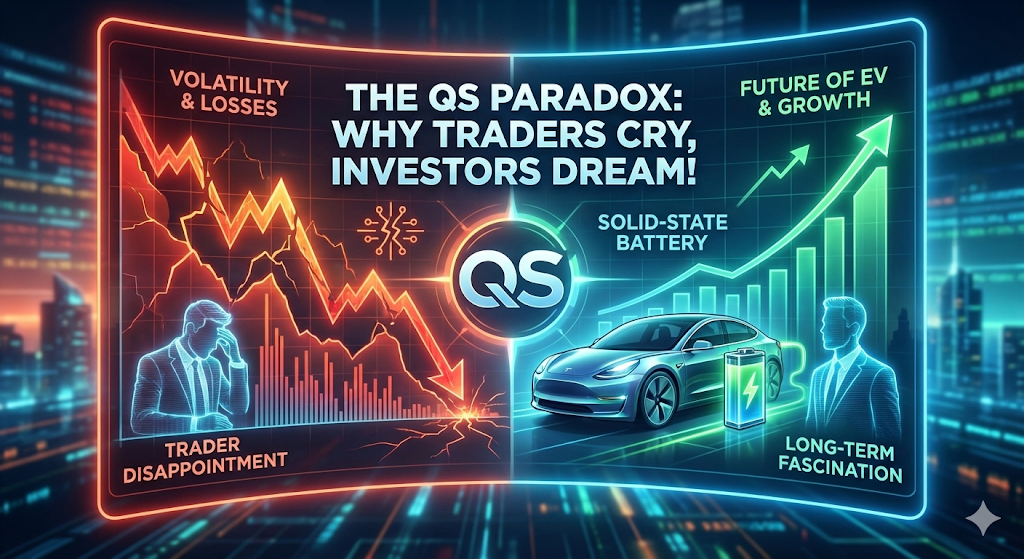
Short-term price movements often obscure long-term transformational potential, especially in frontier technologies where disruption unfolds over years rather than quarters. That reality is playing out vividly in QuantumScape Corp, as the stock recently declined 3.92% in mid-day trading on January 13, sliding from $10.72 to an intraday low of $10.21 before stabilizing near $10.30. The pullback has pushed shares nearly 46% below their 52-week high of $19.07, even as the stock remains more than 200% above its 52-week low of $3.40. This sharp volatility has placed QS directly in the crosshairs of investors attempting to determine whether this represents a warning sign — or a generational buying opportunity.
At its core, QuantumScape represents one of the most ambitious technology bets in the entire electric vehicle ecosystem. While Wall Street analysts currently assign an average price target of $9.89 and maintain a consensus “Hold” rating, this near-term caution may be missing the massive structural transformation unfolding inside the company. In a sector dominated by incremental battery improvements, QuantumScape is pursuing a radical leap forward: commercializing solid-state lithium-metal batteries that promise to redefine range, charging speed, safety, durability, and long-term performance.
What makes this setup compelling is not short-term momentum, quarterly earnings, or technical indicators. The true investment thesis for QS revolves around whether the company succeeds in delivering a breakthrough battery platform that could reshape the economics and performance profile of electric vehicles for decades to come. If successful, today’s valuation could look almost absurdly small in hindsight.
CHECK THIS OUT: The Quiet Semiconductor Disruptor You’ve Never Heard Of: Aeluma Inc (ALMU) and Air Industries Group (AIRI) Narrows Losses to Just $44K — Is This Aerospace Microcap Entering a Turnaround Phase?
The Structural Weakness of Traditional Lithium-Ion Batteries and the Market Opportunity for Disruption
The global electric vehicle market continues to scale at an extraordinary pace, but battery limitations remain the single biggest obstacle to widespread adoption. Despite massive advances in lithium-ion technology, modern EVs still face constraints related to energy density, charging time, thermal instability, degradation, cost, and safety. These weaknesses are not minor inconveniences. They directly influence vehicle price, driving range, charging infrastructure demands, consumer confidence, and manufacturer margins.
Traditional lithium-ion cells rely on liquid electrolytes, which introduce inherent fire risks, thermal runaway potential, and chemical instability. These structural weaknesses limit how aggressively manufacturers can push energy density, charging speed, and long-term durability. As a result, the industry is rapidly approaching diminishing returns on conventional battery chemistry improvements.
This is where QuantumScape enters the equation. The company’s solid-state lithium-metal battery architecture replaces flammable liquid electrolytes with a proprietary solid ceramic separator, enabling the use of a lithium-metal anode. This fundamental design change unlocks a cascade of performance advantages that are impossible within conventional battery frameworks. Higher energy density allows vehicles to travel significantly farther per charge. Faster charging becomes achievable without accelerated degradation. Safety improves dramatically due to the elimination of flammable liquid electrolytes. Cycle life extends, supporting longer battery warranties and higher residual vehicle values.
In practical terms, this means electric vehicles could become cheaper, safer, lighter, faster-charging, and longer-range simultaneously. No incremental improvement in lithium-ion chemistry can deliver that combination. Only a platform-level technological leap can.
Why Solid-State Battery Technology Could Reshape the Entire EV Landscape
Solid-state batteries have long been viewed as the holy grail of energy storage, but technical complexity has kept commercialization elusive. The challenge lies in engineering a solid electrolyte capable of preventing dendrite formation, enabling fast ion transport, maintaining mechanical stability, and supporting mass manufacturing at competitive cost.
QuantumScape claims to have cracked that code. The company’s proprietary ceramic separator allows lithium-metal anodes to operate safely and efficiently, removing the need for traditional graphite or silicon-based materials. This unlocks energy density improvements exceeding 80% over conventional lithium-ion cells while simultaneously improving safety, charging speed, and longevity.
In laboratory testing, QuantumScape’s cells have demonstrated the ability to charge from 10% to 80% in under 15 minutes, operate safely across wide temperature ranges, and maintain performance after hundreds of high-stress charge cycles. If these results scale into commercial production, the implications would be monumental.
Automakers would be able to design lighter vehicles with longer range, smaller battery packs, and lower material costs. Charging infrastructure could become dramatically more efficient, easing grid strain and reducing capital expenditure. Consumers would gain vehicles that feel fundamentally different — faster charging, longer driving range, safer operation, and improved longevity.
This is why solid-state technology is considered the next evolutionary step in battery development, and why companies that successfully commercialize it could command extraordinary strategic value.
Why Wall Street’s Skepticism May Be the Market’s Biggest Blind Spot
Despite this massive opportunity, Wall Street remains cautious. Analyst consensus targets currently imply minimal upside, with some bearish estimates extending as low as $2.50 per share. This skepticism stems primarily from execution risk, manufacturing scale uncertainty, and long commercialization timelines.
However, this conservative stance may actually create one of the most asymmetric investment profiles in the market today. The downside scenario for QS is well understood: technical hurdles delay commercialization, competitors advance faster, capital intensity rises, or manufacturing scalability falters. In such a case, shareholder dilution and valuation compression remain real risks.
But the upside scenario is far more profound. If QuantumScape successfully scales production and secures widespread automaker adoption, the company could become one of the most strategically important battery suppliers globally. Given the trillion-dollar size of the EV market, even modest penetration could translate into tens of billions in annual revenue.
This asymmetry — limited downside relative to potentially extraordinary upside — defines why QS remains one of the most compelling speculative technology investments available today.
Strategic Partnerships That De-Risk Commercialization
One of QuantumScape’s strongest advantages lies in its deep partnership with Volkswagen Group, one of the largest automakers in the world. Through its battery subsidiary PowerCo, Volkswagen has committed capital, engineering resources, and long-term manufacturing collaboration to help bring QuantumScape’s technology to market.
This partnership is not symbolic. Volkswagen’s involvement significantly reduces commercialization risk by providing industrial-scale manufacturing expertise, real-world automotive validation, and direct pathways to mass adoption. PowerCo’s gigafactory ambitions create a direct route for QuantumScape’s technology to move from laboratory success into mass production.
Beyond Volkswagen, QuantumScape continues to expand relationships across the automotive industry, positioning itself as a platform supplier rather than a niche technology provider. As solid-state batteries move closer to commercialization, competition among automakers to secure supply could further strengthen QS’s negotiating leverage.
Why Near-Term Stock Volatility Is Strategically Irrelevant
The recent 3.92% decline in QuantumScape shares illustrates a broader truth about frontier technology investing: short-term stock movements are often disconnected from long-term value creation. Macro uncertainty, interest rate volatility, and algorithmic trading flows frequently dominate price action in speculative growth stocks, particularly pre-revenue companies.
For investors focused on transformational technology shifts, such volatility creates opportunity rather than risk. Every pullback compresses valuation while leaving the core technological thesis unchanged. In fact, periods of pessimism often offer the highest expected returns for those with sufficient patience and conviction.
QuantumScape’s share price currently reflects widespread skepticism rather than fundamental failure. Development milestones continue to advance. Engineering validation continues to progress. Manufacturing pilot lines remain under construction. Each incremental achievement slowly reduces execution risk — yet the stock price continues to discount failure.
This divergence between technological progress and market valuation is precisely what long-term investors seek.
Manufacturing Scale as the Final Frontier
The single greatest challenge facing QuantumScape is manufacturing scale. Producing small quantities of high-performance solid-state cells is fundamentally different from producing millions of automotive-grade batteries at high yield, low defect rates, and competitive cost.
QuantumScape’s development roadmap focuses heavily on engineering breakthroughs that enable scalable manufacturing. These include high-throughput separator production, multilayer cell stacking, uniform ceramic deposition, and cost-optimized assembly techniques. Each milestone reduces production complexity and improves economic viability.
As these processes mature, manufacturing risk declines and investor confidence should rise. This transition phase — when technological validation converges with industrial scalability — often represents the most explosive period of valuation expansion.
Why the Long-Term Total Addressable Market Could Be Enormous
While electric vehicles represent the immediate focus, solid-state batteries possess applications far beyond automotive use. Grid-scale energy storage, aerospace systems, robotics, defense platforms, portable electronics, and industrial power solutions all benefit from higher energy density, improved safety, and longer lifecycle performance.
If QuantumScape succeeds, its technology platform could underpin an entire ecosystem of energy storage applications. This dramatically expands the company’s long-term revenue potential and strategic importance across multiple industries.
When viewed through this lens, QS is not simply an EV battery supplier. It is a foundational energy technology company operating at the core of electrification, decarbonization, and digital infrastructure.
The Psychological Advantage of Extreme Skepticism
One of the most powerful forces in investing is narrative psychology. When expectations are low, incremental progress delivers outsized valuation impact. When expectations are high, even success can disappoint.
QuantumScape currently benefits from extremely low expectations. Analyst ratings remain cautious. Price targets cluster near current levels. Media coverage often highlights risks over breakthroughs. This pessimism creates fertile ground for positive surprises.
Each production milestone, engineering breakthrough, customer partnership, or performance validation has the potential to reset expectations upward, driving substantial repricing.
Final Thoughts: Why QuantumScape Could Define the Next Era of Energy Storage
QuantumScape represents a rare convergence of visionary technology, massive market opportunity, strategic partnerships, and asymmetric return potential. While risks remain substantial, the company is pursuing a technological breakthrough that could fundamentally reshape electric transportation and energy storage.
The recent stock pullback and bearish analyst sentiment should not obscure the magnitude of what QuantumScape is attempting to achieve. If successful, QS could emerge as one of the most important industrial technology companies of the next decade.
For investors capable of enduring volatility, embracing uncertainty, and thinking in multi-year horizons, QuantumScape offers one of the most compelling high-upside opportunities in the public markets today.
READ ALSO: Vuzix Corp (VUZI) Could Be the Dark Horse of Augmented Reality as Defense Contracts & Enterprise Adoption Accelerate and Almonty Industries (ALM) Is Quietly Becoming a Tungsten Powerhouse.