It started as a response to a growing frustration that many internet users and creators were beginning to feel, a sense that the modern web was becoming more centralized, more restrictive, and less aligned with the original promise of open expression and user empowerment. As major platforms grew larger, they also became more opaque, more algorithmically controlled, and more selective about what content and which voices were allowed to thrive. In that environment, the idea of building a platform rooted in transparency, independence, and creator control stopped being a philosophical debate and started becoming a business opportunity.
Rumble Inc. was founded with that exact premise in mind, to create a video and media platform that prioritized free expression, creator rights, and platform neutrality while still operating as a scalable, commercially viable technology business. Unlike traditional social media companies that built their ecosystems around advertiser preferences and centralized moderation, Rumble positioned itself as a creator-first platform that allowed users to distribute, monetize, and grow audiences without fear of sudden demonetization, shadow banning, or opaque policy enforcement. This positioning quickly resonated with independent journalists, political commentators, educators, long-form content creators, and communities seeking alternatives to dominant tech platforms.
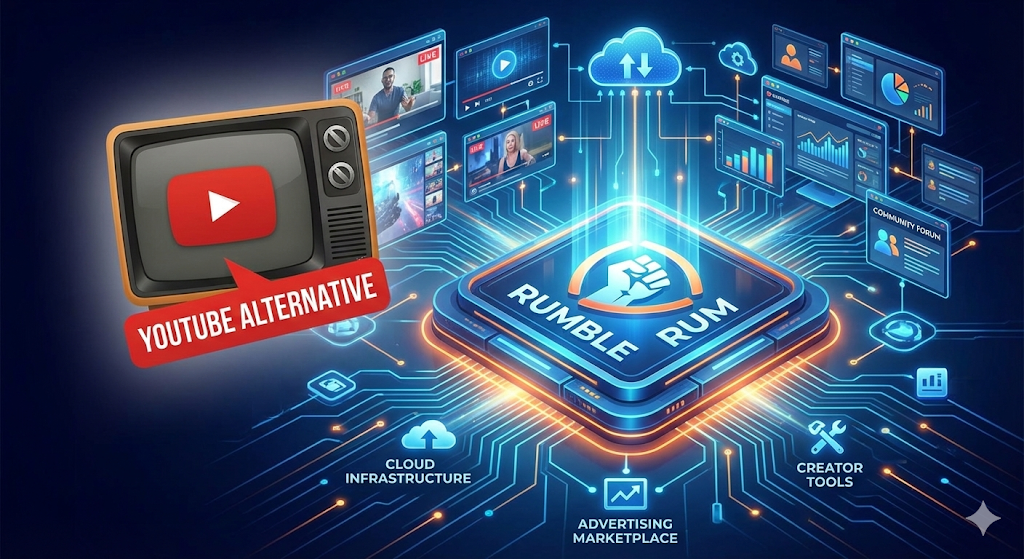
Over time, Rumble evolved beyond being just an alternative video site into a broader digital media and infrastructure company. The platform expanded its technology stack, built its own cloud services, invested in AI-driven content discovery, and developed proprietary tools to manage hosting, distribution, and monetization internally. This vertical integration reduced reliance on external infrastructure providers, improved cost control, and strengthened Rumble’s ability to scale independently. The company began to resemble not only a social media platform, but a digital infrastructure provider for the next generation of independent creators and publishers.
Rumble’s growth also coincided with the expansion of the global creator economy, where individuals increasingly sought direct relationships with audiences rather than relying on intermediaries. This shift toward subscriptions, memberships, tips, and direct audience support aligned naturally with Rumble’s core philosophy. As the creator economy matured, Rumble positioned itself not just as a discovery platform, but as a financial and operational backbone for creators who wanted to own their content, control their monetization, and maintain independence from centralized gatekeepers.
The company’s expansion into cloud infrastructure further differentiated Rumble from competitors. By offering cloud hosting and enterprise-grade infrastructure services, Rumble created an additional revenue stream while also strengthening its own operational resilience. This move positioned Rumble as a hybrid between a media platform, a technology provider, and an infrastructure company, allowing it to benefit from multiple secular trends including cloud computing growth, digital content consumption, and decentralized platform adoption.
Rumble’s leadership consistently framed the company as part of a broader movement toward decentralization, digital sovereignty, and platform neutrality. This narrative became increasingly relevant as debates around censorship, algorithmic control, data ownership, and platform power intensified globally. Rumble’s appeal was not limited to political or ideological communities, but extended to creators, entrepreneurs, and users who valued transparency, independence, and direct monetization.
As digital platforms increasingly merged with financial services, Rumble continued to expand its ecosystem to support this convergence. By integrating payments, subscriptions, digital wallets, and eventually crypto-based transactions, Rumble moved closer to becoming a full-stack digital economy platform. This evolution reflects a broader transformation in how online platforms function, shifting from pure content distribution toward integrated economic systems that facilitate commerce, payments, identity, and community.
Today, Rumble operates at the intersection of social media, digital infrastructure, financial technology, and the creator economy. It is no longer just an alternative to legacy platforms, but a parallel system built to support a more decentralized and user-controlled version of the internet. Rumble’s background is defined not by a single product or political moment, but by a long-term strategy to build a platform where creators own their audiences, users own their data, and economic participation is not controlled by centralized intermediaries.
That foundation, built over years of technological investment, community growth, and strategic expansion, is what gives Rumble its unique positioning in the digital economy. It is a company shaped by the structural shifts happening across media, finance, and technology, and its background reflects the convergence of those trends into a single platform designed for independence, scale, and long-term relevance.
Rumble’s Evolution From Video Platform to Financial Infrastructure
Rumble Inc. has spent the last few years positioning itself not merely as an alternative video platform, but as a parallel digital ecosystem built around creator sovereignty, decentralized infrastructure, and financial independence. What began as a free speech-oriented alternative to legacy social media platforms has steadily transformed into a vertically integrated technology company that controls not only distribution, but monetization, hosting, payments, and now financial rails.
The launch of Rumble Wallet represents a pivotal moment in this evolution. By enabling creators and users to send, receive, and store cryptocurrency directly on the platform without relying on banks or third-party processors, Rumble is effectively internalizing the creator economy’s payment layer. This matters because in digital platforms, control over payments is power. Whoever controls the payment rails controls access, censorship risk, fees, friction, and ultimately creator loyalty.
By introducing native crypto payments through stablecoins and Bitcoin, Rumble is shifting from being a destination for content to becoming an operating system for independent digital commerce. That distinction dramatically expands its addressable market beyond advertising into subscriptions, tips, microtransactions, cross-border payments, and Web3 commerce.
CHECK THIS OUT: Why Nebius (NBIS) Could Outperform CoreWeave & Dominate the $9B AI Infrastructure Market and Is Lucid Group (LCID) Running Out of Cash? $875M Note Deal Raises Alarms.
Why Rumble Wallet Changes the Economics of the Creator Economy
The core value proposition of Rumble Wallet is not crypto speculation. It is transactional sovereignty.
For creators, getting paid is often harder than creating. Payment processors impose fees, delays, geographic restrictions, compliance shutdowns, and opaque moderation rules that can cut off income overnight. Rumble Wallet removes that dependency. A creator can now receive funds directly from viewers in stablecoins or Bitcoin instantly, globally, without banking intermediaries.
This is a fundamental shift in platform economics. It allows Rumble to monetize not only through advertising but through transaction volume, wallet activity, premium services, and future financial products layered on top of the wallet infrastructure. It also increases creator stickiness. A creator who builds income streams directly inside Rumble’s ecosystem becomes far less likely to migrate elsewhere.
This directly aligns with secular trends in the creator economy where individuals are moving away from algorithm-dependent monetization toward direct audience relationships. Rumble Wallet turns that relationship into an on-platform financial loop.
Strategic Alignment With Decentralization and Free Speech
Rumble’s brand has always been built on resistance to centralized moderation and censorship. The integration of decentralized payments is not a gimmick, it is a philosophical extension of the company’s mission.
Free expression on the internet is meaningless if financial access can be silently revoked. Rumble’s leadership understands that content censorship and financial censorship are functionally the same. By building its own payment infrastructure, Rumble insulates creators from deplatforming risks that exist not just socially, but financially.
This positions Rumble uniquely as not just a social media company, but a digital rights infrastructure company. That narrative has powerful resonance in a world increasingly concerned about speech restrictions, platform power, and centralized control.
Monetization Beyond Advertising
Advertising is cyclical, sensitive to macro slowdowns, and heavily dominated by incumbents like Google and Meta. Rumble’s long-term upside comes from escaping pure advertising dependence.
Rumble Wallet introduces transaction-based revenue, subscription-based revenue, and future financial services revenue. Even small transaction fees on millions of micro-payments can compound into meaningful high-margin revenue streams. Stablecoin flows, creator tips, memberships, premium features, and eventually lending, staking, or escrow services could all be layered into the ecosystem.
This shifts Rumble from a media company into a fintech-enabled platform business, which typically commands higher multiples due to revenue diversification and stronger network effects.
AI, Infrastructure, and the Next Phase of Platform Scaling
Rumble has also been quietly building infrastructure through cloud services and AI-powered discovery. This gives the company control over its own hosting stack, reduces reliance on hyperscalers, and creates opportunities to sell enterprise infrastructure services externally.
AI enhances content discovery, personalization, and monetization efficiency. Combined with Rumble Wallet, AI becomes a revenue optimization engine that connects the right content to the right users and then enables instant monetization without friction.
The result is a vertically integrated creator economy platform where discovery, hosting, monetization, and payment all live inside one system.
The Market Is Underpricing Rumble’s Optionality
At its current market valuation, Rumble is still largely being priced as a niche video platform with political baggage and modest ad revenue. That framing ignores the optionality embedded in its infrastructure strategy.
Rumble is building payment rails, cloud infrastructure, AI discovery, subscription systems, and decentralized financial access. Each of these on its own could justify significant valuation. Together, they form a multi-layered platform with asymmetric upside.
The launch of Rumble Wallet is not about today’s revenue. It is about future optionality. It opens doors to Web3 commerce, creator finance, global remittances, decentralized subscriptions, and financial services that traditional platforms cannot or will not offer.
Why This Matters Now
Timing matters. The global regulatory environment is shifting toward crypto normalization. Stablecoins are being embraced for payments. Bitcoin is being institutionalized. Creators are seeking independence. Users are fatigued by centralized platforms. Governments are debating censorship. Payment processors are increasingly politicized.
Rumble sits at the intersection of all these trends.
It offers a censorship-resistant platform, a decentralized payment layer, creator-first economics, AI discovery, and infrastructure independence. That combination is rare and difficult to replicate.
Final Thought
Rumble is no longer just competing with YouTube. It is competing with the entire centralized internet model.
Rumble Wallet is not a feature. It is a structural shift. It transforms Rumble from a content platform into a digital economic ecosystem. That shift expands its total addressable market, strengthens its moat, increases creator loyalty, diversifies revenue, and aligns it with the most powerful technological and social trends of the next decade.
For investors, this creates a classic asymmetric bet. The downside is defined by the current valuation as a niche media platform. The upside is defined by the possibility that Rumble becomes the financial and content backbone of a decentralized creator economy.
That is not priced in. That is why Rumble Inc. remains a compelling long-term bullish thesis.
READ ALSO: Above Food (ABVE) to Issue 1.1 Billion New Shares in Merger and Perpetua Resources (PPTA) Soars 171% as U.S. Approves $1.3B Gold-Antimony Mine.