For more than a century, one of the world’s most influential resource companies has been quietly shaping the physical foundations of modern civilization, supplying the raw materials that make cities rise, industries function, and economies expand. From the earliest days of industrialization to today’s digital and electrified economy, this enterprise has evolved alongside global development itself, moving from a traditional mining business into a diversified supplier of essential commodities that power infrastructure, manufacturing, technology, and the global energy system. Its history mirrors the story of globalization, industrial growth, and technological transformation, positioning it as one of the most enduring and strategically important companies in the global mining industry.
Rio Tinto (NYSE:RIO) traces its origins back to the late nineteenth century, when it emerged from early mining operations in Europe and gradually expanded across continents, acquiring and developing mineral assets that would later form one of the world’s largest and most valuable mining portfolios. Over decades of expansion, Rio Tinto became a pioneer in large-scale mining, logistics, and mineral processing, building integrated operations that could move enormous volumes of iron ore, aluminum, copper, and other industrial metals from remote regions to global markets. This operational scale allowed Rio Tinto to serve as a foundational supplier to steelmakers, manufacturers, construction companies, and governments across the world, embedding the company deeply into the global supply chain.
As the world economy became more interconnected, Rio Tinto’s international footprint expanded to match it. The company developed major operations in Australia, North America, South America, Africa, and Asia, transforming itself into a truly global mining company with exposure to multiple commodities, currencies, and demand centers. This geographic diversification reduced reliance on any single market while giving Rio Tinto privileged access to some of the highest-quality mineral deposits ever discovered. Over time, this strategy positioned Rio Tinto not only as a leading iron ore producer but also as a major player in copper, aluminum, lithium, and other industrial and battery metals critical to modern economic activity.
Throughout the twentieth and early twenty-first centuries, Rio Tinto consistently reinvested in technology, automation, and infrastructure to improve efficiency and safety while lowering production costs. This focus on operational excellence enabled Rio Tinto to remain competitive through multiple commodity cycles, from post-war industrial booms to the rise of China as a manufacturing superpower and, more recently, the acceleration of renewable energy, electric vehicles, and digital infrastructure. As demand shifted from traditional industrial uses toward electrification, clean energy, and artificial intelligence, Rio Tinto gradually repositioned its asset base to reflect these emerging structural trends, increasing its exposure to copper demand, battery metals, and energy transition materials.
Rio Tinto’s evolution from a conventional mining company into a diversified supplier of strategic resources reflects a broader shift in how commodities are perceived by governments, investors, and industries. Metals are no longer viewed simply as inputs for construction and manufacturing, but as critical enablers of technological progress, national security, and economic resilience. This shift has elevated the importance of companies like Rio Tinto, whose assets now sit at the center of electrification, data center expansion, defense infrastructure, and global decarbonization efforts. As a result, Rio Tinto’s role in the global economy has become more strategic, not less, even as its operations have become more disciplined and capital-efficient.
Over its long history, Rio Tinto has weathered wars, recessions, regulatory changes, political shifts, and technological disruption, yet it has remained a central player in global industrial development. This resilience is rooted in the company’s ability to adapt its portfolio, management structure, and strategic focus in response to changing economic realities. Today, Rio Tinto stands not merely as a miner, but as a cornerstone supplier to the industries that define modern life, from urban infrastructure and manufacturing to renewable energy, electric transportation, and digital networks.
In this sense, the story of Rio Tinto is not just the story of a mining company, but the story of how raw materials underpin progress itself. From steel that builds cities to copper that powers grids and data centers, and lithium that enables the battery revolution, Rio Tinto’s history reflects the evolving needs of the global economy. As the world enters a new era defined by electrification, artificial intelligence, and sustainability, Rio Tinto’s long-standing expertise, asset base, and global reach position it as one of the most important industrial companies of the modern age.
Rio Tinto Is Quietly Positioning Itself to Become the Most Important Mining Company of the Next Industrial Era
Few companies sit as centrally at the intersection of infrastructure, industrialization, energy transition, artificial intelligence, and global electrification as Rio Tinto plc. While many investors still think of Rio Tinto primarily as the world’s largest iron ore producer, the company has been systematically transforming itself into a diversified supplier of the world’s most strategically critical raw materials. Iron ore, copper, aluminum, lithium, and other industrial metals now form the backbone of a business that is increasingly aligned not just with traditional construction and manufacturing, but with the structural growth themes that will define the global economy for decades.
As governments invest trillions into power grids, renewable energy, electric vehicles, data centers, defense systems, and semiconductor infrastructure, demand for industrial metals is rising at a pace that traditional supply models cannot easily meet. This is especially true for copper, which is essential for electrification, and lithium, which is central to battery storage and EV adoption. In this environment, scale, asset quality, geopolitical diversification, and capital discipline matter more than ever. Rio Tinto has all four.
The company’s transformation has accelerated since the leadership change in 2024 and 2025, when management began focusing on operational discipline, portfolio simplification, and capital efficiency while doubling down on metals with structural demand growth. That shift is now being recognized by the market, as evidenced by the strong performance of Rio Tinto shares through late 2025 and early 2026. Yet the recent confirmation of buyout talks with Glencore adds a new layer of strategic optionality that could dramatically reshape Rio Tinto’s role in the global mining industry.
CHECK THIS OUT: The Quiet Semiconductor Disruptor You’ve Never Heard Of: Aeluma Inc (ALMU) and Air Industries Group (AIRI) Narrows Losses to Just $44K — Is This Aerospace Microcap Entering a Turnaround Phase?
The Glencore Buyout Talks Signal Strategic Ambition, Not Desperation
The confirmation that Rio Tinto and Glencore are in early-stage talks about a potential combination is being framed by some as a risky move or an unnecessary distraction. In reality, it is a signal of strategic confidence. Rio Tinto is not seeking a merger because it is weak or stagnating. It is exploring a merger because the mining industry is entering a period where scale, resource concentration, and supply security will increasingly determine pricing power and profitability.
If Rio Tinto were to acquire Glencore through an all-share deal, the combined company would become the world’s largest mining company by market capitalization, surpassing BHP and creating a global resource powerhouse valued at roughly $207 billion. This would dramatically increase Rio Tinto’s exposure to copper, nickel, cobalt, and other base metals that are central to the energy transition and defense sectors. It would also strengthen Rio’s trading, marketing, and logistics capabilities through Glencore’s globally integrated commercial network.
The market’s initial reaction, with Rio Tinto shares dipping while Glencore shares surged, reflects short-term concerns about deal pricing rather than long-term strategic value. That is normal in early merger discussions. What matters more is that Rio Tinto now has the balance sheet, credibility, and strategic clarity to consider a deal of this magnitude. The company is not being forced into consolidation. It is choosing to explore it because the future mining landscape will reward those who control the most scarce and strategically important assets.
Moreover, Rio Tinto’s leadership has changed in ways that make disciplined deal-making more likely. Under CEO Simon Trott, the company has become more operationally lean, more financially conservative, and more focused on extracting value from core assets. This is precisely the mindset required to evaluate a complex transaction like Glencore without destroying shareholder value.
The Glencore talks therefore should not be viewed as a gamble, but as an option. They give Rio Tinto strategic flexibility. If the terms are attractive, Rio Tinto can dramatically accelerate its repositioning toward future-facing metals. If the terms are not attractive, Rio can walk away and continue executing on its already strong organic growth pipeline.
Copper Is Becoming the New Oil and Rio Tinto Is Building a Dominant Position
Copper is rapidly becoming one of the most important industrial commodities in the world. Electrification requires copper in almost every component of the modern energy system. Power grids, wind turbines, solar farms, electric vehicles, battery systems, data centers, and military hardware all rely heavily on copper. Artificial intelligence further intensifies this trend because data centers are extremely power-hungry and require massive electrical infrastructure.
S&P Global estimates that global copper demand could rise by roughly 50 percent by 2040, driven by electrification, AI, and defense spending. At the same time, new copper supply is struggling to keep up. Ore grades are declining, permitting timelines are lengthening, geopolitical risks are increasing, and environmental standards are becoming stricter. This creates a structural imbalance that favors existing large-scale producers with high-quality assets.
Rio Tinto already owns some of the most important copper assets in the world, including Oyu Tolgoi in Mongolia, which is one of the largest and most valuable copper mines ever developed. The company continues to invest heavily in expanding copper production while maintaining strict capital discipline. A potential combination with Glencore would further cement Rio Tinto’s leadership in copper and related base metals, making it one of the most important suppliers of electrification metals globally.
This is not a short-term trade. It is a long-term positioning strategy. Investors who view Rio Tinto stock purely as an iron ore proxy are missing the bigger picture. Rio Tinto is quietly becoming one of the most important infrastructure companies in the world, even though it does not build roads, power plants, or data centers directly. It supplies the materials without which those projects cannot exist.
Iron Ore Remains a Cash Engine That Funds the Future
While the narrative increasingly focuses on copper and lithium, iron ore remains the financial backbone of Rio Tinto. Steel remains essential for construction, transportation, infrastructure, and industrial manufacturing. Urbanization in emerging markets, infrastructure renewal in developed economies, and defense spending all require massive volumes of steel.
Rio Tinto’s iron ore assets in Western Australia are among the lowest-cost and highest-quality in the world. This allows the company to generate enormous free cash flow even during periods of moderate commodity prices. That cash flow funds dividends, share buybacks, debt reduction, and reinvestment into growth metals like copper and lithium.
In this sense, iron ore is not a weakness but a stabilizer. It gives Rio Tinto resilience across commodity cycles and reduces the company’s reliance on any single future trend. It also gives management flexibility. Rio does not need to issue equity or over-leverage its balance sheet to invest in growth. It can self-fund much of its transformation.
Lithium and Battery Metals Add Another Layer of Structural Growth
Electric vehicles, grid-scale battery storage, and renewable energy integration all depend on lithium and related battery metals. Rio Tinto has been steadily building exposure to lithium through projects and partnerships, recognizing that battery supply chains are becoming as strategically important as oil supply chains once were.
As governments prioritize domestic supply security for critical minerals, companies like Rio Tinto that can operate responsibly across multiple jurisdictions will be increasingly favored partners. This creates not only revenue opportunities but also political and strategic relevance, which can translate into preferential access to projects, permits, and partnerships.
Valuation Still Does Not Fully Reflect the Strategic Shift
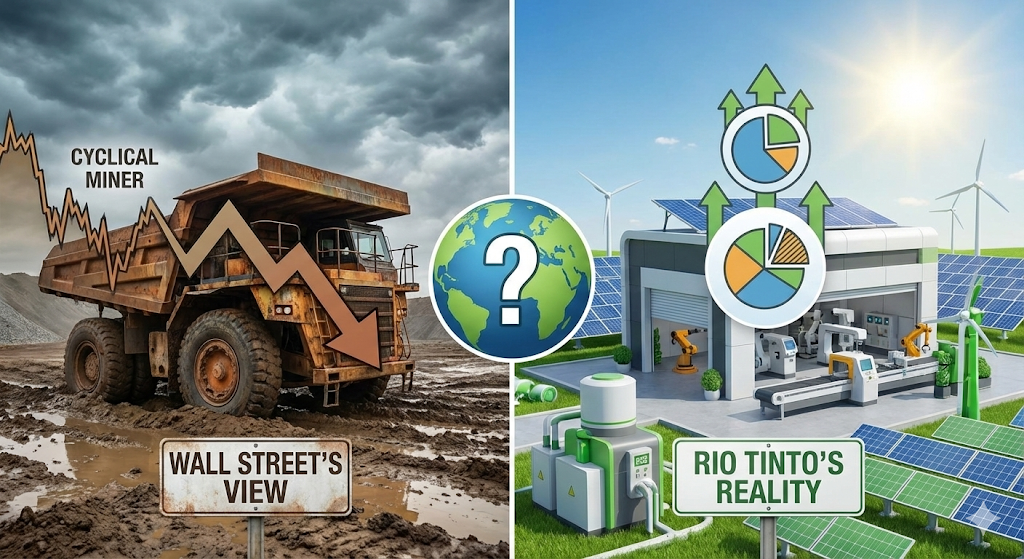
Despite its scale, cash generation, and exposure to long-term growth trends, Rio Tinto stock is still often valued like a cyclical commodity producer rather than a strategic infrastructure supplier. This creates an opportunity for long-term investors.
As the market increasingly recognizes that copper, lithium, and electrification metals are not just cyclical commodities but foundational inputs for the digital, green, and defense economies, valuation frameworks may shift. Multiples may expand, not just because earnings grow, but because the perceived stability and strategic importance of those earnings increases.
The Glencore talks, regardless of whether they lead to a deal, contribute to this re-rating narrative. They signal that the industry is entering a new phase of consolidation around critical resources, and Rio Tinto is positioning itself at the center of that consolidation rather than reacting to it.
Why the Long-Term Bullish Case Remains Intact
The bullish thesis for Rio Tinto is not based on a single commodity price, a single project, or a single deal. It is based on a structural alignment between what the world increasingly needs and what Rio Tinto increasingly produces.
The world needs more electricity, more infrastructure, more computing power, more defense capability, and more energy security. All of these require enormous quantities of industrial metals. Rio Tinto owns and operates some of the most valuable, long-life, low-cost metal assets on the planet. It is financially strong, operationally disciplined, and strategically aware.
The potential Glencore transaction adds upside optionality, not downside inevitability. If executed well, it could accelerate Rio Tinto’s transformation into the world’s most important supplier of future-critical metals. If not executed, Rio remains extremely well positioned to grow organically and return capital to shareholders.
For long-term investors looking for exposure to electrification, energy transition, artificial intelligence infrastructure, and global industrial growth, Rio Tinto is increasingly not just a mining stock, but a strategic asset.
In that sense, the bullish case for Rio Tinto is not that it will benefit from the next commodity cycle, but that it is becoming indispensable to the next economic cycle.
READ ALSO: Vuzix Corp (VUZI) Could Be the Dark Horse of Augmented Reality as Defense Contracts & Enterprise Adoption Accelerate and Almonty Industries (ALM) Is Quietly Becoming a Tungsten Powerhouse.