Born out of the belief that auto insurance pricing had grown disconnected from how people actually drive, a new kind of insurer emerged in the mid-2010s with the ambition of rebuilding the industry around data, fairness, and mobile technology. Instead of relying on traditional proxies such as age, ZIP code, or credit history, the company was designed from day one to use smartphone telematics, artificial intelligence, and behavioral analytics to directly measure driving risk. This founding vision positioned the business squarely within the fast-growing insurtech movement, promising a digital-first experience, personalized auto insurance quotes, and lower premiums for safe drivers through usage-based insurance models powered by real-time data.
Root Inc. (NYSE:ROOT) was established in 2015 and headquartered in Columbus, Ohio, at a time when venture capital was flowing aggressively into financial technology startups seeking to disrupt legacy incumbents. From its earliest days, the company framed itself not as a traditional auto insurer, but as a technology platform built to modernize underwriting through machine learning and mobile data collection. By asking prospective customers to complete a driving test using a smartphone app, the business sought to build proprietary risk profiles that could more accurately price auto insurance policies, reduce adverse selection, and realign incentives between insurers and policyholders. This emphasis on telematics-based insurance quickly became central to its brand identity and investor narrative.
As the company scaled, Root Insurance expanded its operations across multiple U.S. states, navigating the complex, state-by-state regulatory environment that governs auto insurance in the United States. The firm emphasized a fully digital customer journey, allowing users to receive personalized auto insurance quotes, purchase policies, manage coverage, and file claims directly through mobile and web platforms. This end-to-end digital approach differentiated Root from legacy carriers that relied heavily on agents and call centers, reinforcing its positioning as a next-generation auto insurance provider aligned with changing consumer expectations around convenience and transparency.
The broader market environment initially proved receptive to this message. As artificial intelligence, big data, and fintech became dominant investment themes, Root Inc. attracted significant venture funding and public market attention by presenting itself as a data science company operating within insurance rather than a conventional insurer experimenting with technology. Its marketing emphasized fairness, behavioral pricing, and the idea that good drivers should no longer subsidize bad ones, a message that resonated with younger, mobile-first consumers and early adopters of usage-based insurance programs.
Over time, the company continued to refine its technology stack, underwriting models, and distribution strategy, positioning itself within the expanding ecosystem of digital financial services. Root Insurance explored partnerships, embedded insurance opportunities, and integrations with other fintech platforms as part of its effort to meet customers where they already manage their finances. These initiatives aligned with broader trends in embedded finance, AI-driven pricing, and personalized financial products, reinforcing the company’s identity as an insurtech innovator rather than a traditional auto insurance carrier.
Throughout its evolution, Root Inc. has remained closely associated with key insurtech keywords such as telematics insurance, AI insurance pricing, digital auto insurance, and usage-based auto insurance. Its story reflects both the optimism and ambition of a sector that believes technology can fundamentally improve risk assessment and consumer outcomes. From its origins as a startup challenging long-standing industry norms to its current role as a publicly traded technology-driven insurer, the company’s background is deeply intertwined with the broader effort to modernize auto insurance through data, automation, and mobile-first design.
Root Inc.’s Vision of Embedded Insurance Still Faces the Same Old Structural Problems
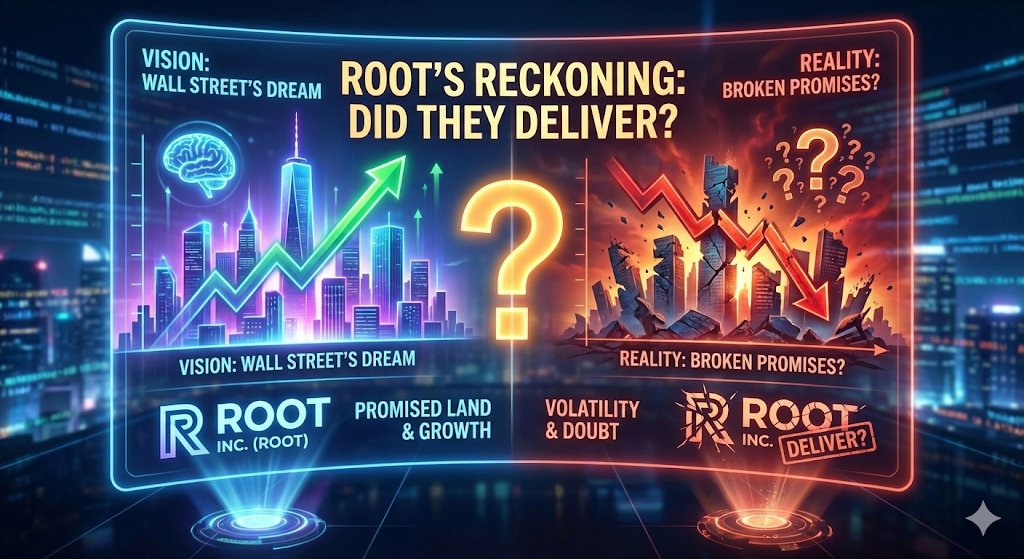
Root Inc. has long positioned itself as a technology-first auto insurance company built to disrupt a legacy industry through artificial intelligence, mobile telematics, and data-driven pricing. From its earliest days, the company argued that traditional auto insurers relied on outdated proxies such as credit scores and demographics, while Root would price risk more fairly by directly measuring how people drive. This promise of smarter underwriting, lower premiums for safe drivers, and a fully digital customer experience helped Root gain attention during the peak of the insurtech boom and eventually propelled it into the public markets.
Yet years after its debut, the fundamental question surrounding Root Inc. remains unresolved. Can a narrow, telematics-first auto insurer consistently generate profitable underwriting results in one of the most competitive and capital-intensive industries in the economy. Despite repeated strategic shifts, cost reductions, and renewed emphasis on discipline, Root continues to operate under structural constraints that technology partnerships and distribution integrations have so far failed to overcome.
CHECK THIS OUT: The Quiet Semiconductor Disruptor You’ve Never Heard Of: Aeluma Inc (ALMU) and Air Industries Group (AIRI) Narrows Losses to Just $44K — Is This Aerospace Microcap Entering a Turnaround Phase?
The Kikoff Partnership Highlights Distribution Creativity but Not Economic Breakthrough
In January 2026, Root Insurance announced a partnership with Kikoff, a personal finance platform that uses artificial intelligence to help users build credit, manage debt, and improve financial health. The collaboration embeds Root’s auto insurance quoting and purchasing flow directly into the Kikoff app, allowing users to receive personalized insurance quotes without leaving the platform. Management framed the deal as a way to simplify insurance decisions, reduce recurring expenses, and align Root’s dynamic pricing with Kikoff’s mission of financial empowerment.
From a surface-level perspective, the partnership fits neatly into current fintech and insurtech trends. Embedded insurance, in which coverage is offered seamlessly within another digital ecosystem, is widely viewed as a growth opportunity. Root’s leadership emphasized convenience, personalization, and lower premiums for safe drivers, while Kikoff’s executives highlighted access to more affordable financial products for users focused on improving their credit profiles.
However, from a bearish standpoint, the Kikoff partnership looks far more like a distribution experiment than a fundamental solution to Root’s long-standing economic challenges. Integrating insurance into a financial wellness app may improve quote flow and top-of-funnel visibility, but it does not change the underlying realities of auto insurance underwriting, claims severity, regulatory friction, or capital requirements. Root has pursued multiple distribution strategies over the years, and none have yet produced a durable, scalable underwriting advantage.
Embedded Insurance Does Not Eliminate Underwriting Risk
One of the persistent misconceptions in the insurtech space is that better distribution automatically leads to better economics. Root’s partnership with Kikoff may reduce friction in the purchasing process, but it does nothing to alter the fundamental risk profile of the policies being written. Auto insurance losses are driven by accident frequency, repair costs, medical inflation, litigation trends, and regulatory constraints, none of which are meaningfully improved by embedding quotes into a third-party app.
If anything, integrating into a credit-focused platform introduces additional risk. Kikoff’s user base consists largely of consumers actively working to improve their financial standing, a demographic that may be more price-sensitive and more likely to churn at renewal. Price sensitivity is already a major challenge in the auto insurance market, and Root lacks the bundling advantages and brand stickiness enjoyed by larger incumbents. Lower premiums may attract users initially, but they can also compress margins and exacerbate loss ratio volatility if pricing discipline slips.
Telematics and AI Pricing Are No Longer a Competitive Moat
Root continues to emphasize its AI-driven pricing and telematics capabilities as a core differentiator, and the Kikoff partnership leans heavily on this narrative. The companies describe dynamic pricing models that adapt to individual driving behavior rather than relying on static comparisons. While this sounds compelling from a marketing standpoint, it ignores how much the competitive landscape has evolved.
Usage-based insurance and telematics are now widely adopted across the industry. Large auto insurers deploy their own mobile apps, in-vehicle data sources, and sophisticated actuarial models backed by decades of claims history. These incumbents can test, iterate, and refine pricing models at scale while absorbing short-term volatility across diversified portfolios. Root, by contrast, remains heavily concentrated in auto insurance, making it far more vulnerable to adverse loss development.
As a result, Root’s technology advantage has steadily eroded. What was once framed as a revolutionary approach increasingly looks like table stakes in modern auto insurance. AI pricing alone has not delivered consistent underwriting profitability, and partnerships like Kikoff do not change that equation.
Customer Acquisition Efficiency Remains an Open Question
Root has historically struggled with customer acquisition costs relative to lifetime value, a problem that persists even as marketing strategies evolve. Embedding insurance into the Kikoff app may reduce direct advertising spend, but it does not guarantee higher-quality customers or longer retention periods. Auto insurance remains a highly competitive, price-driven product, and consumers frequently switch carriers when premiums increase or competitors offer discounts.
Retention challenges are especially problematic for a company without multi-line offerings. Incumbent insurers can bundle auto insurance with homeowners, renters, or life policies, increasing switching costs and improving customer lifetime value. Root lacks these levers, leaving it exposed to churn regardless of how seamlessly policies are purchased or managed through mobile integrations.
Capital Intensity Still Defines the Bear Case
No matter how modern the interface or how advanced the algorithms, insurance is ultimately a balance sheet business. Root must maintain adequate reserves, comply with regulatory capital requirements, and withstand periods of elevated claims costs. The company’s history of operating losses and capital raises underscores how difficult this has been.
The Kikoff partnership does not reduce Root’s capital intensity. If anything, successful distribution partnerships could require additional capital to support growth, particularly if underwriting results deteriorate or loss trends worsen. In a market environment that is far less forgiving of cash-burning models, reliance on external capital remains a significant risk for shareholders.
Management Messaging Has Shifted From Disruption to Survival
Another key element of the bearish thesis is the evolution of management tone. Early narratives centered on transforming auto insurance and creating a fundamentally fairer system. More recent communications emphasize discipline, simplification, and targeted growth. Partnerships like Kikoff are presented as incremental steps toward sustainability rather than bold breakthroughs.
This shift matters because it reflects lowered expectations. When a company transitions from promising industry disruption to focusing on marginal distribution improvements, it suggests that the original thesis has not played out as hoped. While management highlights alignment with financial wellness platforms and consumer empowerment, investors are left waiting for clear evidence of sustained underwriting profitability.
Valuation Reflects Unresolved Structural Risks
Root Inc. may appear inexpensive compared to its historical valuation, tempting contrarian investors searching for a turnaround. However, the discounted valuation reflects persistent uncertainty around the company’s business model. Without consistent improvements in loss ratios, retention economics, and capital efficiency, the stock’s low price is not necessarily a sign of undervaluation but rather a rational response to ongoing risk.
Distribution partnerships, including the Kikoff integration, may generate headlines and modest growth opportunities, but they do not address the core challenges that have plagued the company since its IPO. Until Root demonstrates that its AI-driven, telematics-based approach can deliver durable profitability through an entire underwriting cycle, skepticism is likely to dominate investor sentiment.
The Bearish Conclusion on Root Inc.
Root Inc.’s partnership with Kikoff underscores the company’s willingness to experiment with modern distribution and embedded insurance models. While the collaboration may improve convenience for users and align with broader fintech trends, it does not resolve the deeper structural issues facing the business. Auto insurance remains unforgiving, capital-intensive, and dominated by well-resourced incumbents that have already adopted similar technologies.
For bearish investors, the thesis remains intact. Telematics is no longer a moat, customer acquisition economics remain uncertain, capital requirements are high, and underwriting volatility persists. Partnerships like Kikoff may help Root survive, but they have yet to prove that the company can thrive. Until there is clear, sustained evidence of profitable growth, Root Inc. continues to look less like a disruptive insurtech success story and more like a cautionary tale of technological optimism colliding with insurance reality.
READ ALSO: Vuzix Corp (VUZI) Could Be the Dark Horse of Augmented Reality as Defense Contracts & Enterprise Adoption Accelerate and Almonty Industries (ALM) Is Quietly Becoming a Tungsten Powerhouse.