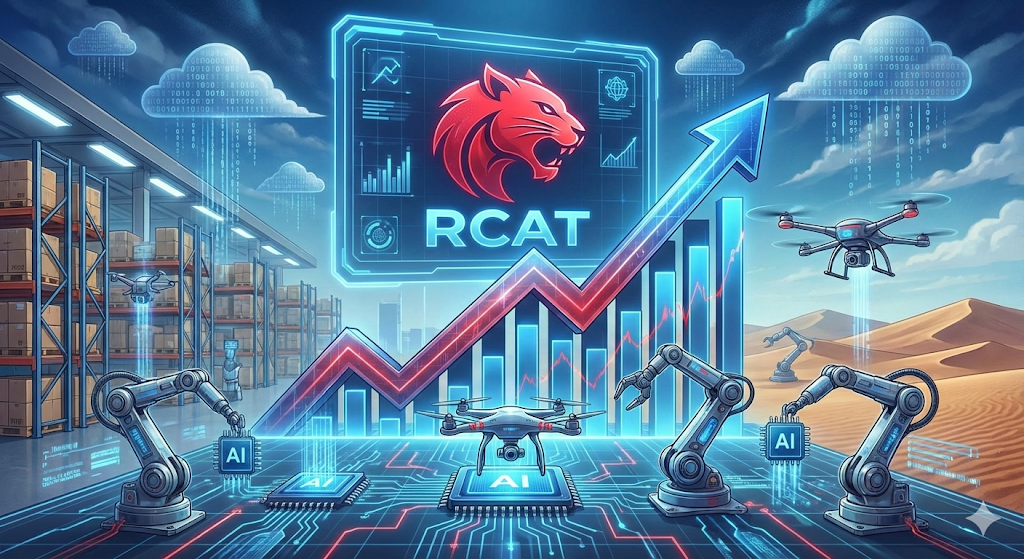
It began as a specialized technology and services provider focused on supporting complex government and defense missions that require precision engineering, advanced analytics, and reliable execution in high-stakes environments. The early vision was to build a company that could bridge the gap between cutting-edge technology and real-world operational needs, particularly in areas involving surveillance, sensing, data processing, and autonomous systems. From the beginning, the emphasis was on mission-critical reliability, secure systems integration, and the development of tools that could function in contested and unpredictable conditions.
Red Cat Holdings Inc. (NASDAQ:RCAT) evolved from those roots into a broader defense technology and autonomous systems company as the global security environment began to change and demand for unmanned platforms accelerated. The company expanded its scope from services into proprietary technology, building capabilities in drone systems, robotic platforms, and software designed to manage and analyze data from distributed autonomous assets. This shift allowed Red Cat Holdings Inc. to move from project-based work toward scalable products and platforms that could be deployed across multiple customers and missions.
Red Cat Holdings Inc. deliberately positioned itself at the intersection of defense, robotics, and artificial intelligence, recognizing that future military and security operations would increasingly depend on autonomous systems supported by intelligent software rather than human-intensive processes alone. The company invested in unmanned aerial systems, sensor integration, and command-and-control software that enables operators to coordinate fleets of drones and robotic assets with improved situational awareness and reduced operational risk.
As its technology matured, Red Cat Holdings Inc. broadened its customer base beyond traditional defense agencies into allied governments and commercial sectors where autonomous systems have growing relevance, including infrastructure monitoring, emergency response, and industrial inspection. This diversification reflected a strategic intent to build a durable platform business rather than remain dependent on a narrow set of government contracts, expanding the company’s total addressable market while retaining its core defense expertise.
Red Cat Holdings Inc. also pursued strategic acquisitions and partnerships to deepen its technology stack and accelerate its evolution into a platform-based company. These moves were designed to add complementary capabilities, strengthen intellectual property, and enhance integration across hardware and software layers. Over time, this created a more comprehensive autonomous systems ecosystem that supports everything from hardware manufacturing to software analytics and mission management.
Headquartered in the United States and operating within tightly regulated and security-sensitive markets, Red Cat Holdings Inc. developed strong compliance, certification, and operational frameworks that are essential for working with defense and government customers. These institutional capabilities form an important part of the company’s competitive advantage, as barriers to entry in this sector are high and trust is built slowly over years of successful execution.
Throughout its development, Red Cat Holdings Inc. has maintained a consistent focus on enabling safer, more efficient, and more intelligent operations through the use of robotics, autonomy, and data. What began as a defense services business has transformed into a technology-driven platform company aligned with long-term trends in automation, artificial intelligence, and unmanned systems. This evolution defines the company’s background and frames its current role as a participant in the next generation of defense and security infrastructure.
Red Cat Holdings Inc. Is Re-Emerging As A High-Conviction Growth Story In Defense Technology And Autonomous Systems
Red Cat Holdings Inc. is increasingly attracting investor attention as one of the most intriguing small-cap plays at the intersection of defense technology, autonomous systems, robotics, and artificial intelligence. While the company’s stock price has experienced periods of volatility and drawdowns, this price behavior masks a deeper structural transformation underway inside the business. Red Cat is evolving from a niche government contractor into a scalable defense and autonomy platform with growing relevance across both military and commercial markets. This strategic shift is unfolding at a time when global defense spending is rising, geopolitical uncertainty is increasing, and autonomous technologies are rapidly becoming core infrastructure for modern security and logistics operations.
The recent sharp rebound in RCAT stock, including a surge of over thirty percent in a single week, reflects more than speculative trading activity. It signals a growing recognition that Red Cat’s asset base, technology portfolio, and strategic positioning may be undervalued relative to its long-term potential. The rebound also highlights how quickly sentiment can shift when investors begin to focus on growth trajectory rather than near-term losses.
CHECK THIS OUT: Why Nebius (NBIS) Could Outperform CoreWeave & Dominate the $9B AI Infrastructure Market and Is Lucid Group (LCID) Running Out of Cash? $875M Note Deal Raises Alarms.
The RCAT Stock Rebound Reflects A Shift In Market Perception
The sharp short-term recovery in Red Cat Holdings stock is occurring against a complex backdrop of mixed long-term returns and improving near-term momentum. While the company remains down on a year-to-date basis, its recent rally suggests that the market is reassessing its future prospects in light of rising revenue, expanding defense demand, and the strategic importance of unmanned systems.
This type of price action is typical of early-stage growth companies transitioning from development to scale. Early volatility reflects uncertainty, while later inflection points often occur when investors start to recognize that future earnings power is beginning to materialize. In Red Cat’s case, improving revenue visibility, growing interest in drone platforms and autonomous systems, and rising defense budgets are helping reshape expectations around the company’s trajectory.
Understanding Red Cat’s Valuation In The Context Of Growth And Asset Intensity
Red Cat Holdings trades at a price-to-book ratio that places it between its direct peer group and the broader electronics sector. This valuation positioning reflects the company’s unique status as both a hardware-focused and software-enabled business. Unlike pure software companies, Red Cat owns tangible assets including manufacturing capabilities, robotics platforms, and intellectual property tied to unmanned systems. Unlike traditional hardware firms, it also owns proprietary software, autonomy frameworks, and data-driven platforms that increase long-term value.
The market’s current valuation implies that investors are acknowledging Red Cat’s growth potential while still discounting execution risk and ongoing losses. This creates a setup where valuation expansion can occur if the company demonstrates continued revenue growth, operational discipline, and progress toward profitability. In that scenario, Red Cat could migrate toward peer-level multiples or beyond as investor confidence strengthens.
Why Red Cat’s Business Model Aligns With Long-Term Defense And AI Trends
The core bullish thesis for Red Cat Holdings rests on the convergence of three structural trends: rising defense spending, accelerating adoption of autonomous systems, and the integration of artificial intelligence into mission-critical operations. Governments around the world are investing heavily in drone technology, robotic platforms, and AI-driven decision systems to improve efficiency, reduce human risk, and enhance situational awareness.
Red Cat is positioned as a provider of both physical unmanned platforms and the software systems that control, coordinate, and analyze them. This dual capability gives the company strategic relevance beyond simple hardware sales. It allows Red Cat to participate in the entire lifecycle of autonomous systems, from development and deployment to maintenance, data analytics, and mission optimization.
As militaries and security agencies increasingly rely on autonomous drones for reconnaissance, surveillance, logistics, and threat detection, companies like Red Cat that offer integrated solutions rather than isolated components stand to benefit disproportionately.
Revenue Growth As The Leading Indicator Of Future Profitability
Although Red Cat is not yet profitable, its revenue growth trajectory is the key variable that long-term investors should monitor. In technology-driven sectors, profitability often lags innovation and market capture. The companies that ultimately succeed are those that establish platform relevance early and monetize later once scale is achieved.
Red Cat’s rising revenue suggests that its technologies are gaining adoption and that customers are willing to pay for its solutions. This adoption validates the company’s product strategy and reduces existential risk. Over time, as scale improves and fixed costs are leveraged across a larger revenue base, margins can expand and losses can narrow.
Insider Alignment And Strategic Commitment
An often overlooked element of Red Cat’s story is insider ownership and strategic alignment. High insider ownership can be a positive signal that management believes in the company’s long-term vision and is financially incentivized to execute successfully. This alignment reduces the risk of short-term decision making that sacrifices long-term value and increases the probability that leadership will focus on sustainable growth rather than short-term stock price movements.
The Long-Term Bullish Case For Red Cat Holdings Inc. (NASDAQ: RCAT)
The bullish investment case for Red Cat Holdings is rooted in its positioning within one of the most durable and geopolitically supported markets in the world. Defense and security spending is not cyclical in the traditional sense. It is driven by national priorities, geopolitical realities, and technological arms races that evolve over decades.
Red Cat’s exposure to drones, robotics, AI, and autonomous systems places it squarely within the future architecture of defense and security infrastructure. While the company remains early in its financial maturation, it has already established technological relevance, customer relationships, and operational capability.
If Red Cat continues to grow revenue, refine its platform, and move steadily toward profitability, the current valuation could prove to be a temporary reflection of uncertainty rather than a permanent ceiling. In that context, RCAT stock represents not just a speculative rebound candidate, but a long-term growth opportunity embedded within the transformation of defense and autonomous technology.
For investors willing to tolerate volatility in exchange for exposure to structural growth trends, Red Cat Holdings Inc. offers a rare combination of defense spending resilience, AI and autonomy upside, and early-stage valuation optionality. Over time, this combination could allow the company to evolve from a volatile small-cap into a strategically significant player in the defense technology ecosystem.
READ ALSO: Above Food (ABVE) to Issue 1.1 Billion New Shares in Merger and Perpetua Resources (PPTA) Soars 171% as U.S. Approves $1.3B Gold-Antimony Mine.