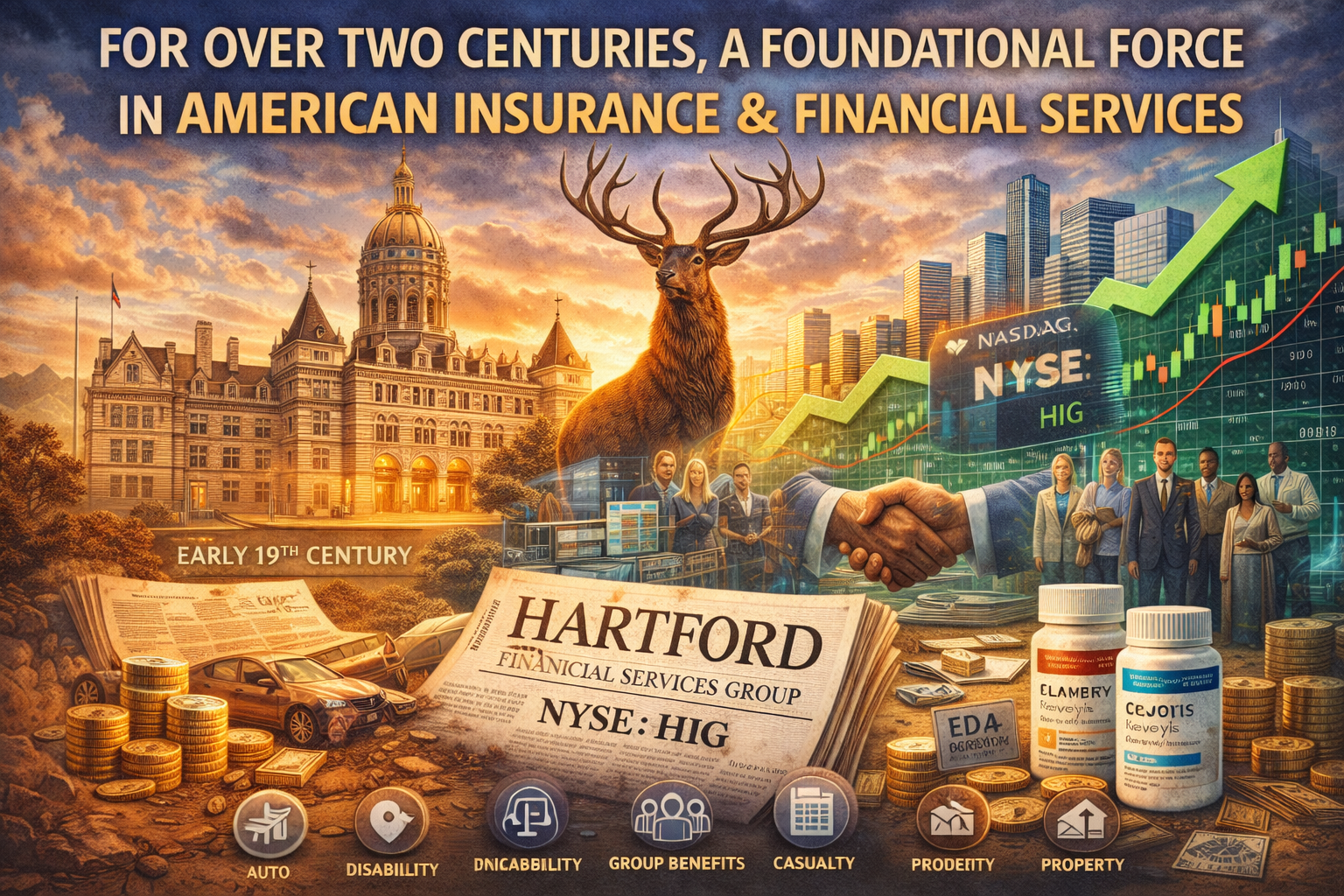
For more than two centuries, one institution has quietly shaped how individuals, employers, and businesses across the country think about protection, risk, and financial security, building a reputation not only as an insurance provider but as a foundational financial services group deeply embedded in American economic life. Founded in the early 19th century in Connecticut, this organization grew alongside the industrialization of the United States, evolving from a regional insurer into a national financial institution that today operates through a network of subsidiaries serving millions of customers, members, drivers, and employers across multiple lines of insurance and financial services. Its long history is marked by a steady expansion of coverage offerings, a disciplined approach to risk, and a strong cultural emphasis on trust, commitment, collaboration, and community impact, positioning it as a central player in the modern insurance and financial services ecosystem.
Hartford Financial Services Group Inc (NYSE:HIG) emerged from these origins as a diversified provider of casualty insurance, property insurance, auto insurance, professional liability coverage, group benefits, disability protection, and umbrella policies designed to protect people, cars, businesses, employees, and assets from accident, risk, and uncertainty. The company built its reputation by helping businesses prepare for operational and financial risks, helping employers protect their workforce through disability and group benefits programs, and helping individuals safeguard their homes, vehicles, and livelihoods. Over time, Hartford Financial Services Group expanded its operations beyond traditional insurance to become a broader financial services group, offering access to resources, risk management tools, and financial solutions that connect customers, brokers, and business partners within an integrated financial services platform.
Hartford Insurance Group’s structure reflects the complexity of modern insurance operations, with multiple subsidiaries organized around specific business lines including commercial insurance, personal insurance, group benefits, and professional liability. These subsidiaries allow the company to select, design, and deliver tailored coverage solutions for a wide range of industries, from small businesses and mid-sized enterprises to large corporate clients and institutional employers. Through this structure, Hartford Financial Services Group Inc supports a nationwide network of brokers, agents, and financial professionals who connect people and organizations with coverage designed to protect property, mitigate accident exposure, manage disability risk, and preserve long-term financial stability.
As the company matured, Hartford Financial Services invested heavily in innovation, data, and digital infrastructure to modernize underwriting, claims processing, customer experience, and risk assessment. Artificial intelligence, automation, and data science became central to how the company evaluates risk, prices insurance, and processes claims, allowing Hartford Financial to improve efficiency, consistency, and responsiveness while maintaining disciplined underwriting standards. This shift reflects the company’s broader transformation from a traditional insurer into a technology-enabled financial institution that integrates digital tools with human expertise, allowing teams, employees, and partners to work more effectively across the organization.
Hartford Financial Services Group Inc also developed a strong identity around social responsibility and community engagement, emphasizing its role in creating a difference beyond financial results alone. The company highlights its commitment to protecting communities, supporting recovery after accidents and natural disasters, and contributing resources to education, resilience, and social impact initiatives. This emphasis on purpose and responsibility has become an important part of the Hartford brand, reinforcing trust among customers and strengthening relationships with employers, members, brokers, and business partners who value stability, reliability, and ethical leadership in their financial services providers.
Over time, Hartford Financial Services Group refined its strategic focus by divesting non-core operations, simplifying its business portfolio, and sharpening its emphasis on core insurance and risk management activities. This process allowed the company to strengthen its capital position, improve operational discipline, and align its resources more closely with its highest-return business segments. As a result, Hartford Financial today operates as a more focused and efficient financial services group, centered on delivering high-quality insurance products, disciplined risk management, and consistent value to customers and investors alike.
Today, Hartford Financial Services Group Inc stands as one of the most established names in the insurance and financial services industry, with deep institutional knowledge, a broad product portfolio, and a nationwide presence that spans individuals, businesses, employers, and institutions. Its evolution from a regional insurer into a modern financial services group reflects both the changing needs of the economy and the company’s ability to adapt through innovation, discipline, and long-term strategic thinking. Through its people, systems, subsidiaries, and partners, Hartford continues to shape how risk is managed, how protection is delivered, and how financial security is created across the country, reinforcing its position as a central pillar of the U.S. insurance and financial services landscape.
Why the 27% Rally in Hartford Financial Services Group Inc. May Be Setting Up a More Fragile Risk Profile Than Investors Expect
Hartford Financial Services Group Inc has delivered a powerful performance over the past year. Shares of Hartford Financial Services Group, also known as Hartford Insurance Group or simply Hartford, are up roughly 27 percent over the last twelve months, significantly outperforming both the broader insurance industry, which gained about 9.7 percent, and the S&P 500, which rose approximately 19.5 percent during the same period. For many investors, this rally has reinforced the narrative that Hartford Financial Services is one of the best-run financial institution names in the insurance sector, with disciplined underwriting, improving combined ratios, and strong capital returns.
However, when the surface-level momentum is stripped away and the underlying business, financial services operations, balance sheet structure, and risk profile are examined more closely, the story becomes less straightforward. Hartford Financial Services Group Inc today sits at a point where expectations are elevated, valuation is no longer cheap, and several structural risks inside its insurance and financial services group are becoming harder to ignore.
This creates a meaningful bearish thesis for Hartford Financial, not because the company is poorly run, but because the current stock price increasingly assumes an ideal operating environment that may be difficult to sustain in practice.

CHECK THIS OUT: Why Nebius (NBIS) Could Outperform CoreWeave & Dominate the $9B AI Infrastructure Market and Is Lucid Group (LCID) Running Out of Cash? $875M Note Deal Raises Alarms.
The Business Model Looks Stable, But Stability Is Being Overpriced
Hartford Financial Services Group Inc is a diversified insurance company founded more than two centuries ago and headquartered in Connecticut. The company provides casualty insurance, property insurance, auto insurance, professional liability coverage, group benefits, disability insurance, and various risk management and financial services to businesses, employers, drivers, members, and customers across the country and select international markets. Through its subsidiaries, Hartford serves millions of people and thousands of businesses, positioning itself as a trusted provider that protects cars, property, employees, and financial security.
The Hartford Insurance Group brand emphasizes trust, commitment, collaboration, and community impact. The company frequently highlights how it helps businesses prepare for risk, protects people from accident and disability, and creates a difference in the communities it serves. From an operational and cultural standpoint, Hartford Financial Services Group is clearly a high-quality company.
The issue for investors is not whether Hartford is a good company, but whether it is a good stock at this price.
With a market capitalization of approximately 38.6 billion dollars and consensus expectations calling for strong earnings growth, much of the company’s operational success is already reflected in the share price. The Zacks Consensus Estimate for 2025 earnings stands at 12.44 dollars per share, implying year-over-year growth of about 20.8 percent, followed by roughly 4.5 percent growth in 2026 to 13 dollars per share. Revenue is expected to reach approximately 19.9 billion dollars in 2025, up about 9.1 percent from the prior year, and continue growing around 7.6 percent in 2026.
These are healthy figures, but they also represent a future that must go nearly perfectly for the stock to justify further upside.
A Rally Driven by Execution and Buybacks Can Fade Faster Than Investors Expect
The recent rally in Hartford Financial Services Group Inc has been fueled by a combination of disciplined underwriting, higher earned premiums, improved investment income, operational restructuring through initiatives like Hartford Next, and aggressive capital returns. The company repurchased 1.5 billion dollars of shares in 2024 and another 1.2 billion dollars during the first nine months of 2025, while returning 446 million dollars in dividends over the same period. As of September 30, 2025, nearly 1.95 billion dollars remained under its current repurchase authorization.
This aggressive capital return strategy has supported earnings per share growth and helped drive the stock higher. But buybacks do not create new customers, new products, or new revenue streams. They amplify existing performance, and when growth slows, buybacks can mask weakening fundamentals for a time before the market adjusts.
At the same time, the trailing twelve-month return on equity of 21.07 percent looks exceptional compared to the industry average of roughly 8 percent. But that level of profitability is unlikely to be sustained indefinitely in a competitive, regulated, and cyclical industry like insurance. As pricing tightens, claims costs normalize, and competition intensifies, returns on equity tend to drift downward toward industry norms.
If ROE compresses even modestly, valuation multiples could compress alongside it.
The Personal Insurance Segment Remains a Structural Weak Point
One of the most important cracks in the bullish story is the Personal Insurance segment. While Business Insurance and Group Benefits have shown improvement, Personal Insurance continues to operate with elevated cost pressures. For the first nine months of 2025, the Personal Insurance combined ratio was 96.2 percent. While technically profitable, this leaves very little margin for error if claims frequency rises, repair costs increase, or auto and property pricing becomes more competitive.
Casualty insurance and auto insurance are particularly sensitive to inflation, accident trends, legal costs, and changes in driving behavior. Even small shifts in claims severity or litigation frequency can quickly erode underwriting margins. In a world of rising repair costs, more expensive vehicles, and higher medical and legal expenses, the risk profile of auto and casualty insurance is becoming more volatile, not less.
Hartford Financial Services Group Inc is therefore increasingly exposed to operational risks that do not show up clearly in backward-looking performance metrics.
Balance Sheet Leverage Introduces Asymmetric Downside Risk
Another underappreciated risk lies in Hartford Financial’s balance sheet structure. As of the end of the third quarter of 2025, long-term debt stood at approximately 4.4 billion dollars, while cash was only about 150 million dollars. Long-term debt represents roughly 24.1 percent of total equity, which is meaningfully higher than the industry average.
This level of leverage is not alarming in good times, but it creates asymmetry. If underwriting results weaken, investment income declines, or catastrophe losses spike, the downside impact on equity holders becomes amplified. Hartford Financial Services Group Inc is, by design, a financial institution built on leverage, but investors often underestimate how quickly sentiment can change when capital flexibility is questioned.
Catastrophe Risk Is Rising, Not Falling
Climate-related risks are increasingly relevant for property and casualty insurers. Wildfires, floods, hurricanes, and other extreme weather events are becoming more frequent and more severe. Even with reinsurance and risk diversification, Hartford remains exposed to higher volatility in claims tied to natural disasters.
The market often treats catastrophe losses as temporary noise, but when those events become recurring rather than occasional, they fundamentally change the earnings profile of an insurance company. Hartford Insurance Group’s current valuation does not appear to fully reflect a future where catastrophe-related losses are structurally higher than historical norms.
Digital Innovation and AI Are Defensive, Not Transformative
Hartford Financial Services has invested in digital tools, data science, AI-driven underwriting, and customer experience platforms to improve efficiency and retention. These investments are necessary and positive, but they are not unique. Every major insurance company is making similar investments. This means digital transformation is defensive, not a lasting competitive moat.
AI will help Hartford work faster, reduce friction, and manage risk more effectively, but it will not eliminate competition, pricing pressure, or regulatory oversight. Over time, these technologies become table stakes rather than sources of excess returns.
The Valuation Now Reflects Optimism, Not Caution
At current levels, Hartford Financial Services Group Inc trades like a company with predictable growth, stable margins, and limited downside. But insurance is inherently cyclical, exposed to unpredictable claims, interest rate shifts, regulatory changes, and macroeconomic stress.
The stock is priced for consistency, not volatility. That mismatch between expectation and reality is what makes the bearish thesis compelling.
If revenue growth slows from the projected 9 percent range, if earnings growth falls short of the 20 percent surge expected in 2025, or if combined ratios deteriorate modestly, the market is unlikely to remain as forgiving as it has been over the past year.
Conclusion: A Great Company at a Risky Price
Hartford Financial Services Group Inc remains a well-managed, reputable insurance company with a strong brand, loyal customers, committed employees, and a long history of serving businesses, employers, drivers, and communities. It protects cars, property, people, and livelihoods across the country. It invests in innovation, supports collaboration, and takes pride in its role as a trusted financial services provider.
But the stock of Hartford Financial Services Group is no longer priced for resilience. It is priced for perfection.
With elevated expectations, rising catastrophe risk, persistent margin pressure in Personal Insurance, higher-than-average leverage, and a valuation that already discounts much of the good news, the risk-reward profile is becoming less attractive. The 27 percent rally that made Hartford look compelling over the past year may, paradoxically, be the very reason the stock now carries more downside risk than upside opportunity.
For investors, the key question is no longer whether Hartford Financial Services Group Inc is a good company. The real question is whether it is still a good investment when so much success is already reflected in the price.
And on that question, caution is increasingly justified.
READ ALSO: Above Food (ABVE) to Issue 1.1 Billion New Shares in Merger and Perpetua Resources (PPTA) Soars 171% as U.S. Approves $1.3B Gold-Antimony Mine.