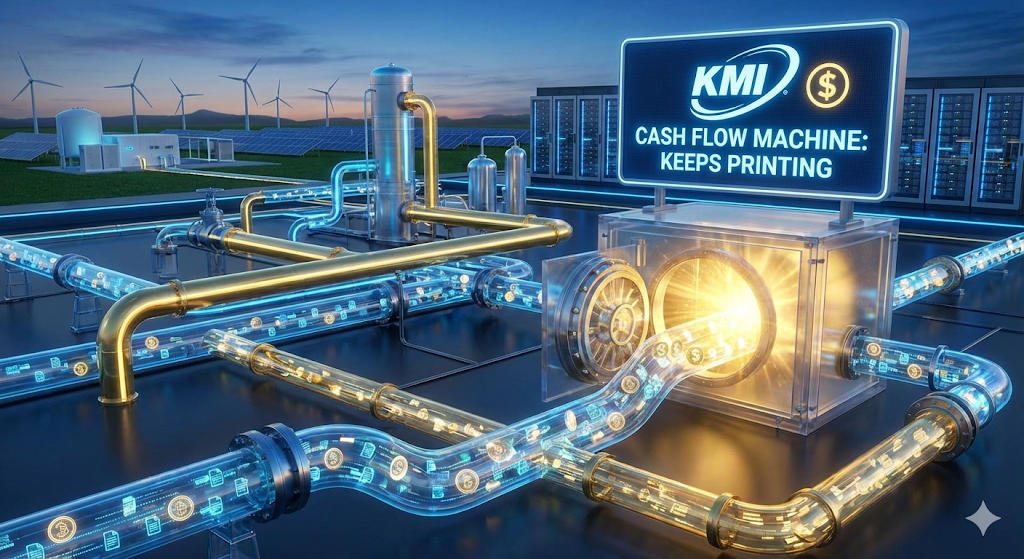
Built on the idea that energy infrastructure should function like a utility rather than a speculative commodity play, one of North America’s largest midstream companies emerged during a period of consolidation and transformation in the U.S. energy sector. The business was shaped by the belief that long-lived physical assets such as pipelines, storage terminals, and processing facilities could generate stable, predictable cash flows regardless of short-term swings in oil and natural gas prices. From its earliest years, the company focused on owning and operating essential infrastructure that moves energy from where it is produced to where it is consumed, positioning itself as a backbone of the modern energy economy rather than a participant in upstream price cycles.
Kinder Morgan (NYSE:KMI) traces its roots to a series of pipeline and terminal businesses that were combined to form a large-scale, integrated energy infrastructure platform. Headquartered in Houston, Texas, the company steadily expanded its footprint across the United States and parts of Canada, building one of the most extensive pipeline networks in North America. Over time, Kinder Morgan became especially synonymous with natural gas transportation, operating tens of thousands of miles of pipelines that serve utilities, power plants, industrial customers, and liquefied natural gas export facilities. This focus aligned the company closely with long-term energy demand trends tied to electricity generation, heating, and industrial use.
As the company grew, Kinder Morgan, Inc. developed a business model centered on fee-based contracts rather than direct exposure to commodity prices. This approach distinguished it from upstream and refining peers and allowed it to generate more consistent cash flow through economic cycles. Revenues were largely derived from long-term agreements, regulated tariffs, and take-or-pay contracts, reinforcing the perception of the company as an energy infrastructure and midstream operator rather than a traditional oil and gas producer. This structure became a defining feature of Kinder Morgan stock and a key reason income-oriented investors gravitated toward the company.
The evolution of Kinder Morgan also reflected broader shifts within the energy industry. As natural gas gained prominence as a cleaner-burning fuel and a bridge in the energy transition, the company’s assets became increasingly strategic. Its pipeline network expanded to support growing domestic consumption, power generation demand, and eventually the rise of LNG exports from the United States. By owning infrastructure that is difficult to replicate due to regulatory, environmental, and capital constraints, Kinder Morgan strengthened its competitive position and embedded itself deeply into the U.S. energy system.
Throughout its history, Kinder Morgan, Inc. navigated periods of aggressive expansion, restructuring, and renewed capital discipline, shaping its modern identity as a cash-flow-focused midstream giant. The company’s background is closely tied to themes such as natural gas pipelines, energy infrastructure stocks, midstream energy companies, and dividend-paying energy assets. Today, Kinder Morgan’s story is defined less by exploration risk and more by the long-term relevance of its physical network, reflecting a strategic emphasis on durability, scale, and essential service in an evolving energy landscape.
Kinder Morgan’s Fourth Quarter Confirms the Strength of Its Midstream Cash Flow Engine
Kinder Morgan, Inc. has once again demonstrated why it remains one of the most durable names in North American energy infrastructure. In its fourth quarter 2025 results, the company delivered a combination of earnings growth, balance sheet improvement, and long-term project visibility that reinforces the core bullish thesis for the stock. While energy markets remain volatile and sentiment around fossil fuels often fluctuates, Kinder Morgan continues to prove that ownership of irreplaceable midstream assets can generate consistent value regardless of commodity price noise.
The company reported adjusted EBITDA growth of 10 percent compared to the same quarter last year, a meaningful acceleration that underscores operating leverage across its natural gas-focused portfolio. Adjusted earnings per share increased by 22 percent year over year, while reported EPS surged 50 percent to $0.45. Net income reached $996 million, up 49 percent from the prior year, reflecting both stronger operating performance and disciplined cost and capital management. These are not marginal improvements, but rather evidence of a business that is scaling cash flows while reducing financial risk.
CHECK THIS OUT: The Quiet Semiconductor Disruptor You’ve Never Heard Of: Aeluma Inc (ALMU) and Air Industries Group (AIRI) Narrows Losses to Just $44K — Is This Aerospace Microcap Entering a Turnaround Phase?
Natural Gas Continues to Be the Backbone of Kinder Morgan’s Growth Story
At the center of Kinder Morgan’s bullish outlook is natural gas, which has increasingly become the most strategically important fuel in the U.S. energy system. During the fourth quarter, natural gas transport volumes rose 9 percent year over year, driven largely by higher LNG feed gas deliveries. Natural gas gathering volumes increased an even more impressive 19 percent, highlighting rising activity in key producing basins and stronger demand for Kinder Morgan’s infrastructure.
These volume trends are critical because they validate the long-term thesis that natural gas demand is not only resilient but structurally growing. LNG exports, data center electricity demand, coal-to-gas switching, and industrial usage all require massive, reliable pipeline networks. Kinder Morgan’s footprint allows it to capture this demand through fee-based contracts that are largely insulated from short-term commodity price fluctuations. As LNG export capacity expands along the Gulf Coast, Kinder Morgan’s pipelines increasingly function as toll roads for global energy trade.
Financial Performance Shows Operating Leverage at Work
The fourth-quarter results illustrate how incremental volume growth translates into disproportionate earnings expansion. Adjusted EBITDA increased at a slower rate than adjusted EPS, indicating improving margins and operating efficiency. Cash flow from operations reached $5.92 billion, providing ample coverage for capital expenditures, dividends, and balance sheet strengthening.
Capital expenditures totaled $3.15 billion, including both sustaining and growth investments. Importantly, Kinder Morgan is funding these investments while still returning capital to shareholders and maintaining leverage discipline. The net debt to adjusted EBITDA ratio improved to 3.8 times, a level that reflects a far healthier balance sheet than in prior cycles. This improvement did not go unnoticed by credit markets, as S&P upgraded Kinder Morgan to BBB+, reinforcing the company’s financial credibility and lowering its long-term cost of capital.
A $10 Billion Project Backlog Signals Long-Duration Growth Visibility
One of the most underappreciated elements of the Kinder Morgan bull case is the size and quality of its project backlog. During the quarter, the company added $650 million in new projects, bringing total backlog to approximately $10 billion. These projects are largely aligned with natural gas transportation, LNG feed gas, and infrastructure modernization, areas where demand visibility is stronger and regulatory barriers to entry are higher.
This backlog provides long-term earnings visibility that few energy companies can match. Unlike upstream producers, Kinder Morgan does not need to continuously drill or acquire acreage to sustain growth. Its projects are typically backed by long-term contracts, reducing execution risk and supporting predictable cash flow expansion over multiple years. As these projects come online, they should further enhance distributable cash flow and dividend coverage.
Dividend Growth Reinforces the Income Investment Case
Kinder Morgan declared a quarterly dividend of $0.2925 per share, representing an annualized payout of $1.17 per share and a 2 percent increase from the prior year. While this growth rate may appear modest, it is significant in the context of capital discipline and balance sheet repair. The dividend is supported by real operating cash flows rather than leverage, making it far more sustainable than higher-yielding but riskier alternatives.
For income-focused investors, Kinder Morgan offers an attractive combination of yield, stability, and inflation protection. Pipeline tariffs and long-term contracts provide natural hedges against rising costs, while the essential nature of the assets reduces demand risk. As interest rates eventually stabilize or decline, dividend-paying infrastructure stocks like Kinder Morgan could see renewed investor interest.
Portfolio Adjustments Highlight Capital Allocation Discipline
During the period, Kinder Morgan spent $650 million on the Outrigger acquisition while also receiving $380 million from divestitures, primarily from the sale of EagleHawk. These moves reflect a more selective approach to capital allocation, emphasizing strategic fit and return on invested capital rather than empire building. Management has shown a willingness to recycle capital, exit non-core assets, and focus on segments where the company has durable competitive advantages.
This discipline is particularly important in a capital-intensive industry. By maintaining flexibility and avoiding overextension, Kinder Morgan strengthens its ability to weather market cycles and pursue high-quality growth opportunities when they arise.
Segment Weaknesses Do Not Undermine the Long-Term Thesis
Not all segments delivered growth in the quarter. Refined products volumes declined 2 percent year over year, and crude and condensate volumes fell 8 percent, largely due to taking the Double H pipeline out of service for an NGL conversion project. Additionally, the CO2 segment experienced lower production volumes across oil, NGL, and CO2.
From a bullish perspective, these declines are contextual rather than structural. Kinder Morgan’s strategic emphasis has clearly shifted toward natural gas, where growth, margins, and long-term relevance are strongest. Temporary volume declines tied to asset conversions or maintenance projects often pave the way for higher-value uses in the future. The market’s tendency to overreact to short-term segment softness can create opportunity for long-term investors.
Market Skepticism Creates Opportunity
Despite strong operating results, Kinder Morgan continues to face skepticism, as reflected in external warning indicators and debates over valuation. Concerns around competition for new projects, regulatory uncertainty, and timing of initiatives such as the Western Gateway Pipeline and Mississippi Crossing remain part of the narrative. However, these uncertainties are inherent in large-scale infrastructure development and are not unique to Kinder Morgan.
What distinguishes the company is its ability to absorb delays, adapt capital plans, and continue generating cash flow from existing assets. The current valuation reflects caution rather than optimism, which can be attractive for investors willing to focus on fundamentals rather than headlines.
The Bullish Takeaway on Kinder Morgan, Inc.
Kinder Morgan’s fourth quarter results reinforce a simple but powerful investment case. The company owns critical energy infrastructure that benefits from structural natural gas demand growth, generates predictable cash flows, maintains improving financial health, and returns capital to shareholders through a sustainable dividend. A growing project backlog provides long-term visibility, while balance sheet discipline reduces risk.
In a market often dominated by short-term narratives and speculative growth stories, Kinder Morgan represents a business grounded in physical assets, real demand, and cash flow reality. For investors seeking exposure to the backbone of the U.S. energy system, combined with income and resilience, Kinder Morgan, Inc. stands out as a compelling long-term bullish investment.
READ ALSO: Vuzix Corp (VUZI) Could Be the Dark Horse of Augmented Reality as Defense Contracts & Enterprise Adoption Accelerate and Almonty Industries (ALM) Is Quietly Becoming a Tungsten Powerhouse.