Few companies in the modern technology landscape have pursued as ambitious and unconventional a vision as the idea of delivering power through the air. The concept itself feels almost futuristic, echoing early scientific experiments and long-standing human fascination with wireless energy transmission. From its earliest days, this company set out to turn that concept into a commercial reality, not by building consumer gadgets or lifestyle products, but by engineering a foundational layer of infrastructure that could reshape how electronic devices are powered, connected, and deployed across industries.
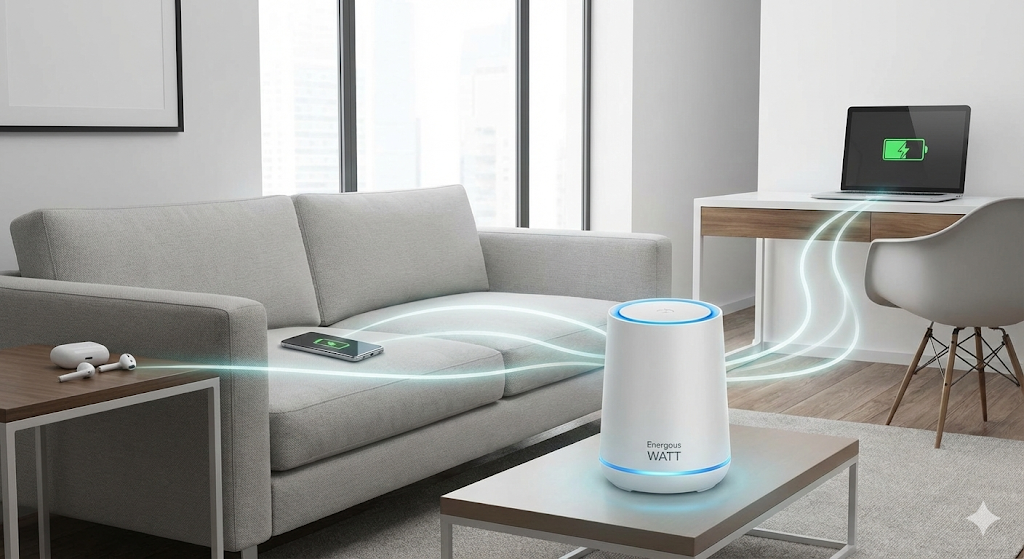
Energous Corporation (NASDAQ:WATT) was founded with the explicit goal of developing radio frequency based wireless power technology that could transmit energy safely and efficiently over distance. Rather than focusing on charging pads, cords, or contact-based solutions, the company chose to explore RF wireless charging as a way to power low-energy devices remotely, enabling new categories of sensors, tags, trackers, and Internet of Things devices that could operate without traditional batteries or frequent manual charging. This strategic focus placed Energous Corporation at the intersection of wireless power, IoT infrastructure, and energy innovation long before those themes became mainstream in technology discourse.
As the Internet of Things began to expand, with billions of connected devices projected to come online across industrial, commercial, and consumer environments, the challenge of powering those devices emerged as a fundamental bottleneck. Batteries introduced maintenance costs, environmental waste, and operational friction, while wired power limited placement and flexibility. Energous Corporation positioned its technology as a potential solution to this problem by enabling devices to harvest power over the air, opening the possibility of self-sustaining sensor networks in smart buildings, logistics, healthcare, retail, and industrial monitoring.
The company’s early years were heavily focused on research and development, regulatory approvals, and building a robust intellectual property portfolio around RF energy transmission. Because wireless power intersects with telecommunications regulations, safety standards, and spectrum management, progress required not only engineering breakthroughs but also close coordination with regulators and certification bodies. This regulatory pathway became a defining feature of the company’s background, shaping its long development cycles and influencing the pace at which products could reach the market.
Over time, Energous Corporation evolved from a pure research-driven organization into a product company, developing chips, reference designs, transmitters, receivers, and software platforms that could be integrated into commercial devices. This transition marked a shift from theoretical innovation toward practical deployment, as the company began working with device manufacturers, system integrators, and enterprise partners to embed wireless power into real-world applications.
The company also expanded its positioning from a single-technology developer into a broader wireless power platform provider. Its product portfolio came to include both near-field and far-field wireless charging solutions, as well as power management software and networked power delivery systems designed to support scalable IoT deployments. This platform approach allowed Energous Corporation to address a wider range of use cases, from asset tracking and electronic shelf labels to medical sensors and industrial monitoring devices.
Throughout its evolution, the company consistently framed its mission around enabling a new generation of connected devices that could be deployed without the constraints of batteries and wires. This narrative resonated strongly with emerging trends in smart infrastructure, automation, and digital transformation, as organizations sought to deploy more sensors and data collection points without increasing maintenance complexity.
Geographically, Energous Corporation built a presence that spans engineering, partnerships, and commercialization efforts across multiple regions, allowing it to participate in global discussions around energy efficiency, sustainability, and connectivity. Its positioning aligned with broader macro trends such as smart cities, Industry 4.0, logistics automation, and healthcare digitization, all of which rely heavily on dense networks of low-power connected devices.
Another defining element of the company’s background is its emphasis on ecosystem development rather than vertical integration alone. Instead of manufacturing finished products for end users, Energous Corporation focused on enabling other companies to incorporate wireless power into their own devices. This business model emphasized partnerships, standards, and compatibility, aiming to create a foundation upon which a broader wireless power ecosystem could be built.
The company’s story is therefore less about a single breakthrough moment and more about a long, patient effort to transform a scientific possibility into a commercial platform. Its background reflects the complexity of building deep technology, where progress is measured not only in product launches but in certifications, integrations, partnerships, and gradual shifts in industry behavior.
Today, Energous Corporation occupies a unique position in the technology landscape as one of the few publicly traded companies singularly focused on RF wireless power as a core business. Its history is intertwined with the rise of IoT, the push for automation, and the search for more efficient and sustainable ways to power the expanding universe of connected devices.
That background defines both the company’s promise and its challenges. It is the story of a business built around a bold technological vision, shaped by long development timelines, regulatory complexity, and the slow maturation of markets needed to support it. Whether that vision ultimately becomes a widespread infrastructure layer or remains a specialized niche will define the company’s future, but its past is already marked by its role as a pioneer in the pursuit of wireless power at scale.
Energous Corporation Is Reporting Explosive Revenue Growth, But the Underlying Business Still Raises Serious Questions
At first glance, the story looks extraordinary. A company reports record annual revenue, triple-digit growth, improved operating performance, new products, and expanding partnerships. On the surface, this sounds like the beginning of a turnaround narrative that investors love. But when you look deeper at Energous Corporation, the headline numbers hide a set of structural risks, financial realities, and commercialization challenges that continue to support a fundamentally bearish thesis.
Energous Corporation, traded under the ticker WATT on the Nasdaq, operates in the wireless power and RF-based charging space, aiming to power IoT devices over the air using radio frequency technology. The company’s promise has always been bold: to eliminate batteries, wires, and charging docks by enabling devices to be powered remotely through wireless energy transmission. It is a vision that sounds revolutionary, but one that has struggled for years to translate into large-scale commercial adoption and sustainable financial performance.
The company’s January 2026 update reporting preliminary 2025 revenue of approximately $5.6 million, representing over 630 percent year-over-year growth, is undeniably eye-catching. It is the highest annual revenue in the company’s history, and management framed 2025 as a pivotal transition year toward tangible commercial success. Yet when examined in absolute terms and in relation to the company’s funding needs, operating history, and market context, the numbers still raise more questions than they answer.
CHECK THIS OUT: The Quiet Semiconductor Disruptor You’ve Never Heard Of: Aeluma Inc (ALMU) and Air Industries Group (AIRI) Narrows Losses to Just $44K — Is This Aerospace Microcap Entering a Turnaround Phase?
Record Revenue Growth From an Extremely Small Base Does Not Automatically Mean Business Viability
The most important context for Energous’ 630 percent growth is the starting point. The prior year’s revenue base was exceptionally low. Growing from roughly under one million dollars to $5.6 million feels dramatic in percentage terms, but in practical business terms, it remains very small for a publicly traded technology company that has been operating for years, raised hundreds of millions over its lifetime, and aims to become a global infrastructure provider.
A business that generates $5.6 million in revenue while requiring nearly $24 million in equity financing in the same year is not funding its operations from customers. It is funding its operations from investors. That distinction matters enormously when evaluating long-term sustainability.
Even after the revenue increase, Energous remains deeply subscale relative to its ambitions. The company is trying to build a hardware-software ecosystem, certify devices, develop silicon, support integration partners, and penetrate enterprise and industrial markets. Those are capital-intensive activities that typically require far larger revenue bases before profitability becomes plausible.
The fact that Energous had to raise $23.9 million in equity capital in 2025 while producing $5.6 million in revenue highlights a fundamental mismatch between business scale and financial needs.
Improved Losses Still Mean Losses, and the Business Remains Structurally Unprofitable
Management emphasized that net losses declined by more than 45 percent year over year, framing this as a sign of operating discipline and progress toward profitability. While that improvement is real, it does not change the core reality that the business is still losing money.
Reducing losses from a very high level does not mean the business has reached a point of operating leverage. It means the business is still burning cash, just at a slower rate. Without sustained revenue growth into tens or hundreds of millions, fixed costs associated with engineering, certification, manufacturing, sales, marketing, and regulatory compliance will continue to overwhelm gross profit.
There is also no evidence yet that Energous has achieved meaningful pricing power, recurring revenue at scale, or long-term contracts that guarantee stable cash flow. Most deployments appear to be early-stage, experimental, or limited in scope, rather than large rollouts that could support a profitable enterprise.
Wireless Power Remains a Commercially Unproven Category
One of the deepest risks in the Energous story is not financial. It is technological and market-based.
RF-based wireless power faces inherent physical constraints. Power transmission over the air using radio waves is inefficient, limited in range, constrained by regulations, and subject to interference, line-of-sight issues, and power density restrictions. These limitations mean that the technology is often only practical for very low-power devices in tightly controlled environments.
That narrows the addressable market dramatically compared to what the original vision implied.
While Energous has made progress certifying products and launching new chips and systems, the question is not whether the technology works. It is whether it works well enough, cheaply enough, and reliably enough to justify widespread adoption compared to alternatives like batteries, wired power, inductive charging, or energy harvesting.
So far, the market has not provided clear evidence that RF wireless power is becoming a dominant standard. Most large device manufacturers have not adopted it at scale, and there is no sign that it is becoming embedded into mainstream consumer or industrial platforms.
Partnerships and AWS Integration Do Not Guarantee Revenue Scale
The company highlighted its integration into the Amazon Web Services Partner Network as a validation of its platform and a pathway to future growth. While this is positive from a technical and marketing perspective, it does not equate to revenue commitments.
Being part of an ecosystem is not the same as being chosen by customers. Many companies are AWS partners. Very few turn that into material financial scale.
The same is true of distribution and integration partnerships more broadly. They lower friction for adoption, but they do not guarantee demand. Ultimately, customers must see enough value to change their purchasing behavior, redesign products, and commit to new infrastructure. That is a slow and uncertain process.
The Business Is Still Heavily Dependent on Capital Markets
A core pillar of the bearish thesis is that Energous is still not a self-funding business. It relies on issuing stock to finance operations. That creates ongoing dilution risk for shareholders and makes the company vulnerable to shifts in market sentiment.
If capital markets become less friendly, or if the share price weakens, the company’s ability to raise money could be impaired, forcing cost cuts, strategic retreats, or unfavorable financing terms.
This dynamic turns Energous into a capital markets-dependent entity rather than a customer-funded enterprise. That is inherently risky, especially in volatile markets.
A History of Overpromising and Underdelivering Still Haunts the Narrative
Energous has been promising a wireless power revolution for more than a decade. Over that time, timelines have slipped, expectations have been reset, and adoption has remained slower than initially projected.
This history matters because it affects credibility. Investors have heard versions of this story before. That does not mean progress is not real today, but it does mean skepticism is justified until revenue scale, customer concentration, and profitability provide hard proof.
The Bearish Bottom Line
Energous Corporation is showing signs of improvement. Revenue is growing. Losses are shrinking. Products are launching. Partnerships are expanding.
But none of that yet changes the fundamental risk profile of the business.
The company is still small relative to its ambitions. It is still losing money. It still depends on external capital. Its core technology is still commercially unproven at scale. And its market remains niche rather than mainstream.
From a bearish perspective, the danger is that investors see explosive percentage growth and mistake it for business maturity. In reality, Energous is still in a fragile transition phase, where execution risk, funding risk, technology risk, and market adoption risk all remain elevated.
Until the company demonstrates sustained revenue growth into meaningful scale, clear paths to profitability, and broad market adoption of its wireless power platform, the stock remains a high-risk bet on a future that has been promised many times, but not yet delivered.
That is why, despite the excitement around its latest numbers, Energous Corporation remains, at its core, a speculative and structurally risky investment rather than a proven growth business.
READ ALSO: Vuzix Corp (VUZI) Could Be the Dark Horse of Augmented Reality as Defense Contracts & Enterprise Adoption Accelerate and Almonty Industries (ALM) Is Quietly Becoming a Tungsten Powerhouse.