Born out of the consolidation wave that reshaped the North American energy infrastructure landscape, this company emerged as one of the most expansive and influential midstream operators in the United States, quietly building a network that now underpins the movement of crude oil, natural gas, and natural gas liquids across key production basins and demand centers. From its earliest days, the business focused on assembling strategic pipeline assets, storage facilities, and terminals that connect upstream producers with downstream markets, positioning itself at the center of the U.S. energy value chain. Its growth story is deeply tied to the shale revolution, as rising domestic production created an urgent need for large-scale, integrated midstream systems capable of handling massive volumes efficiently and reliably.
Energy Transfer (NYSE:ET) grew rapidly by pursuing an acquisition-driven strategy that favored scale, geographic reach, and asset diversity. Over time, the partnership assembled one of the largest and most complex portfolios of energy infrastructure in North America, spanning interstate and intrastate natural gas pipelines, crude oil transportation systems, fractionation facilities, export terminals, and storage assets. This approach allowed the company to serve a wide range of customers, from major exploration and production companies to refiners, utilities, petrochemical firms, and international buyers, embedding its assets deeply into the physical flow of energy across the continent.
As the U.S. energy market evolved, Energy Transfer expanded beyond its initial footprint, extending its presence into prolific regions such as the Permian Basin, Eagle Ford, Marcellus and Utica shales, and the Bakken. The partnership’s infrastructure became increasingly interconnected, enabling it to capture value not just from transportation, but also from storage, processing, and export activities. This integrated model helped establish the company as a critical intermediary in the energy supply chain, benefiting from long-term contracts and fee-based revenues that were designed to provide stability across commodity price cycles.
The company’s history is also closely tied to the master limited partnership structure, which shaped both its growth strategy and investor appeal. By emphasizing distributable cash flow and income generation, Energy Transfer attracted income-focused investors seeking exposure to energy infrastructure with the potential for high yields. Over the years, the partnership balanced this income focus with aggressive capital investment, reinvesting cash flows into new projects and expansions aimed at supporting long-term volume growth and maintaining relevance in a competitive midstream sector.
Energy Transfer’s background cannot be separated from the broader transformation of U.S. energy markets. The rise of natural gas as a dominant fuel for power generation and industrial use played a significant role in shaping the company’s asset base, leading to increased investment in gas transportation, storage, and export-related infrastructure. At the same time, continued demand for crude oil and refined products ensured that its liquids-focused assets remained integral to domestic and international energy flows, reinforcing the partnership’s diversified exposure across multiple energy commodities.
Over multiple market cycles, Energy Transfer developed a reputation for operational scale and deal-making ambition. Its leadership pursued transactions that expanded the partnership’s reach, often favoring size and strategic positioning over simplicity. This approach resulted in a sprawling asset network that reflects decades of consolidation within the midstream industry, where scale is often viewed as a competitive advantage in securing contracts, optimizing logistics, and spreading fixed costs across large volumes.
The company’s evolution also mirrors the changing priorities of energy infrastructure investors. Early growth phases emphasized expansion and asset accumulation, while later periods focused more heavily on balance sheet management, distribution stability, and operational efficiency. Through these shifts, Energy Transfer remained a central player in discussions about U.S. energy security, export capacity, and the role of midstream companies in supporting both domestic consumption and global energy markets.
Today, the background of Energy Transfer is defined by its sheer footprint and longevity within the midstream sector. Decades of asset development, acquisitions, and operational integration have positioned it as one of the most recognizable names in U.S. energy infrastructure. Its story reflects the rise of American energy production, the importance of pipelines and terminals in enabling that growth, and the complex trade-offs inherent in building and maintaining large-scale, capital-intensive systems that are expected to operate reliably for generations.
Reconsidering the Bear Case After a Massive Run
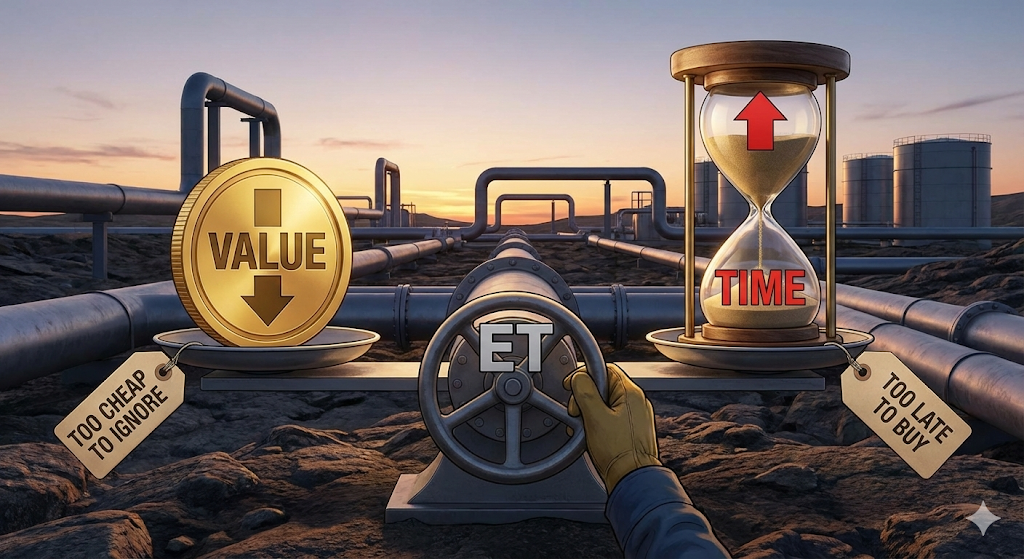
After delivering extraordinary multi-year returns, Energy Transfer LP is increasingly being viewed through a very different lens. The question many income-focused and value-oriented investors are now asking is not whether Energy Transfer was a great investment over the past five years, but whether the risk-reward profile still makes sense at current levels after such a dramatic re-rating. When a midstream energy stock posts nearly 240 percent gains over five years, the burden of proof quietly shifts from the bear to the bull. At this stage of the cycle, the bearish thesis does not hinge on collapse or crisis, but on the growing mismatch between expectations, valuation narratives, and the underlying realities of cash flow growth, capital intensity, leverage, and long-term energy transition risks.
Energy Transfer trades in a sector that markets itself as stable, toll-road-like, and income-generating. That narrative has worked exceptionally well during the rebound phase of the energy cycle, when volumes recovered, distributions stabilized, and investor confidence returned. However, as unit prices plateau and long-term growth catalysts become less certain, the same characteristics that once supported the bull case begin to expose structural weaknesses that matter far more in a mature phase of the cycle.
CHECK THIS OUT: The Quiet Semiconductor Disruptor You’ve Never Heard Of: Aeluma Inc (ALMU) and Air Industries Group (AIRI) Narrows Losses to Just $44K — Is This Aerospace Microcap Entering a Turnaround Phase?
Strong Historical Returns Can Mask a Late-Cycle Setup
One of the most overlooked aspects of Energy Transfer’s current setup is the timing of investor enthusiasm. The unit price has been relatively flat in the short term, modestly down over the past year, and essentially unchanged year to date, yet the longer-term returns remain eye-catching. That contrast alone is often a warning sign. Strong three-year and five-year returns frequently indicate that much of the easy money has already been made, particularly in capital-intensive industries like midstream energy infrastructure.
Markets tend to reward recovery and rerating phases aggressively, then struggle to justify further upside once normalization is complete. Energy Transfer’s recovery from distressed valuations was driven by improved commodity prices, restored distributions, and renewed confidence in pipeline utilization. Those tailwinds are now largely priced in. What remains is a business facing slower organic growth, rising maintenance capital needs, and increasingly complex decisions about where future returns will come from.
The Illusion of Deep Undervaluation in DCF Models
Discounted cash flow models are often cited as the strongest argument against a bearish view on Energy Transfer. On paper, projecting future free cash flow and discounting it back can produce intrinsic values that appear dramatically higher than the current unit price. However, DCF outputs are only as reliable as the assumptions embedded within them, and this is where the bear case gains traction.
Energy Transfer’s free cash flow projections assume a relatively stable operating environment, consistent throughput volumes, manageable capital expenditures, and limited disruption from regulatory, competitive, or energy transition pressures. In reality, midstream assets are not static annuities. They require continuous reinvestment, face periodic contract renegotiations, and remain exposed to producer behavior that is itself cyclical. Small changes in assumed growth rates, terminal values, or discount rates can dramatically reduce the implied intrinsic value. When investors anchor on a single DCF outcome showing a large margin of safety, they may underestimate how fragile that margin actually is.
Earnings Multiples Do Not Fully Capture Risk
From an earnings perspective, Energy Transfer trades near the industry average on a price-to-earnings basis and well below some peer group valuations. At first glance, this supports the idea that the units are still undervalued. The bearish interpretation, however, is that the market is assigning a discount for very real reasons.
Midstream earnings are not equivalent to the earnings of asset-light businesses or companies with strong secular growth drivers. They are tied to physical infrastructure, long depreciation cycles, and significant financing costs. A lower multiple can simply reflect higher perceived risk, slower growth, and limited optionality. In Energy Transfer’s case, complexity across crude oil, natural gas, NGLs, storage, and export assets makes earnings quality harder to assess and increases uncertainty around long-term profitability.
Capital Intensity and Leverage Remain Structural Constraints
One of the core pillars of the bearish thesis is Energy Transfer’s balance sheet and capital allocation profile. Midstream businesses require constant capital to maintain and expand their asset base. Pipelines, terminals, and storage facilities do not generate returns without ongoing spending, and large-scale projects often carry execution risk, cost overruns, and delayed payback periods.
Energy Transfer carries substantial debt, and while leverage is manageable in a stable rate environment, it becomes a meaningful constraint when interest rates remain elevated or refinancing conditions tighten. Servicing debt competes directly with distributions and growth investments. Even if cash flows remain stable, the opportunity cost of carrying high leverage can limit strategic flexibility and cap upside for unitholders.
Distribution Yield Is a Double-Edged Sword
High distribution yields are often cited as a reason to own Energy Transfer, but from a bearish standpoint, yield can be a warning rather than a reward. Elevated yields frequently reflect market skepticism about sustainability, growth, or both. While Energy Transfer has worked hard to rebuild credibility after past distribution cuts, the memory of those cuts still shapes investor psychology.
If future cash flow growth underwhelms or capital spending rises unexpectedly, the distribution becomes a fixed obligation that limits management’s ability to adapt. In such scenarios, even a stable distribution can weigh on valuation if investors believe growth has stalled and the units have effectively become a bond-like instrument with equity risk.
Energy Transition and Long-Term Demand Uncertainty
Perhaps the most underappreciated bearish factor is the slow but persistent shift in global energy markets. Natural gas is often positioned as a bridge fuel, and midstream operators benefit from that narrative today. However, bridge fuels are, by definition, transitional. Over long time horizons, electrification, renewables, and efficiency improvements can reduce growth in fossil fuel demand.
For Energy Transfer, this does not imply imminent decline, but it does suggest that terminal value assumptions deserve scrutiny. Infrastructure built today must generate returns decades into the future to justify its cost. If long-term demand growth is lower than expected, or if regulatory and environmental pressures increase, the economic life of these assets may be shorter or less profitable than models assume.
Why the Bear Case Matters Now
The bearish thesis on Energy Transfer is not about imminent collapse or financial distress. It is about asymmetry. After a massive multi-year rally, upside increasingly depends on optimistic assumptions about growth, valuation expansion, and long-term demand stability. Downside, on the other hand, can emerge from far more ordinary developments such as slower volume growth, higher interest costs, rising maintenance capital, or shifting investor sentiment toward yield-heavy equities.
At current levels, Energy Transfer looks less like a deeply mispriced recovery story and more like a mature midstream operator facing the natural limits of its business model. For investors focused on risk-adjusted returns rather than historical performance, that distinction matters.
Final Bearish Perspective on Energy Transfer Units
Energy Transfer remains a significant player in North American midstream energy infrastructure, but size and scale do not eliminate risk. The combination of capital intensity, leverage, complex operations, and long-term energy transition uncertainty creates a setup where expectations may be higher than what fundamentals can comfortably support going forward. Strong historical returns, attractive headline valuation metrics, and compelling income narratives can obscure these risks, particularly for investors anchoring on past performance.
From a bearish perspective, the key question is no longer whether Energy Transfer was undervalued in the past, but whether it can deliver enough incremental growth and stability in the future to justify holding or adding units today. As the cycle matures and easy gains fade, the risk of disappointment grows, and that is precisely where the bear case becomes most relevant.
READ ALSO: Vuzix Corp (VUZI) Could Be the Dark Horse of Augmented Reality as Defense Contracts & Enterprise Adoption Accelerate and Almonty Industries (ALM) Is Quietly Becoming a Tungsten Powerhouse.