A New Industrial Cycle Is Taking Shape—And One Company in the Philippines Is Quietly Aligning With It
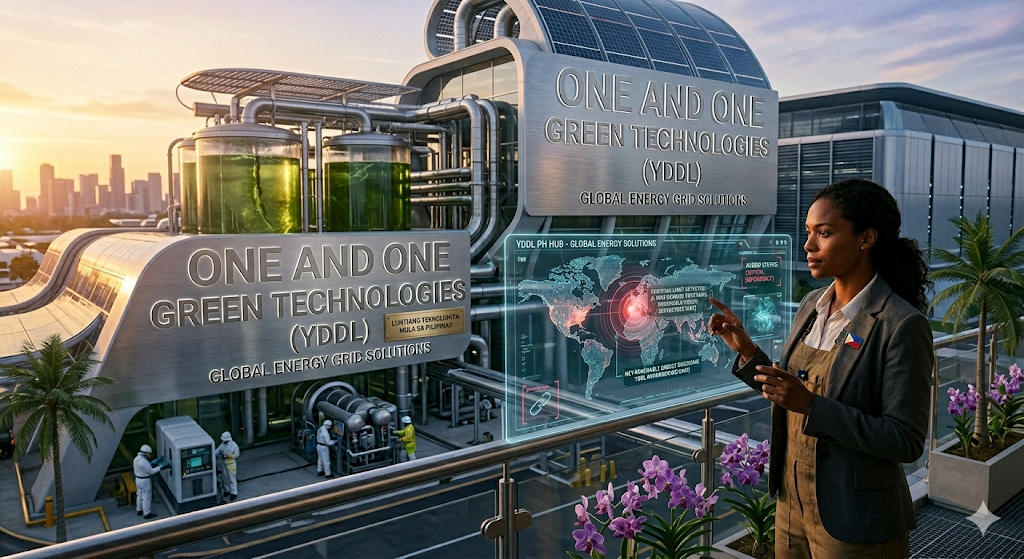
A powerful rotation is quietly unfolding beneath the surface of global equity markets, and One and One Green Technologies Inc. (NASDAQ:YDDL) is emerging as one of its most striking expressions. In a trading session that captured the attention of momentum-driven investors and long-term industrial allocators alike, the stock surged nearly 20 percent to an intraday high of $13.48, breaking through key resistance levels and extending a broader narrative that has been building across capital markets. This move, while dramatic on the surface, reflects something deeper: a growing appetite for capital-intensive, asset-backed companies tied to industrial recycling, AI infrastructure demand, and sustainable materials supply chains.
A Breakout Move Backed by Capital Expansion
The rally coincides with a newly filed SEC registration for up to $18.0 million in Units, each combining equity exposure with detachable warrants, a structure that signals both aggressive capital expansion and a willingness to embrace future dilution in exchange for accelerated growth. With an assumed offering price of $8.12 per Unit and warrants exercisable at a premium, the financing framework underscores management’s confidence in scaling operations, particularly in funding land acquisition, facility expansion, and working capital requirements. While the structure introduces dilution risk through up to 3.3 million additional shares, the market appears to be pricing in the longer-term payoff of increased processing capacity and revenue generation.
Against this backdrop, One and One Green Technologies. INC (NASDAQ:YDDL) is positioning itself not merely as a participant in this shift, but as a direct reflection of it. Based in San Rafael, Bulacan, the company is currently the only Philippines-based recycler with a government-issued license to import hazardous waste and convert it into high-value nonferrous metals—a distinction that places it in a unique category within the global recycling and industrial materials sector.
CHECK THIS OUT: Top 10 Best Cheap HVAC Stocks to Buy Now and Top 5 Copper Stocks to Buy Right Now.
Institutional Capital Is Moving—And the Direction Is Clear
Recent reports from major global investment banks have reinforced a trend that seasoned market observers would recognize as cyclical, yet structurally significant. Strategy teams at both Goldman Sachs and Morgan Stanley have independently highlighted a decisive rotation of institutional capital toward companies with tangible, hard-to-replicate assets.
Morgan Stanley’s analysis points to a confluence of forces driving this shift: a broadening capital expenditure cycle, the rapid expansion of AI infrastructure, and policy incentives that favor investment-heavy industries. In simpler terms, the digital economy is now demanding a physical backbone—data centers, power grids, and industrial materials—at a scale never seen before.
Goldman Sachs, on the other hand, frames this transformation under what it calls the “HALO” strategy, or Heavy Assets, Low Obsolescence. The thesis is straightforward but powerful: companies that own and operate physical infrastructure—especially those with regulatory barriers and long development timelines—are increasingly outperforming their asset-light counterparts. In fact, the firm noted that its capital-intensive basket has outperformed capital-light equities by a striking margin since 2025.
For investors searching for industrial stocks tied to AI growth, recycling companies with strong fundamentals, or emerging market infrastructure plays, this shift is more than academic—it is actionable.
A Business Model Built Before the Trend Became Obvious
What makes One and One Green Technologies particularly interesting is that its business model was not designed in response to these trends—it predates them. Since its founding in 2014, the company has focused on building a foundation rooted in physical infrastructure, regulatory positioning, and environmental compliance.
At the center of this model is its government-issued hazardous waste import license, a regulatory asset that cannot be easily replicated. In an industry where compliance, environmental standards, and permitting can take years—if not decades—to secure, such a license effectively acts as both a moat and a gateway. It allows the company to access consistent, lower-cost raw material streams while limiting competition from unlicensed operators.
The company’s 1,000,000-ton annual processing capacity further reinforces this advantage. This is not merely a number—it represents years of regulatory engagement, infrastructure investment, and operational scaling. In the language of institutional investors, it is the kind of licensed capacity with high barriers to entry that defines long-term value.
From Waste to Wealth: The Economics of Modern Recycling
There is a certain irony in the modern industrial economy. As technology becomes more advanced, the materials required to sustain it—copper, aluminum, precious metals—become more valuable, not less. Data centers, electric vehicles, and renewable energy systems all depend heavily on these inputs.
One and One operates at the intersection of this dynamic. By transforming electronic waste, scrap metal, and industrial byproducts into high-value outputs such as copper alloy ingots, brass, aluminum scrap, and recovered precious metals, the company effectively converts waste streams into economic assets.
This model aligns closely with the growing emphasis on sustainable resource management, a theme that continues to gain traction among both regulators and investors. In an era where environmental, social, and governance (ESG) considerations are becoming central to capital allocation decisions, companies that can combine profitability with environmental responsibility are increasingly favored.
The AI Boom Has a Physical Side—and It’s Massive
One of the more overlooked aspects of the artificial intelligence boom is its reliance on physical infrastructure. While much of the attention has focused on software, algorithms, and chips, the reality is that AI requires an enormous amount of hardware—data centers, power systems, and, critically, metal-intensive components.
Goldman Sachs estimates that the five largest U.S. hyperscalers could deploy more than $650 billion in capital expenditures in 2026 alone, much of it directed toward building the infrastructure needed to support AI workloads. These investments are not abstract; they translate directly into demand for materials like copper, which is essential for electrical systems and connectivity.
This is where companies like One and One enter the picture. By supplying industrial manufacturers across the Asia-Pacific region, the company is effectively embedded in the supply chains that support this massive buildout. For investors looking for AI infrastructure plays beyond traditional tech stocks, this represents a compelling, if less obvious, angle.
Building a Global Supply Chain, One Step at a Time
In recent months, One and One has taken concrete steps to expand its reach beyond the Philippines. A $17 million purchase order from a Japan-based trading company marked a significant milestone, providing access to a steady stream of electronic waste and scrap metal.
The company has also entered the European market through a partnership with a Madrid-based recovery firm, signaling its intent to diversify sourcing channels and tap into global e-waste streams. Meanwhile, its expansion into the Greater Manila Area reflects a parallel strategy of strengthening domestic supply chains.
Taken together, these moves illustrate a broader ambition: to build a globally integrated supply network that maximizes the utilization of its licensed processing capacity. In the language of industrial strategy, the infrastructure is already in place—the focus now is on filling it.
The Bigger Picture: A Structural Shift, Not a Temporary Trend
For those who have spent decades observing market cycles, the current shift toward capital-intensive industries feels both familiar and different. Familiar, because history has repeatedly shown that physical infrastructure becomes critical during periods of technological expansion. Different, because the scale and speed of today’s transformation—driven by AI, electrification, and sustainability—are unprecedented.
One and One Green Technologies sits at the convergence of these forces. It is a company built on physical assets, protected by regulatory barriers, and aligned with long-term industrial demand. Whether viewed through the lens of AI-driven infrastructure, sustainable recycling, or emerging market industrial growth, it represents a model that is increasingly in favor.
For investors, the question is no longer whether such companies matter—it is how early they are willing to recognize their relevance.
YOU MUST READ THIS: Top 10 Semiconductor Stocks on Sale Right Now.
Disclosure: No material interests to disclose. This article was originally published on Global Market Bulletin.