Wall Street loves a good growth story—right up until the growth story asks for another extension cord and a multibillion-dollar loan. On October 30, the AI trade received a costly reminder that the future does not come with free installation. Reuters reported that a technology selloff dragged MSCI’s global index down 1.5%, as results from Intel and Amazon put the cash demands of AI spending under an increasingly unforgiving spotlight. Intel plunged 28.6%, while the Philadelphia semiconductor index shed more than 7%, marking its biggest one-day decline since late June. Alphabet had already rattled investors a day earlier, falling 12.6% after reporting that AI spending had pushed cash flow into negative territory. Artificial intelligence still promised to change the world. Shareholders were beginning to ask whether it could start by finding a cheaper contractor.
The nerves had been building well before that selloff. Reuters reported on October 15 that South Korea’s KOSPI index, home to some of the world’s largest chipmakers, dropped roughly 8% in a single session. Saxo Bank chief investment strategist Charu Chanana suggested that the Asian retreat reflected a repricing of the cost of capital more than a sudden deterioration in technology fundamentals. Investors had not necessarily stopped believing in AI. They had simply reached the part of the relationship where someone asks about outstanding debts.
Interest rates help explain why Wall Street’s enthusiasm has started bringing a calculator to the presentation. Bloomberg reported on October 4 that benchmark 10-year Treasury yields were near 5.3%. Franklin Templeton Institute head market strategist Chris Galipeau said the conversation would change if yields reached 6%. At that level, investors would have another demanding benchmark against which to judge ambitious growth plans. Computing power might keep getting more impressive, but the borrowing costs would be doing some heavy lifting of their own.
For the companies funding the expansion, the bills are becoming too large to hide behind a slide titled “Long-Term Opportunity.” Bloomberg Intelligence analyst Robert Schiffman said hyperscalers including Meta, Amazon, Alphabet, Microsoft, and Oracle now face cash requirements far beyond what they generate, pushing them toward debt markets. AI can draft a business plan, summarize a balance sheet, and produce an encouraging speech in seconds. Persuading a lender to accept “enormous potential” as a monthly payment remains a work in progress.
Oracle is among the companies Schiffman highlighted, and its selloff presents a question worth examining. Why does Wall Street remain so supportive when the share price appears to have filed a formal objection? The answer requires a closer look at how expectations for future growth stack up against the expense of delivering it.
Chip Stocks Have More Than the Electricity Bill to Worry About
For chipmakers, financing is only one item on the growing list of headaches. Competition has arrived, and it has no intention of waiting politely outside. Bloomberg reported on October 13 that the KOSPI fell 5.5% in a single day after China’s CXMT announced a memory-chip breakthrough, challenging the bullish outlook for its global peers. Investors already weighing the cost of expanding production suddenly had another calculation to make. Even if demand lives up to expectations, how much of the profit will still be theirs once competitors finish helping themselves?
The same report said Broadcom chief executive Hock Tan compared the approach of some AI investors to gambling and warned that the industry could encounter funding limits. Coming from a major industry executive, that is the sort of observation that can make a roomful of optimists sit a little straighter. Promising technology still needs financing, and financing still requires someone willing to examine the numbers and sign the check. A compelling presentation may earn applause. Construction crews generally prefer a bank transfer.
Nvidia sits at the center of this debate. Its role in AI makes it a natural focal point for both confidence in future demand and concern about how long customers can sustain their spending. Investors are watching the appetite for its computing power alongside the financial capacity of the companies buying it. Selling the equipment for a gold rush can be an attractive business, provided the prospectors can keep paying for their orders.
Caution is also surfacing among the institutions helping finance the expansion. The same Bloomberg report said JPMorgan Chase and Goldman Sachs took the rare step of limiting their exposure to a loan for AI startup Volta Infrastructure Holdings. In Asia, the collapse of Nvidia-backed data center operator Firmus Grid’s initial public offering has added to investor scrutiny of AI deals built around future earnings. Those profits may eventually arrive, but investors increasingly want a timetable with something more specific than “please remain excited.”
Beneath the futuristic machinery, investors face a decidedly old-fashioned task: finding businesses whose growth prospects justify the asking price. A falling stock can offer an opportunity, but a red price tag alone does not make it a bargain. The earnings outlook, financing needs, and competitive position still deserve inspection before anyone heads to the checkout. With that in mind, we screened for companies pairing relatively low forward earnings multiples with expectations for meaningful sales growth—looking for businesses where the numbers can carry their share of the sales pitch.
CHECK THIS OUT: Q3 2026 Hedge Fund Investor Letters
Our Methodology
For this article, we screened our database of 1,006 hedge funds for stocks trading at a forward price-to-earnings ratio below 15 and carrying expected forward revenue growth of at least 15%, pairing a valuation filter with a sales-growth requirement. From the qualifying companies, we selected the 10 largest by market capitalization and ranked them in ascending order by the number of hedge funds holding stakes in each as of Q2 2026.
If you want to read the full article, click here to view: 10 Best Cheap Stocks to Buy for 2027
Seagate Technology Holdings plc (NASDAQ:STX)
Market capitalization: $139.43 billion
Forward P/E: 9.23
Expected forward revenue growth: 46.16%
Number of hedge fund holders: 131
Hard Drives Make a Very Profitable Comeback
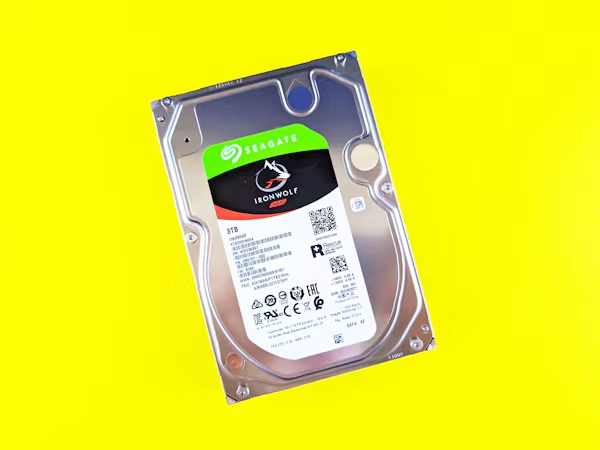
Seagate Technology Holdings plc (NASDAQ: STX) is giving investors a reason to reconsider a technology that rarely wins the glamour contest. Fiscal first-quarter 2027 revenue reached approximately $4.2 billion, up 61% year over year, while the adjusted operating margin climbed to 50.7%. Adjusted earnings totaled $7.68 per share, and free cash flow approached $1.5 billion. In its late-October results, chief executive Dave Mosley described “another quarter of record profitability and our highest ever free cash flow.” The appeal is straightforward: demand for mass-capacity storage can grow alongside AI without requiring the storage supplier to build the model that becomes everyone’s favorite chatbot. The customer still needs somewhere economical to retain the resulting data.
The next stage of the business rests partly on the Mozaic platform and HAMR technology, which increase storage capacity through higher recording density. Management attributed margin expansion to pricing and a more favorable product mix as Mozaic 4 shipments increased. It also maintained a fiscal 2027 capital-expenditure target of 4% to 6% of revenue, a useful measure of how much spending is required to support the transition. On the balance sheet, the company retired $1.2 billion of debt during the quarter and another $750 million after quarter-end. Our interpretation is that this combination deserves attention: improving products can support profitability, while lower debt can leave more of the resulting cash available for shareholders.
Shareholder returns are consequently becoming a larger part of the story. The company returned $568 million through dividends and repurchases during the quarter and increased its quarterly dividend approximately 3% to $0.76 per share. Management also said repurchases should increase significantly in calendar 2027 after the debt-reduction program. At the supplied forward P/E of 9.23, investors are weighing whether strong cash generation can continue as customers adopt higher-capacity products. That is a more useful framework than assuming an established technology must be a declining business. The remaining test is whether storage demand, pricing discipline, and execution stay aligned. A comeback becomes more convincing when it funds both product development and distributions to shareholders.
Ranking rationale: Seagate Technology Holdings plc (NASDAQ: STX) ranks fourth with 131 hedge fund holders. Its supplied 46.16% expected revenue growth and single-digit forward earnings multiple meet the screen. Strong free cash flow, debt reduction, and the product transition provide the business context, rather than changing its ownership-based position.
YOU MUST READ THIS: 10 Best Stocks to Buy for the Next 20 Years and 10 Cloud Stocks Hedge Funds Are Betting On After a Sharp Selloff.
Disclosure: No material interests to disclose. This article was originally published on Global Market Bulletin.