We recently published our article 5 Stocks Under $10 Analysts Believe Could Soar 200%. To read the full story, you can go directly to 10 Stocks Under $10 Analysts Believe Could Soar 200%. In this article, we discuss ARS Pharmaceuticals Inc. (NASDAQ:SPRY) as one of the stocks gaining attention, and here’s a closer look at why it stands out in today’s market.
Stocks trading below $10 have always attracted investors looking for outsized returns. The appeal is easy to understand: a stock rising from $5 to $15 delivers a 200% gain, meaning the investment triples in value. However, a low share price does not automatically mean a company is cheap.
One useful piece of market trivia is that share price and company size are not the same thing. A stock trading at $6 can still represent a multibillion-dollar business if the company has hundreds of millions of shares outstanding. That is why investors searching for the best stocks under $10 should also examine market capitalization, revenue growth, profitability, debt, cash flow, and long-term business prospects.
The companies featured in this article are not small penny stocks. Each has a market capitalization of more than $2 billion and carries a consensus analyst price target suggesting at least 200% upside.
Small-Cap Stocks Are Gaining Momentum
The search for 10 stocks under $10 that could soar 200% comes as smaller companies begin outperforming the broader U.S. stock market.
On July 2, Dominic Pappalardo, Chief Multi-Asset Strategist at Morningstar Wealth, said small-cap stocks could continue delivering above-market returns because their valuations remain attractive compared with large-cap shares.
During 2026, the Morningstar U.S. Small Cap Market Index gained 14%, outperforming the 10.7% increase recorded by the broader Morningstar U.S. Market.
This performance is notable because U.S. small-cap stocks have generally lagged their mid-cap and large-cap peers over the past 15 years. That prolonged underperformance has left many smaller companies trading at discounted valuations, creating potential opportunities for investors looking for undervalued stocks under $10.
The small-cap rally has continued despite a volatile year shaped by geopolitical tensions, including the Iran-U.S. conflict. Latin American stocks have also performed well since the beginning of the war, supported partly by the region’s exposure to oil and other commodities.
Small Caps May Offer Better Diversification
Pappalardo also pointed to diversification as another reason investors may consider small-cap stocks.
Although the S&P 500 includes around 500 companies, approximately 40% of the index is concentrated in its 10 largest holdings. This means a relatively small group of mega-cap companies can have an enormous influence on the performance of the broader market.
Small-cap indexes are generally less concentrated. Their performance is spread across a wider range of industries, including healthcare, financial services, industrials, energy, consumer products, and technology.
This broader exposure could appeal to investors who believe the market has become too dependent on a handful of large technology companies. It may also create opportunities to find high-upside stocks under $10 that are overlooked by investors focused primarily on the biggest names on Wall Street.
Why Stocks Under $10 Can Produce Large Returns
Low-priced stocks can generate dramatic percentage gains because even a relatively small dollar increase can translate into a large return.
For example, a stock rising from $3 to $6 doubles in value. If it reaches $9, it produces a 200% gain. However, the same mathematics also works in reverse. A decline from $6 to $3 results in a 50% loss.
That is why stocks with triple-digit upside potential usually come with considerable risk. A depressed stock price may reflect temporary market pessimism, but it can also signal weak earnings, high debt, slowing demand, regulatory problems, or uncertainty surrounding the company’s business model.
Analyst price targets should therefore be treated as research tools rather than guarantees. A consensus estimate showing 200% upside means analysts see significant recovery potential, but the company may still need to meet ambitious revenue, earnings, or operational expectations.
Small-Cap Valuations Remain Appealing
Morningstar Wealth believes small-cap stocks are more undervalued than they have been in years, while large-cap stocks currently appear expensive.
That valuation gap could support further gains if investors begin shifting money away from highly valued mega-cap stocks and toward smaller companies with stronger recovery potential.
Still, not every inexpensive stock will become a winner. The strongest opportunities may be found in companies with improving fundamentals, manageable debt, competitive advantages, and identifiable growth catalysts.
With that background, let’s examine the 10 stocks under $10 that could soar 200%.
CHECK THIS OUT: Top 10 Stocks That Could Make You a Millionaire Over the Next 3 Years andTop 10 Cheap Stocks Under $10 To Buy Now.
Our Methodology
In order to come up with our list of the 10 stocks under $10 that could soar 200%, we screened U.S.-listed stocks trading below $10 with market capitalizations above $2 billion, shortlisted those with at least 200% consensus upside as of the July 10 close, and ranked the 10 qualifying companies in ascending order based on their projected upside.
5 Stocks Under $10 Analysts Believe Could Soar 200%
2. ARS Pharmaceuticals Inc. (NASDAQ:SPRY)
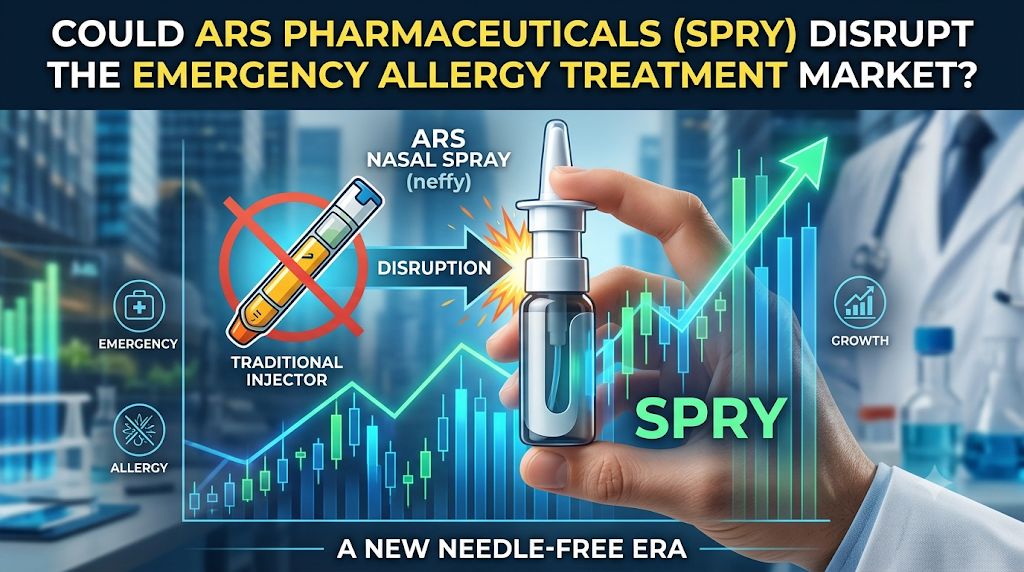
ARS Pharmaceuticals Inc. (NASDAQ: SPRY) takes the second position among the 10 best stocks under $10 that could triple, with shares recently trading at approximately $7 after falling 6.23%. The biopharmaceutical company is developing and commercializing treatments for severe allergic reactions, led by neffy, an epinephrine nasal spray designed to treat anaphylaxis without the use of a needle.
The central investment thesis for ARS Pharmaceuticals Inc. (NASDAQ: SPRY) is relatively easy to understand. Epinephrine is the established emergency treatment for anaphylaxis, but it has traditionally been administered through an injection. Many patients, parents, caregivers, and children feel anxious or hesitant about needles, which can lead to delays in treatment during a medical emergency.
Neffy attempts to address that problem by delivering epinephrine through a nasal spray. A needle-free treatment could make administration easier, reduce hesitation, and expand the number of people willing and able to carry and use epinephrine promptly.
On July 8, ARS Pharmaceuticals Inc. (NASDAQ: SPRY) announced a significant leadership transition. Effective July 6, company co-founder and Chief Executive Officer Richard Lowenthal was no longer employed by the business. Donn Casale, who had been serving as president, was appointed the new chief executive officer and a member of the company’s board of directors beginning July 7.
Unexpected executive transitions can create uncertainty, particularly when a company is moving from drug development into full commercial execution. Investors may question whether the leadership change reflects strategic disagreements, operational problems, commercial challenges, or a planned shift toward a different type of executive expertise.
ARS Pharmaceuticals Inc. (NASDAQ: SPRY) emphasized Casale’s more than 25 years of experience across the biopharmaceutical industry and commercial leadership. His background appears directly relevant to the company’s current needs because neffy’s long-term value will depend not only on regulatory approval but also on payer coverage, physician education, patient awareness, distribution, and sales execution.
Casale previously served as Chief Commercial Officer at Dynavax Technologies, where he played an important role in expanding annual revenue for HEPLISAV-B, a hepatitis B vaccine, to more than $300 million. The vaccine reportedly captured more than half of the U.S. market before Dynavax was acquired by Sanofi for approximately $2.2 billion.
That record gives investors a concrete reason to pay attention to the transition. ARS Pharmaceuticals Inc. (NASDAQ: SPRY) now needs a leader capable of turning a differentiated medical product into a widely used commercial treatment. Casale’s experience scaling a vaccine, competing for market share, working with healthcare providers, and navigating payer systems could be useful as neffy expands.
A strong product does not automatically produce strong sales. Pharmaceutical commercialization requires physicians to understand when and how to prescribe the treatment. Pharmacies must stock or distribute it efficiently. Insurers must decide whether to cover it and under what conditions. Patients must learn that the product exists, believe that it can help them, and obtain it at an affordable price.
The payer-access challenge became visible on June 24, when ARS Pharmaceuticals Inc. (NASDAQ: SPRY) provided an update concerning insurance coverage for neffy. Based on the latest available feedback, the company said no new coverage decisions or commercial formulary additions had been issued for neffy during the July 1 review cycle.
The absence of new formulary decisions may delay broader patient access. Even when a treatment is approved and available, insurance restrictions can limit adoption. Patients may face prior-authorization requirements, higher out-of-pocket costs, step-therapy rules, or other administrative barriers.
ARS Pharmaceuticals Inc. (NASDAQ: SPRY) said it would continue working with additional payers to improve coverage. Management also emphasized that neffy remained broadly accessible to commercially insured patients through direct coverage arrangements and a newly introduced retail cash option.
The retail cash option could help patients who are uninsured, underinsured, or unable to secure immediate coverage through their health plans. However, the effectiveness of this strategy will depend on the out-of-pocket price, patient willingness to pay, and whether the company can make the purchasing process simple.
The commercial opportunity is substantial because severe allergies affect both adults and children. Patients at risk of anaphylaxis may include those with food allergies, insect-sting allergies, medication allergies, or other serious immune reactions.
Many patients are advised to carry epinephrine at all times, often in more than one location. A family may require several devices for home, school, work, travel, and other environments. This creates the possibility of recurring demand, although the market is already served by established injectable epinephrine products.
The major advantage of neffy is convenience. A nasal spray may be less intimidating and potentially easier for an untrained person to administer during an emergency. This could be particularly valuable in schools, restaurants, workplaces, aircraft, public venues, and households where a patient may suddenly become unable to treat themselves.
ARS Pharmaceuticals Inc. (NASDAQ: SPRY) must nevertheless convince healthcare providers that the nasal spray delivers reliable epinephrine exposure across different patient conditions. Physicians may consider factors such as nasal congestion, allergies, improper technique, product storage, dosing consistency, and the speed of treatment.
The company must also compete with widely recognized epinephrine autoinjector brands. Established products benefit from years of physician familiarity, emergency-treatment protocols, school policies, and insurance coverage. Neffy’s success will depend on whether its convenience is strong enough to change prescribing habits and patient preferences.
ARS Pharmaceuticals Inc. (NASDAQ: SPRY) is a biopharmaceutical company focused on developing and commercializing treatments for serious allergic reactions. Neffy allows epinephrine to be administered through the nose rather than through an injection for emergencies such as anaphylaxis.
For investors searching for healthcare stocks under $10, commercial-stage biotech stocks, allergy-treatment stocks, and small-cap pharmaceutical companies with blockbuster potential, ARS Pharmaceuticals Inc. (NASDAQ: SPRY) offers a more commercially advanced opportunity than many clinical-stage names.
The main question is no longer simply whether the treatment can receive regulatory approval. The question is whether management can build widespread coverage, convince physicians to prescribe it, make it affordable for patients, and establish a durable position within the emergency-allergy market.
The new CEO’s commercial track record may improve confidence in that effort. However, payer delays and leadership changes have created additional uncertainty at a critical stage.
ARS Pharmaceuticals Inc. (NASDAQ: SPRY) could become one of the most successful stocks under $10 if neffy develops into a broadly used alternative to injectable epinephrine. The opportunity is large, the product is easy to understand, and the unmet need is real. Execution will now determine whether that promise translates into meaningful revenue growth and long-term shareholder returns.
YOU MUST READ THIS: 10 Robotics Stocks to Buy Now as Amazon (AMZN) Hits 1M Robots
Disclosure: No material interests to disclose. This article was originally published on Global Market Bulletin.