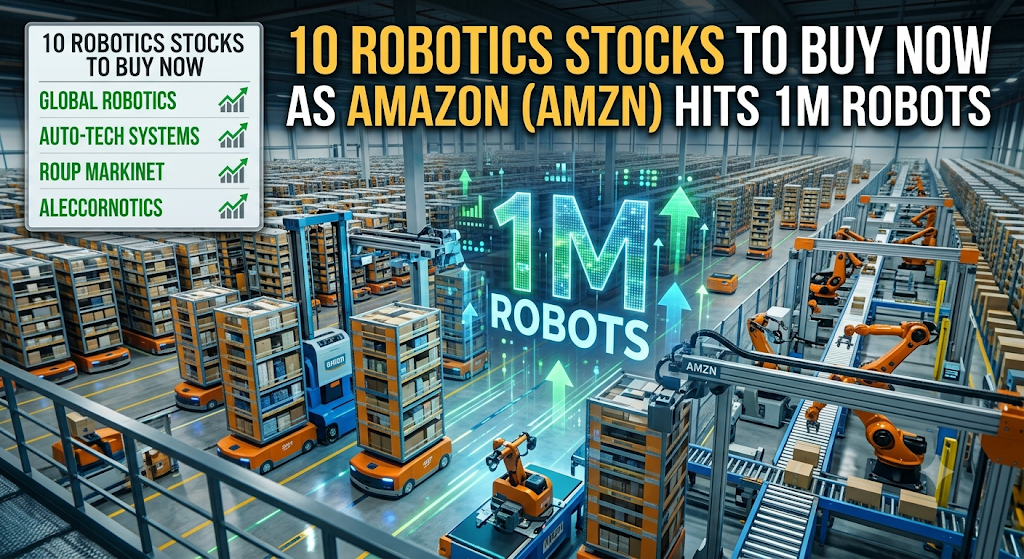
In this article, we will take a look at the 10 Robotics Stocks to Buy Now as Amazon (AMZN) Hits 1M Robots.
The robotics industry used to sound like a story reserved for science fiction movies, advanced research labs, or giant factories with machines working behind glass walls. That is no longer the case. Robotics has moved from the “future technology” shelf into the center of the global economy, and investors are starting to pay much closer attention. From warehouse automation and surgical robotics to defense autonomy, elder care robots, collaborative robots, and AI-powered industrial systems, robotics is becoming one of the most important growth themes in the stock market.
What makes the story even more interesting is that the current robotics boom is not being driven by hardware alone. The real excitement is coming from the combination of robotics hardware, machine learning, physical artificial intelligence, computer vision, sensors, automation software, and foundation models. In simpler terms, robots are no longer just machines programmed to repeat one task. More advanced robotics systems are being designed to perceive their surroundings, adjust to real-world conditions, learn from data, and operate in environments that are messy, unpredictable, and constantly changing.
That is a major shift. For decades, robots were most useful in controlled environments, such as automotive factories or electronics manufacturing plants. They were powerful, precise, and efficient, but they were also limited. Today, the rise of physical AI is changing what robots can do. A robot that can recognize objects, understand movement, navigate a warehouse floor, assist in surgery, support military operations, or help care for aging populations is far more valuable than a machine that simply repeats one mechanical motion. That is why robotics stocks, AI robotics stocks, automation stocks, and industrial technology stocks are now attracting serious attention from long-term investors.
Physical AI Is Changing the Rules of Robotics
One of the biggest reasons the robotics sector is accelerating is the rapid maturation of physical artificial intelligence. Unlike traditional AI, which often lives inside software, cloud systems, search engines, chatbots, or digital platforms, physical AI is about bringing intelligence into the real world. It allows machines to interact with physical spaces, physical objects, and human activity.
This is where robotics becomes especially powerful. A robot equipped with advanced sensors, cameras, edge computing, machine learning models, and real-time decision-making capabilities can perform tasks that once required human judgment. It can inspect products, move packages, assist doctors, support soldiers, help older adults, guide logistics operations, and work side by side with employees on factory floors.
The trivia behind this trend is that robotics has been developing for decades, but many of the most important breakthroughs are only now becoming commercially useful. The word “robot” itself comes from a 1920 play by Czech writer Karel Čapek, where it was used to describe artificial workers. More than a century later, that concept has evolved into a multibillion-dollar global industry. Another interesting piece of robotics history is that the first industrial robot, Unimate, was introduced to a General Motors plant in the early 1960s. It was built for heavy, dangerous work. Today’s robots, however, are not just strong. They are becoming smarter, more flexible, and more connected.
That distinction matters for investors. The next generation of robotics companies is not simply selling machines. Many of them are selling productivity, efficiency, safety, data, precision, and scalability. In the finance landscape, those are words that tend to get Wall Street’s attention.
The Robotics Market Is Entering a Record Growth Phase
The global robotics sector is now experiencing an unprecedented boom amid the commoditization of hardware and the rapid improvement of AI models. According to the Robotics Center, the robotics sector is growing at a record 34% year over year and is expected to reach $38 billion in 2026. That kind of growth rate is difficult to ignore, especially in a market where investors are constantly searching for long-term technology trends that could reshape entire industries.
The American robotics industry appears to be entering a decisive acceleration phase. This is not limited to one narrow corner of the economy. Robotics is spreading across healthcare, logistics, defense, e-commerce, manufacturing, agriculture, food service, construction, and senior care. Surgical robots are helping doctors perform complex procedures with greater precision. Defense autonomy is changing how governments think about surveillance, battlefield systems, drones, and unmanned vehicles. Collaborative robots, often called cobots, are helping human workers complete tasks in factories and warehouses. Elder care robotics is gaining attention as countries deal with aging populations and labor shortages.
For investors looking for the best robotics stocks to buy, the opportunity is attractive because robotics sits at the intersection of several major themes: artificial intelligence, automation, labor productivity, supply chain modernization, healthcare innovation, national security, and demographic change. That mix gives the robotics industry a wider runway than many single-product technology trends.
Still, the opportunity is not without risk. Robotics companies often require heavy investment in research and development. Some operate in competitive hardware markets with margin pressure. Others depend on enterprise adoption cycles, government contracts, healthcare approvals, or manufacturing demand. That is why robotic stocks can be high-risk, high-reward opportunities. The sector has a high ceiling, but not every company will become a long-term winner.
Amazon Shows How Big the Robotics Revolution Can Become
Few companies demonstrate the power of robotics better than Amazon. The e-commerce and cloud giant has become one of the most visible leaders in warehouse automation and logistics robotics. Amazon has already deployed more than 1 million robots across its operations, a milestone that shows how far automation has moved from experimental technology into everyday business infrastructure.
The company’s use of robotics is not just about having futuristic machines inside fulfillment centers. It is about speed, efficiency, cost control, and scale. Roughly 75% of Amazon’s global deliveries are now assisted by robots, allowing the company to improve productivity across its massive logistics network. That is an extraordinary figure because it shows how robotics can influence one of the most important parts of the modern economy: moving products from sellers to customers faster and more efficiently.
One of the most striking productivity numbers linked to Amazon’s automation push is the increase in packages shipped per employee. The figure has reportedly climbed to 3,870 packages from just 175 in 2015, a jump that highlights how robotics can dramatically increase output per worker. That is the kind of operating leverage investors often look for when analyzing automation stocks, AI-powered robotics stocks, and companies benefiting from the future of work.
At the same time, the Amazon robotics story also shows the complicated human side of automation. Robots may allow the company to slow hiring or replace certain manual tasks, but Amazon still employs around 1.56 million humans. That detail is important because the robotics revolution is not simply about robots replacing people overnight. In many cases, it is about companies redesigning workflows where humans and machines operate together. In warehouses, hospitals, factories, and defense systems, the most valuable robotics platforms may be those that make human work faster, safer, and more productive.
Why Robotics Stocks Are Becoming Harder to Ignore
For long-term investors, the rise of robotics creates a compelling but challenging stock market opportunity. The best robotic stocks to buy are not always the most obvious names. Some companies are pure-play robotics firms. Others are diversified technology, industrial, healthcare, or defense companies with major exposure to automation. Some are building surgical systems. Some are selling sensors and chips. Some are developing machine vision platforms. Others are building autonomous robots for warehouses, factories, farms, hospitals, and military applications.
This is why the robotics investment theme requires patience and selectivity. The sector is growing quickly, but investors still need to separate durable businesses from hype-driven stories. Strong robotics companies often have a mix of deep engineering talent, proprietary technology, recurring revenue opportunities, enterprise customers, strong balance sheets, and clear use cases. In the stock market, the strongest long-term robotics winners may be companies that solve expensive real-world problems instead of simply chasing futuristic headlines.
The rise of AI robotics also comes at a time when businesses are under pressure to do more with fewer workers. Labor shortages, wage inflation, supply chain disruptions, and the demand for faster delivery times have made automation more attractive. In healthcare, robotics can support precision and consistency. In defense, autonomous systems can reduce human risk in dangerous environments. In elder care, robotics may help address the growing need for assistance as populations age. In manufacturing, collaborative robots can help companies improve production without fully replacing human workers.
That combination of economic pressure and technological progress is one reason robotics has become one of the most exciting investment themes in the market. Investors are no longer asking whether robots will matter. The better question is which robotics companies, automation leaders, AI hardware suppliers, and industrial technology stocks are best positioned to benefit as adoption accelerates.
The Long-Term Case for Robotic Stocks
The robotics industry is still young compared with more mature areas of technology, but its growth trajectory is becoming harder to dismiss. As hardware becomes cheaper, AI models become more capable, and companies search for productivity gains, robotics could become a larger part of everyday business operations. The next wave of winners may come from surgical robotics, warehouse automation, autonomous defense systems, humanoid robots, industrial automation, logistics technology, machine vision, and AI-powered manufacturing platforms.
For patient investors, this creates a high-risk, high-reward setup. Robotics stocks can be volatile, especially when valuations run ahead of near-term earnings. However, the long-term market opportunity remains significant. The companies that can turn robotics innovation into real revenue, strong margins, and scalable business models may be among the most important technology and industrial winners of the next decade.
With the robotics sector growing rapidly and the adoption of physical AI entering a new phase, this article takes a closer look at some of the best robotic stocks to buy for investors seeking long-term exposure to automation, artificial intelligence, and the future of intelligent machines.
CHECK THIS OUT: Top 10 Cheap Stocks Under $10 To Buy Now and 10 Most Profitable Energy Stocks to Buy in 2026.
Our Methodology
Our ranking was based on each company’s robotics exposure, AI and automation relevance, recent business developments, hedge fund interest, and short percentage of float as the robotics sector gains momentum from Amazon.com, Inc. (NASDAQ: AMZN)’s 1 million robot milestone.
10 Robotics Stocks to Buy Now as Amazon (AMZN) Hits 1M Robots
10. Symbotic Inc. (NASDAQ:SYM)
Symbotic Inc. (NASDAQ: SYM) takes the No. 10 spot among the 10 robotics stocks to buy now as Amazon.com, Inc. (NASDAQ: AMZN) hits 1 million robots, and this is one of the more direct warehouse automation names in the group. While some companies on this list are robotics-adjacent through chips, software, industrial automation, or medical technology, Symbotic Inc. (NASDAQ: SYM) is much closer to the actual warehouse floor. The company develops AI-powered robotic warehouse automation systems designed to move pallets, cases, and individual items through modern distribution centers with greater speed, density, accuracy, and efficiency. In a market where investors are searching for robotics stocks, AI robotics stocks, automation stocks, warehouse automation stocks, and artificial intelligence stocks with real-world use cases, Symbotic Inc. (NASDAQ: SYM) stands out because its technology directly targets the supply chain bottlenecks that major retailers and logistics operators are trying to solve.
The timing is important. Amazon.com, Inc. (NASDAQ: AMZN) has already deployed more than 1 million robots across its operations, and that milestone has changed how investors look at the entire robotics industry. The robotics story is no longer just about futuristic machines or humanoid robots walking across a stage. It is about fulfillment centers, labor productivity, inventory accuracy, package movement, and the ability of large companies to deliver goods faster without letting costs spiral out of control. Symbotic Inc. (NASDAQ: SYM) fits that theme because its end-to-end system uses robotics, machine learning, high-density storage, and AI-powered software to help companies rethink the warehouse as a strategic asset rather than just a storage box. The company says its systems are built to improve speed, flexibility, throughput, and operating efficiency in warehouses, which makes Symbotic Inc. (NASDAQ: SYM) one of the clearer pure-play robotics stocks to watch in the supply chain automation market.
One reason Symbotic Inc. (NASDAQ: SYM) deserves a place in this list is its deep relationship with Walmart Inc. (NYSE: WMT), which has been one of the most aggressive large retailers in warehouse automation. Walmart Inc. (NYSE: WMT) previously expanded its partnership with Symbotic Inc. (NASDAQ: SYM) to implement the company’s automation system across 42 regional distribution centers, showing that this is not a small pilot project or a nice-to-have experiment. More recently, Symbotic Inc. (NASDAQ: SYM) completed the acquisition of Walmart Inc. (NYSE: WMT)’s Advanced Systems and Robotics business and signed a related commercial agreement, with Walmart Inc. (NYSE: WMT) paying a total of $520 million tied to a development program. That agreement also included potential deployment for 400 accelerated pickup and delivery centers if performance criteria are met, giving Symbotic Inc. (NASDAQ: SYM) a major runway in AI-powered logistics automation.
For investors looking at the best robotics stocks to buy, Symbotic Inc. (NASDAQ: SYM) is interesting because it sits at the intersection of robotics hardware, artificial intelligence, warehouse automation, retail logistics, and supply chain modernization. The company is not simply selling robots. It is selling a system that could help large enterprises redesign how goods move from warehouse to store, from store to customer, and from inventory shelf to pickup order. That is why Symbotic Inc. (NASDAQ: SYM) has become a name to watch as Amazon.com, Inc. (NASDAQ: AMZN), Walmart Inc. (NYSE: WMT), and other major retailers race to automate fulfillment. The risk, of course, is that robotics deployment is capital-intensive, execution-heavy, and tied to large customer schedules. But for patient investors looking for a high-risk, high-reward robotics stock with a direct link to AI warehouse automation, Symbotic Inc. (NASDAQ: SYM) deserves attention.
Click next to see the following stock...