We recently published our article Top 10 Semiconductor Stocks on Sale Right Now, where we identified chipmakers trading at attractive valuations despite ongoing market pressures. In this piece, we turn our attention to SiTime Corporation (NASDAQ:SITM), one of the companies on that list, to take a closer look at its positioning, recent developments, and why it could present an opportunity at current levels.
A Shockwave Through Silicon: Why Semiconductor Stocks Are Suddenly Under Pressure
For decades, semiconductor stocks have stood at the very heart of modern economic growth—quietly powering everything from smartphones and electric vehicles to artificial intelligence, cloud computing, and defense systems. Industry veterans often remark that “every major technological revolution begins and ends with chips,” a reality that has made the semiconductor sector one of the most closely watched spaces in global financial markets. Yet, as 2026 unfolds, even this critical backbone of the digital economy is not immune to geopolitical shockwaves.
In recent weeks, escalating tensions surrounding the U.S.-Israel conflict with Iran have sent ripples across global markets, and nowhere has the impact been more pronounced than in semiconductor stocks. What began as a localized geopolitical risk has quickly evolved into a broader macroeconomic concern, triggering a noticeable semiconductor sell-off and pushing several high-quality chip stocks into what analysts now describe as deeply oversold territory.
Seasoned market observers—those who have tracked cycles from the Asian financial crisis to the COVID-era supply chain disruptions—recognize this pattern all too well. When geopolitical uncertainty collides with a globally interconnected industry like semiconductors, volatility is not just expected; it becomes inevitable. And in today’s environment, where the semiconductor supply chain spans continents and relies heavily on fragile logistics networks, even a single disruption can cascade into far-reaching consequences.
The Hidden Backbone: Why the Middle East Matters More Than Investors Think
One of the lesser-known but critically important realities of the semiconductor industry is its dependence on specialized raw materials—many of which originate from geopolitically sensitive regions. While most investors focus on chip designers, foundries, and AI-driven demand, the upstream supply chain often remains overlooked until disruptions occur.
According to recent global reports, the Middle East plays a pivotal role in supplying key materials such as helium and bromine—both essential in semiconductor manufacturing processes. Helium, for instance, is not just used in balloons or medical imaging; it is a critical component in cooling systems for semiconductor fabrication and advanced chip production. What makes this even more significant is that Qatar alone accounts for more than one-third of the world’s helium supply, a statistic that rarely makes headlines but carries enormous implications for global chip production.
As tensions escalate and the possibility of disruptions around the Strait of Hormuz intensifies, analysts warn that as much as 25% of global supply chains tied to semiconductor manufacturing could be at risk. For an industry already operating on tight margins and just-in-time logistics, such a scenario is more than a temporary setback—it is a potential bottleneck that could ripple across the entire technology ecosystem.
Investor sentiment took another hit following reports of a drone attack on QatarEnergy’s Ras Laffan Industrial City, a critical hub for energy and industrial output. While the immediate damage may be contained, the broader implication is clear: even short-term production halts—estimated at two to three months—can lead to prolonged normalization periods for global supply chains. For semiconductor companies, this translates into delayed production cycles, rising input costs, and increased uncertainty in meeting demand.
Energy Shock Meets AI Demand: A Perfect Storm for Chip Stocks
Compounding the situation is the surge in global energy prices, with Brent crude oil climbing above the $100 per barrel threshold. Historically, rising energy costs have had a direct and often underestimated impact on semiconductor stocks, particularly as chip manufacturing and AI infrastructure are among the most energy-intensive industrial processes in the modern economy.
Artificial intelligence, one of the primary growth drivers behind the recent semiconductor bull run, relies heavily on massive data centers that consume vast amounts of electricity. As power costs increase, the economics of scaling AI infrastructure become more challenging, potentially slowing down capital expenditures from hyperscalers and enterprise clients. This creates a paradox where the very sector fueling semiconductor demand—AI—also becomes vulnerable to rising operational costs.
For investors searching for the best semiconductor stocks or undervalued chip stocks, this dynamic introduces both risk and opportunity. While short-term demand may soften due to cost pressures, the long-term structural drivers of AI, automation, and digital transformation remain intact. This divergence between short-term headwinds and long-term growth potential is precisely what creates oversold conditions in the market.
Billions Wiped Out: Market Reaction and Valuation Reset
The financial impact of these developments has been swift and significant. Reports indicate that more than $200 billion in combined market value has been erased from major memory chipmakers such as Samsung and SK Hynix since the onset of the conflict. For a sector that had previously enjoyed strong momentum driven by AI and data center demand, this sudden reversal underscores the sensitivity of semiconductor stocks to external shocks.
However, for those with a long memory of market cycles, such periods of sharp correction often signal the early stages of a valuation reset rather than a structural decline. Historically, the best semiconductor stocks have emerged stronger after periods of volatility, as weaker hands exit the market and long-term investors begin to accumulate positions at discounted levels.
In the language of modern investing, this is where opportunity begins to take shape. Oversold semiconductor stocks—particularly those with strong fundamentals, resilient supply chains, and exposure to long-term growth themes—often become prime candidates for a rebound once macroeconomic conditions stabilize.
A Contrarian Opportunity in the Making
What makes the current environment particularly compelling is the convergence of fear-driven selling and enduring structural demand. While headlines focus on geopolitical risks and supply chain disruptions, the underlying drivers of semiconductor growth—artificial intelligence, 5G, electric vehicles, and cloud computing—remain firmly in place.
For investors actively searching for semiconductor stocks to buy now, the present moment may represent a classic contrarian setup. Markets, after all, are forward-looking. By the time geopolitical tensions ease and supply chains normalize, much of the upside may already be priced in.
As the semiconductor sector navigates this latest wave of uncertainty, one thing remains clear: volatility may dominate the headlines, but it is often during such periods that the most compelling investment opportunities are quietly formed. In that context, examining the most oversold semiconductor stocks is not merely a defensive exercise—it is a strategic move for those looking to position themselves ahead of the next potential rally in the global chip industry.
Our Methodology
In order to come up with our list of the top 10 semiconductor stocks on sale right now, we screened U.S.-listed semiconductor stocks with a Relative Strength Index (RSI) below 30 to identify oversold conditions. From there, we focused on companies with at least 30% upside based on analyst price targets and trading at least 20% below their 52-week highs. The final list was ranked in ascending order of upside potential using data as of March 16, 2026.
Top 10 Semiconductor Stocks on Sale Right Now
6. SiTime Corporation (NASDAQ:SITM)
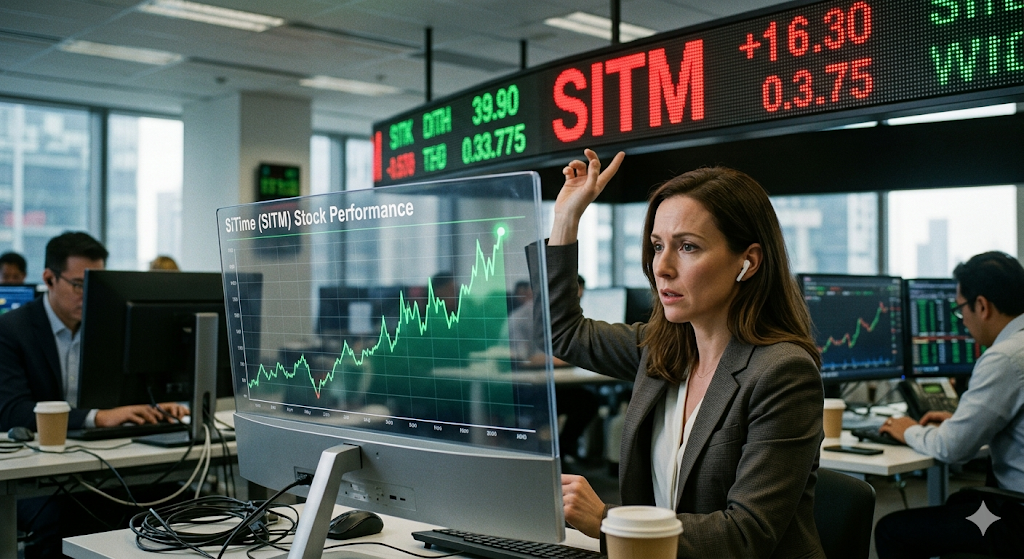
SiTime Corporation (NASDAQ:SITM), trading at $351.02, represents a niche but increasingly critical segment of the semiconductor industry—precision timing solutions. While often overlooked, timing chips are essential components in modern electronics, ensuring synchronization across complex systems ranging from data centers to autonomous vehicles.
As of March 2026, over 80% of analysts remain bullish on SiTime, with a consensus price target of $450 implying significant upside. This optimism is largely driven by the company’s strategic shift toward higher-value markets, including AI infrastructure, cloud computing, and enterprise applications.
Management’s recent commentary at the Morgan Stanley Technology Conference highlighted a clear transition away from traditional consumer markets toward more lucrative segments. With communications, enterprise, and data center applications now accounting for the majority of revenue, SiTime is positioning itself at the center of the next wave of semiconductor demand.
The company’s acquisition of Renesas Electronics’ timing division further strengthens its competitive position, paving the way for margin expansion and accelerated revenue growth. Management has outlined ambitious targets, including gross margins of 65% and annual revenue growth of up to 30%.
At the same time, the company remains mindful of external risks, including geopolitical tensions and supply chain disruptions—factors that have already impacted the broader semiconductor sector.
For investors searching for oversold semiconductor stocks with strong growth potential and exposure to AI-driven demand, SiTime stands out as a specialized player with outsized upside.
READ ALSO: Top 10 Cheap Robotics Stocks To Buy Now and Top 5 Best Cybersecurity Micro-Caps to Watch in 2026.
Disclosure: No material interests to disclose. This article was originally published on Global Market Bulletin.