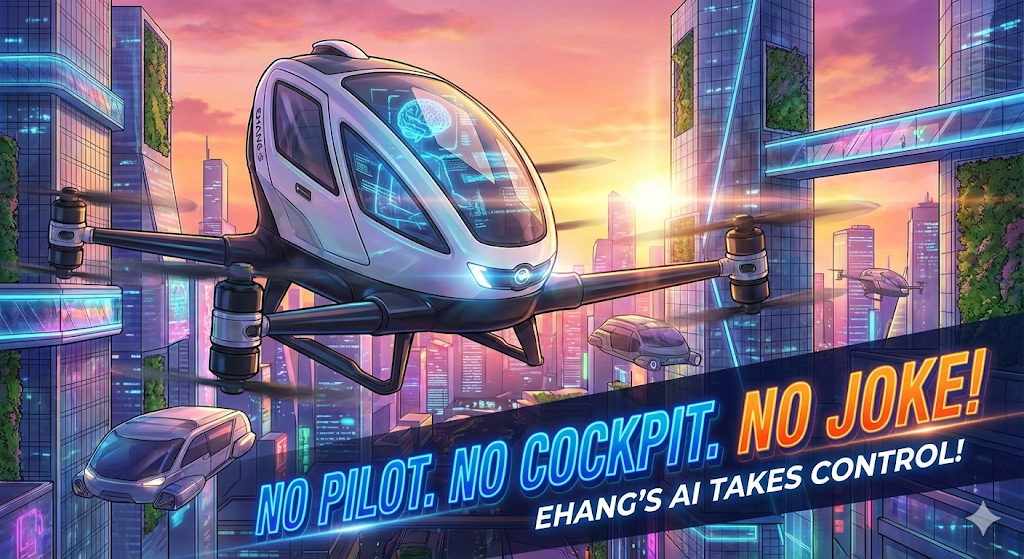
Founded in China at a time when autonomous flight was still viewed as a futuristic experiment rather than a commercial reality, EHang Holdings Limited emerged with a bold and unconventional vision: to build safe, pilotless aerial vehicles capable of transforming urban transportation, logistics, and aerial services. Established in 2014, the company positioned itself early at the intersection of autonomous technology, electric aviation, and urban air mobility, betting that advances in sensors, AI-driven flight control systems, and electric propulsion would eventually make short-range autonomous air travel viable. From the outset, the focus was not on incremental aerospace improvements, but on reimagining flight as a software-defined, highly automated system designed for dense urban environments.
In its early development phase, EHang (NASDAQ:EH) concentrated on building proprietary autonomous flight technologies rather than adapting traditional piloted aircraft designs. This decision shaped the company’s identity and long-term strategy, prioritizing centralized command-and-control systems, redundancy-driven safety architecture, and simplified aircraft design optimized for autonomy. Instead of targeting private pilots or niche aviation enthusiasts, EHang focused on scalable use cases such as urban passenger transport, emergency response, aerial sightseeing, and logistics, embedding autonomy into the core of its electric vertical takeoff and landing platform from day one. This approach differentiated the company from many urban air mobility peers that initially relied on piloted concepts as a transitional step.
As the autonomous eVTOL sector began attracting global attention, EHang steadily expanded its ecosystem beyond aircraft development. The company invested in simulation platforms, autonomous traffic management concepts, and integrated operations software, recognizing that air vehicles alone would not be sufficient to enable commercial deployment. This systems-level mindset positioned EHang as both a hardware and software company, blending aerospace engineering with robotics, artificial intelligence, and data-driven operations. Over time, this integrated approach became central to its positioning within the broader urban air mobility narrative.
EHang’s background is also closely tied to its early engagement with regulators and local governments, particularly in China. Rather than avoiding regulatory scrutiny, the company actively collaborated with aviation authorities to shape certification pathways for pilotless aircraft. This proactive stance allowed EHang to accumulate real-world flight data through extensive test programs and demonstration projects across multiple cities. These demonstrations were not merely marketing exercises, but part of a longer-term strategy to validate autonomous aerial systems under controlled, regulator-supervised conditions, gradually building trust in the safety and reliability of pilotless eVTOL operations.
The evolution of EHang’s product lineup reflects this long-term orientation. The EH216 series became one of the most recognizable autonomous passenger-grade eVTOL platforms globally, serving as a proof of concept for short-range, low-altitude urban flights. At the same time, the company continued to iterate on airframe design, propulsion efficiency, and systems redundancy, applying lessons learned from thousands of autonomous test flights. This iterative development process laid the foundation for more advanced platforms, including longer-range and higher-capacity aircraft designed to expand the addressable market beyond initial urban demonstration routes.
Manufacturing and industrialization gradually became a more prominent part of EHang’s background as the company transitioned from prototype-driven development to commercialization readiness. Investments in dedicated production facilities and supply chain partnerships reflected an understanding that scaling autonomous aviation requires not just technological breakthroughs, but disciplined industrial execution. By integrating manufacturing considerations early into its engineering processes, EHang sought to avoid the pitfalls that have historically plagued aerospace startups attempting to scale too quickly without operational maturity.
Over time, EHang’s identity evolved from a niche drone innovator into a globally recognized autonomous aviation company. Its background became defined not only by technological ambition, but by persistence in navigating regulatory complexity, public skepticism, and the inherent challenges of introducing a new mode of transportation. As urban air mobility gained traction as a long-term megatrend, EHang positioned itself as one of the few companies with real-world autonomous flight experience, an expanding portfolio of certified aircraft, and a growing operational footprint.
Today, EHang’s background reflects a decade-long effort to push autonomous eVTOL technology from concept to commercial reality. Its journey illustrates how early conviction in autonomy, combined with sustained investment in safety, compliance, and systems integration, can create a differentiated position in one of the most challenging frontiers of modern transportation. This foundation continues to shape how EHang is perceived within the global urban air mobility and autonomous aviation landscape.
A Leadership Move That Reframes EHang’s Long-Term Investment Case
EHang Holdings Limited has long been one of the most polarizing names in the urban air mobility and autonomous aviation space, largely because its vision has always been far ahead of what most investors considered commercially realistic. The appointment of founding engineer Shuai Feng as Chief Technology Officer in January 2026 represents more than a routine executive reshuffle. It marks a structural shift in how the company aligns engineering leadership, manufacturing execution, regulatory compliance, and commercialization under a single accountable authority. For a company attempting to industrialize pilotless human-carrying eVTOL aircraft, this consolidation directly impacts how investors should think about risk, scalability, and credibility.
From the beginning, EHang’s story has hinged on whether autonomous aerial vehicles could move from high-profile demonstrations into regulated, revenue-generating transport systems. Markets have historically discounted the company because of perceived gaps between technology ambition and industrial execution. By elevating Shuai Feng, a founding engineer deeply involved in the EH216 program, the VT35 long-range eVTOL, and the Hefei manufacturing hub, EHang is signaling that its next phase is not about vision, but about disciplined delivery.
CHECK THIS OUT: The Quiet Semiconductor Disruptor You’ve Never Heard Of: Aeluma Inc (ALMU) and Air Industries Group (AIRI) Narrows Losses to Just $44K — Is This Aerospace Microcap Entering a Turnaround Phase?
Why Shuai Feng’s Background Matters More Than the Title Change
Shuai Feng is not an external hire brought in for optics. He has been embedded in EHang’s product engineering DNA since its earliest days, shaping the architecture of autonomous flight systems, propulsion integration, redundancy frameworks, and safety-critical software. His elevation to CTO formalizes authority he already exercised informally, but more importantly, expands his remit to include procurement, supply chain integration, manufacturing scale-up, and compliance oversight.
This matters because eVTOL commercialization is not primarily a software problem. It is an industrial systems problem where engineering decisions cascade into manufacturing yield, cost structure, certification timelines, and operational safety. By placing technology, compliance, and supply chain execution under one leader, EHang reduces internal friction between R&D ambitions and real-world constraints. For investors, this integration lowers one of the most persistent execution risks in the autonomous aviation sector: misalignment between engineering teams and industrial operations.
Connecting Technology Roadmaps to Certification and Revenue Visibility
One of the central investor concerns around EHang has always been certification risk. Pilotless, human-carrying eVTOL aircraft face a higher regulatory bar than piloted alternatives, particularly in China where authorities have taken a cautious, safety-first approach. Shuai Feng’s expanded role explicitly links the technology roadmap to regulatory compliance, which is critical for turning certifications into predictable deliveries rather than sporadic headline wins.
The EH216-S certification milestones and the VT35 long-range eVTOL development program both fall squarely within Feng’s expertise. His leadership ensures that design iterations, component sourcing, and manufacturing processes are optimized with certification requirements in mind from the outset, rather than retrofitted later. This approach may slow near-term delivery volumes, but it strengthens the long-term investment thesis by prioritizing repeatability, safety, and regulator confidence, all of which underpin sustainable revenue growth in urban air mobility.
The Hefei Manufacturing Hub as a Test of Industrial Credibility
EHang’s Hefei manufacturing hub has become a focal point for investors evaluating whether the company can transition from prototype-driven narratives to industrialized production. Under Shuai Feng’s expanded mandate, the facility is no longer just a manufacturing site but a proof point for EHang’s ability to integrate supply chains, manage quality control, and scale production without compromising safety standards.
For bullish investors, this is a critical inflection. Many eVTOL peers remain trapped in perpetual development cycles with limited manufacturing readiness. EHang’s willingness to prioritize operational readiness over aggressive delivery targets suggests a more conservative but ultimately more credible commercialization path. In a sector where one high-profile safety failure could set adoption back years, this discipline strengthens the long-term risk-reward profile.
Reframing the Growth Narrative Toward Execution Rather Than Hype
Financial projections for EHang often appear ambitious, with forecasts pointing to multi-billion-yuan revenue potential by the late 2020s. Skeptics focus on the gap between current deliveries and those targets, while bulls emphasize first-mover advantage in autonomous eVTOL certification. The CTO appointment does not magically close that gap, but it does meaningfully alter how investors should assess the probability of execution.
By unifying engineering leadership with supply chain management and compliance, EHang is effectively compressing decision-making loops that previously spanned multiple organizational layers. This increases responsiveness to manufacturing bottlenecks, regulatory feedback, and component shortages, all of which have historically derailed aerospace commercialization efforts. For a company operating in a capital-intensive, safety-critical industry, organizational efficiency can be as important as technological differentiation.
Autonomous eVTOLs and the Long-Term Urban Air Mobility Thesis
The broader bullish thesis on EHang still rests on the belief that autonomous eVTOLs can become a viable component of future urban transportation networks. This requires not only technological feasibility but also regulatory acceptance, public trust, and cost structures that make operations economically sustainable. Shuai Feng’s appointment does not change the fundamental bet, but it increases confidence that EHang understands the complexity of moving from controlled test environments to scaled commercial operations.
The VT35 long-range eVTOL, in particular, expands the addressable market beyond short-hop urban flights into regional mobility use cases. Integrating this platform into the same industrial and compliance framework as the EH216-S suggests a modular, scalable approach to product development. For investors, this hints at optionality beyond a single aircraft model, which is essential for justifying long-term valuation upside in the autonomous aviation sector.
Balancing Near-Term Caution With Long-Term Optionality
It is important to acknowledge that EHang’s emphasis on operational readiness could temper near-term revenue acceleration. Certification timelines, cautious production ramps, and conservative deployment strategies may frustrate momentum-driven investors. However, for long-term shareholders, this approach aligns better with the realities of aerospace commercialization, where premature scaling often leads to costly setbacks.
Shuai Feng’s dual focus on technology leadership and industrial execution reflects an understanding that safety, reliability, and compliance are not constraints on growth but prerequisites for it. This mindset may ultimately differentiate EHang from competitors that prioritize speed over sustainability.
Why the CTO Appointment Strengthens the Bullish Case
In isolation, a CTO appointment rarely changes an investment thesis. In EHang’s case, the elevation of a founding engineer with deep product, manufacturing, and compliance experience meaningfully reshapes the execution narrative. It reduces organizational risk, tightens alignment between engineering and commercialization, and signals to regulators and partners that EHang is serious about industrial discipline.
For investors willing to accept the inherent risks of autonomous aviation, this leadership move strengthens the long-term bull case by increasing the likelihood that EHang can translate certifications into scalable, repeatable operations. The story is shifting from whether autonomous eVTOLs are possible to whether EHang can industrialize them responsibly. With Shuai Feng at the helm of technology, supply chain, and compliance, that question now has a clearer, more credible answer.
READ ALSO: Vuzix Corp (VUZI) Could Be the Dark Horse of Augmented Reality as Defense Contracts & Enterprise Adoption Accelerate and Almonty Industries (ALM) Is Quietly Becoming a Tungsten Powerhouse.