The company was created to solve a very practical problem that modern cities increasingly face: last-mile delivery has become expensive, inefficient, and difficult to scale using human couriers alone. As food delivery, grocery delivery, and on-demand commerce accelerated across dense urban areas, the cost structure of traditional delivery models began to strain platforms, merchants, and consumers. Sidewalk congestion, labor shortages, rising wages, and inconsistent delivery times exposed a clear gap in the logistics ecosystem, creating the conditions for autonomous delivery to move from concept to necessity. This environment shaped the foundation of a business focused on using artificial intelligence and robotics to handle short-distance, high-frequency deliveries in real urban settings.
Serve Robotics (NASDAQ:SERV) was developed out of an internal robotics program at Postmates, where engineers were tasked with building delivery robots that could operate reliably on public sidewalks rather than in controlled or private environments. That origin gave the company an early advantage, grounding its technology in real delivery use cases instead of laboratory simulations. The early emphasis was not on flashy demonstrations, but on solving the daily challenges of navigation, safety, and efficiency in crowded city neighborhoods. This practical focus helped shape the company’s long-term approach to autonomous delivery, prioritizing repeatable performance, regulatory compliance, and seamless integration into existing delivery platforms.
Serve Robotics evolved as its autonomous delivery robots moved from testing phases into live commercial deployments. The company concentrated on dense urban markets where short-distance deliveries are common and cost pressures are highest. Its robots were designed specifically for sidewalk operation, using a combination of computer vision, sensor fusion, and AI-driven decision-making to safely interact with pedestrians, traffic signals, and unpredictable obstacles. Over time, these deployments generated valuable real-world data, allowing the company to continuously improve navigation algorithms, routing efficiency, and fleet management systems. This accumulation of operational experience became a defining part of the company’s background and a key differentiator within the broader robotics and AI landscape.
As the autonomous delivery sector began to mature, Serve Robotics positioned itself not merely as a hardware manufacturer, but as a technology platform embedded within the on-demand delivery economy. The company focused on building software infrastructure that could manage fleets of robots, optimize delivery routes, and integrate directly with major food delivery and logistics platforms. These integrations allowed autonomous deliveries to appear seamlessly within consumer apps, making robotic delivery a natural extension of existing ordering behavior rather than a separate novelty. This strategy reinforced the company’s relevance to merchants and platforms seeking scalable ways to reduce last-mile costs without sacrificing service quality.
The background of Serve Robotics is closely tied to the rise of physical AI, a category that extends artificial intelligence beyond screens and servers into machines operating in the physical world. While much of the AI boom has centered on data centers and software models, Serve Robotics developed at the intersection of AI, robotics, and urban infrastructure. Its delivery robots rely on real-time inference, edge computing, and adaptive learning to function autonomously in complex environments. This alignment with broader AI trends has increasingly placed the company within conversations about the future of automation, smart cities, and next-generation logistics systems.
Serve Robotics’ transition to the public markets marked an important milestone in its development. As a publicly traded company, it gained access to capital needed to expand its robot fleet, enter additional cities, and accelerate research and development. Although still in a growth stage with limited current revenue, the company’s public profile highlighted its long-term ambition to become a foundational player in autonomous last-mile delivery. Investors began evaluating the business not solely on near-term financials, but on its potential to scale alongside the continued expansion of e-commerce, food delivery, and urban logistics demand.
Today, Serve Robotics’ background reflects years of iteration, deployment, and adaptation within one of the most challenging environments for automation: public city streets and sidewalks. The company’s history is defined by real-world execution rather than theoretical promise, shaped by regulatory engagement, safety considerations, and constant interaction with consumers and merchants. Its focus on autonomous delivery robots, physical AI, and scalable urban logistics positions it as one of the early builders of a new delivery infrastructure layer. As autonomous delivery moves from experimentation toward broader adoption, the company’s development path underscores its role in shaping how goods are transported across cities in an increasingly automated economy.
Nvidia’s CES Moment and the Reframing of Serve Robotics’ Long-Term Story
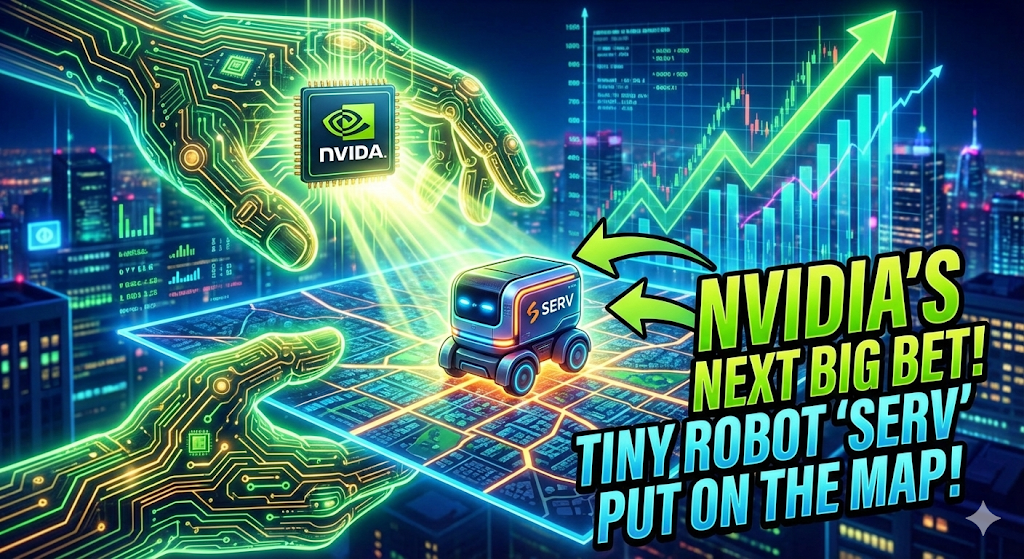
The renewed investor focus on autonomous delivery and physical AI has brought Serve Robotics Inc back into the spotlight at a pivotal moment in its evolution. When Nvidia CEO Jensen Huang highlighted the company during CES as a leader in physical AI, it was more than a passing mention. It functioned as a form of third-party validation that reframed how the market views Serve Robotics, not as a niche delivery experiment, but as an early infrastructure builder in a category that blends artificial intelligence, robotics, and real-world logistics. In markets, narrative shifts matter, and CES marked a turning point where Serve Robotics began to be discussed alongside broader conversations about AI hardware, edge computing, and autonomous systems rather than being boxed into the narrow label of a food delivery adjunct.
The market reaction was swift, with the stock posting sharp short-term gains that contrasted with a still-negative one-year total return. This divergence is important. It suggests the rally is not merely speculative excess layered on top of already euphoric sentiment, but rather a reassessment phase where investors are starting to price in a longer-dated opportunity that was previously misunderstood or ignored. For emerging technology companies, especially those operating at the intersection of robotics and AI, these moments often mark the early stages of a broader repricing cycle rather than the end of one.
CHECK THIS OUT: The Quiet Semiconductor Disruptor You’ve Never Heard Of: Aeluma Inc (ALMU) and Air Industries Group (AIRI) Narrows Losses to Just $44K — Is This Aerospace Microcap Entering a Turnaround Phase?
Understanding Serve Robotics’ Physical AI Advantage
Serve Robotics occupies a distinctive position within the artificial intelligence ecosystem because it operates in physical AI rather than purely digital applications. While much of the AI investment cycle has focused on software models, cloud platforms, and data infrastructure, the next phase of value creation increasingly involves embedding AI into machines that operate in the real world. Serve Robotics’ sidewalk delivery robots are a practical manifestation of this shift. They combine perception, navigation, decision-making, and fleet orchestration in dense urban environments where variability is high and margins for error are low.
This real-world deployment is a critical differentiator. Many AI companies demonstrate impressive capabilities in controlled environments, but far fewer have accumulated operational data from thousands of live deliveries. That data advantage compounds over time. Each delivery improves routing algorithms, obstacle avoidance, and energy efficiency, creating a feedback loop that strengthens the platform. Nvidia’s CES spotlight matters precisely because it signals that this kind of applied, embodied AI is becoming strategically important to the broader AI hardware and software stack.
Partnerships as Proof of Commercial Relevance
Serve Robotics’ partnerships play an outsized role in the bullish thesis because they demonstrate commercial relevance beyond pilot programs and proof-of-concept trials. Integration with major delivery platforms such as DoorDash and long-standing ties to Uber Eats provide access to real order flow, merchant networks, and consumer demand. These relationships are not just revenue opportunities; they are distribution channels that reduce go-to-market friction and accelerate scaling once unit economics reach inflection points.
In the context of valuation, these partnerships justify why investors are willing to look beyond current revenue figures. Platforms like DoorDash are incentivized to reduce last-mile delivery costs, particularly in urban cores where labor expenses, congestion, and inefficiencies compress margins. Autonomous delivery robots offer a structural solution rather than a temporary fix. As utilization rates rise and robots are deployed more densely within cities, Serve Robotics stands to benefit from operating leverage that is not yet visible in headline financials.
Valuation Premiums and the Nature of Early-Stage AI Infrastructure
Critics often point to Serve Robotics’ price-to-book multiple and current losses as evidence that the stock is overvalued. In isolation, those metrics appear stretched. However, valuation frameworks for early-stage AI infrastructure companies differ fundamentally from those applied to mature businesses. Price-to-book ratios are backward-looking measures anchored in accounting values that rarely capture the option value embedded in intellectual property, data, and network effects.
Serve Robotics’ premium reflects expectations that its assets will generate disproportionate future returns once scale is achieved. The market is not valuing the company based on today’s revenue of under two million dollars; it is valuing the potential for a city-by-city rollout of autonomous delivery infrastructure in a multi-billion-dollar last-mile logistics market. While that potential carries execution risk, it also explains why comparisons to traditional hospitality or logistics peers often miss the point. Serve Robotics is being priced as an AI-enabled platform company rather than a delivery contractor.
Financial Losses as Investment in Scale, Not Structural Weakness
The company’s net losses are substantial, but context matters. Serve Robotics is in a capital-intensive scaling phase where upfront investment in hardware, software development, and fleet deployment precedes revenue acceleration. This pattern mirrors the early years of many successful platform companies, particularly those that combine physical assets with software. The key question for investors is not whether losses exist today, but whether those losses are translating into defensible capabilities and future revenue streams.
Evidence suggests they are. Expansion into new cities, increasing robot counts, and deeper platform integrations all point toward a strategy focused on long-term dominance rather than short-term profitability optics. As robot density increases within each market, marginal delivery costs decline, utilization improves, and contribution margins move toward breakeven and eventually positive territory. This is the operating leverage bulls are betting on, and it is precisely the dynamic that valuation models struggle to capture in early stages.
Why Nvidia’s Endorsement Changes the Risk Perception
Nvidia’s public acknowledgment of Serve Robotics alters the perceived risk profile of the company. It signals that Serve is aligned with the direction of AI hardware evolution and edge computing, areas where Nvidia has unmatched insight. For investors, this reduces one of the biggest uncertainties surrounding emerging robotics firms: whether their technology stack will remain relevant as AI capabilities advance.
Being recognized as a physical AI leader implies compatibility with future generations of AI chips, sensors, and inference systems. It also positions Serve Robotics as a potential beneficiary of broader AI investment cycles rather than a standalone bet on delivery trends. This alignment can attract a different class of investors, including those focused on AI infrastructure rather than consumer delivery economics alone.
The Long-Term Market Opportunity in Autonomous Delivery
The addressable market for autonomous last-mile delivery is vast and still largely untapped. Urbanization, consumer demand for on-demand services, and pressure on delivery platforms to improve margins all converge in favor of automation. Sidewalk delivery robots address a specific but significant segment of this market, particularly short-distance, high-frequency orders that are inefficient for human couriers.
Serve Robotics’ strategy of focusing on dense urban environments maximizes the value of each robot and accelerates data accumulation. Over time, this can create local network effects where higher robot density improves service quality, attracts more merchants, and reinforces platform adoption. These dynamics underpin the bullish view that current valuation debates may be premature, as they focus on static snapshots rather than evolving market structures.
A Bullish Perspective on Valuation After the CES Repricing
From a bullish standpoint, the recent rally following CES does not necessarily imply that Serve Robotics is fully priced. Instead, it may represent the market’s first serious attempt to incorporate physical AI optionality into the stock. Even after the move, the company’s market capitalization remains modest relative to the scale of the opportunity it is targeting.
Valuation compression risk exists, particularly if revenue growth stalls or losses fail to narrow over time. However, for long-term oriented investors, the more relevant question is whether Serve Robotics can establish itself as a core layer in autonomous delivery infrastructure. If it succeeds, today’s valuation multiples may look conservative in hindsight rather than excessive.
Final Bullish Take on Serve Robotics’ Future
Serve Robotics sits at the crossroads of artificial intelligence, robotics, and logistics, three domains undergoing profound transformation. Nvidia’s CES spotlight did not create this opportunity, but it crystallized it in the minds of investors. While near-term financial metrics remain challenging, the company’s strategic positioning, partnerships, and accumulation of real-world operational data support a bullish thesis centered on long-term scale and platform value.
For investors willing to tolerate volatility and uncertainty, Serve Robotics represents a leveraged way to gain exposure to physical AI and autonomous delivery. The current debate over valuation reflects the tension between traditional metrics and emerging business models. If autonomous delivery becomes a standard feature of urban logistics, Serve Robotics has a credible path to being one of the defining winners of that shift.
READ ALSO: Vuzix Corp (VUZI) Could Be the Dark Horse of Augmented Reality as Defense Contracts & Enterprise Adoption Accelerate and Almonty Industries (ALM) Is Quietly Becoming a Tungsten Powerhouse.