For more than a century, one industrial organization has steadily shaped how buildings around the world are heated, cooled, and made livable, evolving from a traditional mechanical engineering enterprise into a global provider of climate, energy, and building system solutions that influence modern infrastructure, sustainability, and urban development. Its early foundations were built on practical engineering challenges tied to comfort, air quality, refrigeration, and energy efficiency, and over time those roots expanded into a sophisticated, globally scaled business serving commercial, residential, and industrial markets across continents.
Trane Technologies plc (NYSE:TT) emerged from those origins as a diversified industrial company focused on heating, ventilation, air conditioning, refrigeration, and integrated building systems designed to improve indoor environments and reduce energy consumption. Through its portfolio of brands, engineering platforms, and service networks, Trane Technologies delivers climate solutions that support offices, hospitals, data centers, schools, manufacturing plants, and homes, positioning the company at the intersection of infrastructure, sustainability, and economic development.
Over decades of expansion, Trane Technologies built a global footprint supported by manufacturing facilities, research centers, and service operations in North America, Europe, Asia, and emerging markets. This international scale allows the company to adapt products and services to regional regulatory standards, climate conditions, and energy requirements, making it a trusted partner for governments, corporations, and property developers seeking efficient, reliable, and compliant building systems. The company’s evolution reflects the broader shift from mechanical equipment manufacturing toward integrated solutions that combine hardware, software, controls, and lifecycle services.
Trane Technologies has also steadily repositioned itself from a cyclical industrial manufacturer into a solutions-oriented provider focused on sustainability, energy efficiency, and environmental impact. As global awareness of climate change, carbon emissions, and energy consumption increased, the company aligned its research, product development, and corporate strategy around reducing environmental footprints and enabling customers to meet stricter regulatory and corporate sustainability targets. This strategic realignment transformed Trane from a traditional HVAC supplier into a company increasingly viewed as a climate and energy technology leader.
The company’s business model integrates equipment sales with long-term service, maintenance, optimization, and performance management offerings, allowing Trane Technologies to support customers across the entire lifecycle of a building or industrial asset. This structure creates durable customer relationships and recurring revenue streams while enabling continuous performance improvements through data, monitoring, and digital tools. The emphasis on lifecycle engagement reflects the company’s shift from transactional sales toward long-term partnership models.
Trane Technologies has also invested heavily in innovation, digitalization, and smart building technologies that allow customers to monitor energy use, optimize system performance, and reduce operating costs. Through sensors, controls, analytics, and connected platforms, the company supports more intelligent and responsive building environments that adapt to occupancy, climate conditions, and energy prices. This technological evolution reinforces Trane’s identity as not just a manufacturer, but a provider of integrated climate and building intelligence.
Throughout its history, Trane Technologies has emphasized engineering excellence, reliability, and customer trust as core elements of its brand. Its culture reflects a focus on safety, quality, regulatory compliance, and long-term value creation, reinforcing its reputation among institutional customers who depend on consistent performance in mission-critical environments. This emphasis has helped Trane establish durable relationships across healthcare, education, industrial, and commercial sectors where system reliability is essential.
Today, Trane Technologies plc stands as a globally recognized industrial and climate solutions company whose products and services shape the comfort, efficiency, and sustainability of the built environment. Its transformation from a mechanical engineering firm into a technology-enabled climate and infrastructure provider mirrors broader shifts in urbanization, energy policy, and environmental responsibility. Through its people, systems, and long-term strategic orientation, Trane continues to influence how modern buildings function, how energy is consumed, and how infrastructure evolves in a world increasingly focused on efficiency, resilience, and sustainability.
The Truth About Trane Technologies: Why This “Boring” Winner May Be More Fragile Than It Looks
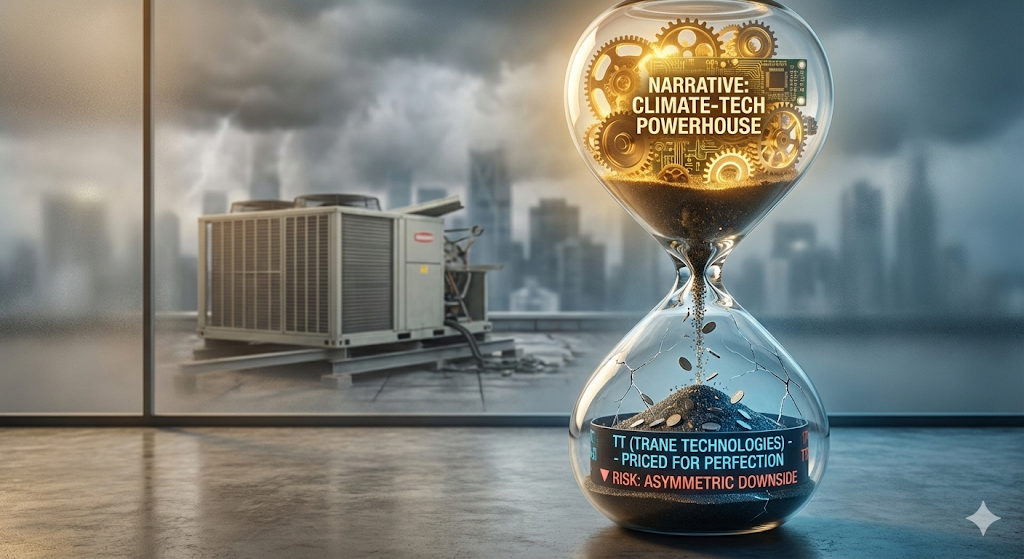
Trane Technologies plc has quietly become one of the most admired industrial and climate-technology companies in the market. Trading on the New York Stock Exchange under the ticker TT and identified internationally by ISIN IE00BK9ZQ967, the company has transformed what once looked like a traditional HVAC manufacturer into a perceived climate-tech powerhouse. Its stock has traded near all-time highs, outperformed many classic industrial names, and attracted attention from long-term investors searching for exposure to sustainability, infrastructure modernization, and energy efficiency.
But the very factors that make Trane Technologies look like a “monster win” also make it vulnerable. When a stock is widely viewed as high-quality, resilient, and inevitable, it often becomes priced for perfection. That creates a situation where even small deviations from expectations can have outsized consequences for valuation. The question is not whether Trane Technologies is a good business. The question is whether it is now a risky investment because of how good the story already looks.
CHECK THIS OUT: Why Nebius (NBIS) Could Outperform CoreWeave & Dominate the $9B AI Infrastructure Market and Is Lucid Group (LCID) Running Out of Cash? $875M Note Deal Raises Alarms.
The Climate-Tech Narrative Has Become the Valuation, Not the Optional Upside
Trane Technologies sits at the intersection of energy efficiency, climate policy, and infrastructure investment. Buildings consume a significant portion of global energy, and governments and corporations are under increasing pressure to reduce emissions and operating costs. That makes efficient heating, ventilation, air conditioning, and refrigeration systems not just useful but necessary.
This narrative has turned Trane from a “boring industrial” into a climate-tech darling for institutional investors and thematic funds. It now attracts capital not only as a manufacturer, but as a sustainability solution provider. That shift has supported premium valuation multiples relative to traditional industrial peers.
The problem is that once a narrative becomes consensus, it stops being a source of upside and becomes a source of risk. The market already assumes that climate regulation, infrastructure spending, and energy efficiency trends will benefit Trane in a linear and persistent way. If those tailwinds slow, face political resistance, or produce less incremental demand than expected, the valuation premium becomes difficult to defend.
Climate spending is not automatic. It is dependent on public budgets, corporate capital expenditures, and regulatory continuity. Any slowdown in construction, infrastructure investment, or retrofitting programs can directly affect Trane’s revenue pipeline.
A Stock at All-Time Highs Is Not a Margin of Safety
Trane Technologies has traded near its all-time highs after a multi-year run that significantly outpaced many industrial and broad market benchmarks. This strong price performance is frequently cited as evidence of quality and momentum. But from a bearish perspective, it also means the market has already rewarded the company for execution, growth, and narrative alignment.
At elevated price levels, future returns depend not on the business being good, but on it becoming better than already high expectations. That is a much harder task.
When valuation is stretched, risk becomes asymmetric. Upside is incremental, while downside can be sharp if earnings disappoint, guidance is trimmed, or macro conditions deteriorate. In that environment, the stock does not need bad news to fall. It only needs less good news than expected.
Cyclical Exposure Is Being Ignored in Favor of the Sustainability Story
Despite the climate-tech framing, Trane remains fundamentally tied to construction cycles, capital expenditure decisions, and industrial demand. Large commercial HVAC systems, building retrofits, and industrial refrigeration projects are capital-intensive and can be delayed when economic conditions tighten.
Higher interest rates, slowing global growth, and tightening credit conditions all reduce the willingness of businesses and property owners to invest in large infrastructure upgrades. Even if long-term sustainability goals remain intact, short-term budget constraints can delay execution.
This makes Trane’s revenue more cyclical than the narrative suggests. Investors are currently treating it like a structural growth story insulated from economic cycles, when in reality it remains sensitive to construction activity, real estate investment, industrial production, and corporate confidence.
Cost Inflation and Competitive Pressure Limit Pricing Power
Trane Technologies relies on a complex global supply chain that includes metals, electronics, refrigerants, semiconductors, and logistics services. While the company has demonstrated operational discipline, it cannot fully escape input cost volatility.
At the same time, competition in HVAC and building systems remains intense. Rivals like Carrier Global and Johnson Controls continue to invest heavily in technology, services, and pricing strategies to defend or gain market share. This competition limits Trane’s ability to pass through cost increases without sacrificing volume or margins.
The result is a structural tension between cost inflation and pricing power that can quietly erode profitability, especially during economic slowdowns when customers become more price-sensitive.
Services and Digital Transformation Are Not Risk-Free Growth Engines
Management has emphasized expansion into services, digital solutions, and lifecycle management as a way to create recurring revenue and smooth earnings volatility. While strategically sound, this transition introduces execution risk.
Building a services-heavy business alongside a manufacturing base requires different operational capabilities, incentive structures, and customer relationships. It also exposes the company to churn, contract renewals, service quality risks, and margin differences between equipment sales and services revenue.
If the services strategy underperforms or cannibalizes higher-margin equipment sales, the net effect on profitability may be negative rather than positive.
Institutional Confidence Can Shift Quietly Before Prices Do
Trane does not attract retail hype or social media frenzy. Its investor base is dominated by institutions, ETFs, and long-term funds. That makes price movements quieter but also more sudden when sentiment changes.
When institutions reassess exposure, they do not tweet about it. They rebalance portfolios quietly, which can gradually turn into selling pressure without obvious catalysts. That is often how high-quality stocks begin to weaken before the broader market notices.
The “Boring Winner” Can Become the Overowned Trade
The appeal of Trane Technologies lies in its combination of quality, predictability, and alignment with global trends. But that same appeal can make it overowned. When many portfolios hold the same “safe compounder,” correlations rise and diversification falls. In times of stress, those crowded trades can unwind faster than expected.
Trane’s reputation as a safe, boring, long-term winner may ironically increase its vulnerability during market corrections, as investors seek liquidity and sell what they can, not what they should.
Conclusion: A Great Business at a Risky Moment
Trane Technologies plc is a well-run, strategically positioned, and globally respected company. It benefits from real long-term trends in energy efficiency, climate policy, and infrastructure modernization. It is not a speculative hype stock or a broken business.
But the stock is no longer priced like a cyclical industrial company. It is priced like a structural growth asset with limited downside. That creates a mismatch between perception and reality.
In a world of economic uncertainty, rising costs, competitive pressure, and political risk around climate spending, the assumption of smooth, uninterrupted growth becomes fragile. When expectations are high, resilience becomes less valuable than surprise.
The truth about Trane Technologies is not that it is a bad company. The truth is that it may now be a great company at the wrong price, at the wrong point in the cycle, with too much optimism already built in.
That is what makes the bearish thesis not contrarian for the sake of being contrarian, but rational in the face of a market that may be mistaking stability for inevitability.
READ ALSO: Above Food (ABVE) to Issue 1.1 Billion New Shares in Merger and Perpetua Resources (PPTA) Soars 171% as U.S. Approves $1.3B Gold-Antimony Mine.