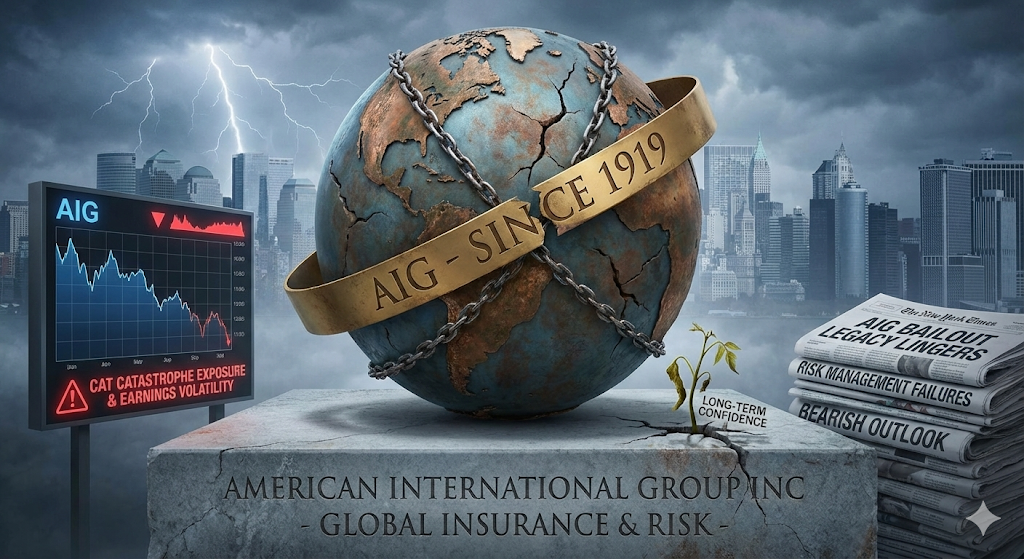
Few corporations in modern financial history have played as central a role in shaping global insurance, financial risk transfer, and institutional protection as this one, whose evolution mirrors the expansion of international commerce, the rise of complex financial instruments, and the increasing need for sophisticated risk management across borders, industries, and generations. From its earliest days as a modest insurance enterprise serving local markets, it steadily transformed into a leading global insurance organization with operations spanning more than 200 countries and jurisdictions, becoming deeply embedded in the architecture of modern finance, commercial enterprise, and retirement planning across the world.
American International Group Inc (NYSE:AIG) traces its roots back to 1919, when it was founded in Shanghai as American Asiatic Underwriters by Cornelius Vander Starr. The original vision was simple but ambitious: to provide insurance products in emerging international markets at a time when Western financial institutions had limited presence abroad. Over the following decades, American International expanded aggressively through Asia, Europe, and Latin America, establishing itself as a truly international group long before globalization became a dominant economic theme. By the mid-20th century, American International had already built a network of agents, brokers, and local subsidiaries that allowed it to offer general insurance, property casualty insurance, and life insurance across continents, embedding the company into the commercial infrastructure of global trade and finance.
As American International Group continued to grow, it evolved into a diversified financial services organization, combining traditional insurance businesses with institutional markets, investment operations, and retirement products. The company became a major provider of professional liability insurance, general liability coverage, political risk insurance, and specialty commercial products designed to help corporations manage increasingly complex operational, legal, and geopolitical risks. At the same time, American International expanded its presence among individual customers through life insurance, individual retirement, and group retirement plans, positioning itself as a financial partner not only for corporations but also for households planning for long-term income, wealth protection, and retirement security.
By the late 1990s and early 2000s, American International Group had grown into one of the largest financial institutions in the world, with assets approaching one trillion dollars and operations that spanned insurance, reinsurance, asset management, and structured finance. The company’s scale, complexity, and reach reflected both the ambition of its strategy and the growing interdependence of global financial markets. Its portfolio included property casualty insurance for multinational corporations, retirement products for millions of employees, insurance coverage for infrastructure and industrial projects, and investment services for institutional clients, making American International one of the most systemically important financial companies in the world.
The global financial crisis of 2008 marked a defining moment in the history of American International Group and in the history of the financial system itself. Exposure to credit default swaps and structured finance products led to massive losses, forcing the U.S. Treasury and Federal Reserve to intervene in what became the largest corporate rescue in American history. The episode reshaped not only the company but also public perception of systemic risk, financial regulation, and the responsibilities of global financial institutions. In the years that followed, American International underwent one of the most extensive corporate restructurings ever seen, selling assets, shrinking its balance sheet, exiting non-core businesses, and refocusing its strategy on core insurance operations and disciplined underwriting.
Over the last decade, American International Group has repositioned itself primarily as a global insurance and retirement company, with a renewed focus on underwriting quality, capital efficiency, and long-term risk management rather than financial engineering. Under the leadership of Peter Zaffino, now chairman and CEO, the company has emphasized modernizing AIG operations, simplifying organizational structure, improving risk selection, and leveraging data, analytics, and artificial intelligence to enhance underwriting and claims management. The company has invested heavily in digital infrastructure, data platforms, and partnerships designed to transform how insurance portfolios are built, monitored, and optimized in real time.
Today, American International Group operates through two main segments, General Insurance and Life and Retirement, serving commercial clients, institutional markets, and individual customers across the world. Its products range from property casualty insurance and professional liability insurance for global corporations to retirement income solutions, annuities, and life insurance for individuals and employers. Through a network of agents, brokers, and network partners, American International maintains one of the largest distribution footprints in the insurance industry, allowing it to serve clients in nearly every major economy while managing political risk, regulatory complexity, and local market variation.
The company’s identity has become inseparable from the modern concept of risk itself. American International Group does not merely sell insurance products; it participates in the economic infrastructure that allows businesses to invest, governments to function, and individuals to plan for the future. Whether insuring multinational supply chains, financing retirement income, or supporting infrastructure development, the company occupies a unique position at the intersection of finance, commerce, and long-term economic stability. Its history reflects the evolution of the global economy from localized trade to interconnected institutional markets, and its continued efforts to redefine itself mirror broader shifts in how financial institutions manage complexity, uncertainty, and systemic exposure in an increasingly volatile world.
Bearish Thesis on American International Group Inc AIG: Why Investors Should Be Cautious
American International Group Inc AIG remains one of the most talked-about names in the global insurance industry not just because it is a leading global insurance organization providing property casualty insurance, professional liability insurance, and a suite of insurance products to both individual customers and businesses, but also because of its complex history, ongoing operational risks, and persistent strategic challenges that could weigh on AIG common stock performance. American International Group, commonly referred to simply as AIG, is headquartered in New York and operates across more than 200 countries through its extensive aig operations and network partners, yet beneath this broad footprint lie risks that should make even the most optimistic investors pause.
CHECK THIS OUT: Why Nebius (NBIS) Could Outperform CoreWeave & Dominate the $9B AI Infrastructure Market and Is Lucid Group (LCID) Running Out of Cash? $875M Note Deal Raises Alarms.
AIG’s Legacy of Risk Management Failures and Structural Weaknesses
Any comprehensive bearish analysis of American International Group must start with the shadow of AIG’s failure during the 2008 financial crisis. Prior to that crisis, AIG was so large and so intertwined with global financial markets that many analysts believed its collapse would have triggered widespread systemic damage. The Federal Reserve stepped in with up to $85 billion in emergency liquidity support because AIG’s failure was deemed too catastrophic to allow to unfold organically, effectively placing the company under partial government control at the time. At its peak, AIG held nearly $1 trillion in assets and lost $99.2 billion in 2008, with massive positions in credit default swaps exposing the firm to risks it simply was not capitalized to manage. The bailout remains one of the most controversial events in the history of American financial markets, and although AIG has since sold assets and repaid much of the government loans, the underlying risk management weaknesses that led to that failure continue to cast a long shadow.
Despite post-crisis reforms and operational shifts, American International still operates in highly volatile markets, especially within its property casualty insurance and general insurance segments. The basic aim of any insurer is to manage risks, but when catastrophe events escalate in frequency and severity, those same risks can quickly overwhelm underwriting discipline. For instance, in the third quarter of 2025, AIG reported that while its underwriting income was strong, net premiums written barely grew year-over-year — Gross premiums written rose only 1% to $8.686 billion while net premiums written declined 2% to $6.23 billion. Those figures tell a story of pricing pressures and subdued growth in core insurance books.
Catastrophe Exposure and Earnings Volatility
AIG’s property casualty insurance business, which includes general liability, professional liability insurance, and other lines designed to protect corporations against a wide range of risks, is especially sensitive to unpredictable events such as natural disasters. In first quarter 2025 earnings, AIG reported a significant slump in underwriting income — down 59% from the prior year — largely due to catastrophe losses from the devastating Los Angeles wildfires, which alone resulted in $460 million in charges and roughly $525 million in total losses for the quarter. While AIG beat profit expectations with adjusted after-tax income of $1.17 per share, that figure represents weaker profitability compared to prior quarters and highlights how quickly catastrophe exposure can erode earnings.
This kind of volatility feeds into political risk and market skepticism. When a company’s core business — insuring against risk — gets repeatedly hammered by the very events it underwrites, investors are right to question the long-term sustainability of its financial objectives and investment strategies. Combined with global macroeconomic pressures and evolving insurance industry competition, this dynamic makes AIG’s earnings stream inherently more unpredictable than some of its peers.
Stock Performance and Investor Confidence Under Strain
For long-term investors in AIG common stock, market performance has been a mixed bag. In early 2025 the stock underperformed broad markets, trading below previous 52-week highs and lagging behind competitors in the Insurance-Diversified industry group. Even positive quarterly results sometimes coincided with aig common stock declines — as seen when AIG reported stronger earnings yet saw its share price dip in response to broader sector pressures.
Moreover, the company’s ex dividend date in late 2025 saw yet another reminder that dividend reliance is no guarantee against price volatility — $0.45 per share was declared for shareholders of record on December 16, 2025, payable December 30, but this kind of yield can offer only limited cushion when confidence is shaky.
Corporate Governance and Management Risks
One of the soft but material risks investors should weigh involves AIG’s board and executive leadership. Team stability and credibility matter enormously in capital markets. Recently, AIG withdrew an executive hire after scrutiny over past workplace conduct, prompting questions about executive vetting and corporate governance at the highest levels. Such incidents can unsettle institutional markets and erode confidence in strategic decision-making.
Even Peter Zaffino, AIG’s chairman and CEO who has led turnaround efforts including divestitures and a heavier focus on underwriting discipline and emerging technologies like AI, cannot fully insulate the firm from legacy baggage or structural headwinds. While Zaffino’s strategy aims to modernize AIG’s franchise and strengthen aig operations, the rate of transformation may not be quick enough to alter entrenched risk perceptions among investors.
Competitive and Structural Challenges in Insurance Businesses
The insurance industry itself is undergoing deep changes. Competition from nimble insurtech firms, rising reinsurance costs, and shifts in global risk patterns are forcing traditional carriers to navigate increasingly complex landscapes. AIG’s breadth — spanning individual retirement products, group retirement plans, other financial services, and large commercial insurance portfolios — is both a strength and a weakness. The sheer complexity of managing such diversified insurance businesses can dilute focus and make risk aggregation more opaque. When one part of the portfolio suffers, cross-segment exposures can ripple through the entire enterprise.
Furthermore, long-tail liabilities such as professional liability insurance and group retirement obligations involve forecasting claims that may surface years or decades later. Mistakes in reserving or inadequate price adjustments for political risk and evolving regulatory expectations could require reserve strengthening and lead to earnings hits in future periods.
Conclusion: Why a Bearish Outlook Makes Sense
In sum, while American International Group Inc AIG remains a global heavyweight with a vast company profile, deep assets, and a diverse suite of insurance products, it also carries substantial risks that give bearish investors plenty of reason for concern. The legacy of AIG’s failure during the financial crisis continues to inform risk premiums, catastrophe exposures drive earnings volatility, and aig common stock price action reflects an uneven confidence backdrop. Challenges in corporate governance, intense competition, and macroeconomic pressures add further strains that could hamper AIG’s financial objectives and limit upside potential.
For investors seeking stable returns and predictable performance in the insurance industry, AIG’s complex risk profile, combined with structural uncertainties and a history of episodic underperformance, might suggest a more cautious stance — one that prioritizes disciplined evaluation over headline growth figures. This bearish thesis does not ignore the positives, but rather stresses the importance of weighing persistent risks that could undermine long-term investment returns in American International Group Inc.
READ ALSO: Above Food (ABVE) to Issue 1.1 Billion New Shares in Merger and Perpetua Resources (PPTA) Soars 171% as U.S. Approves $1.3B Gold-Antimony Mine.