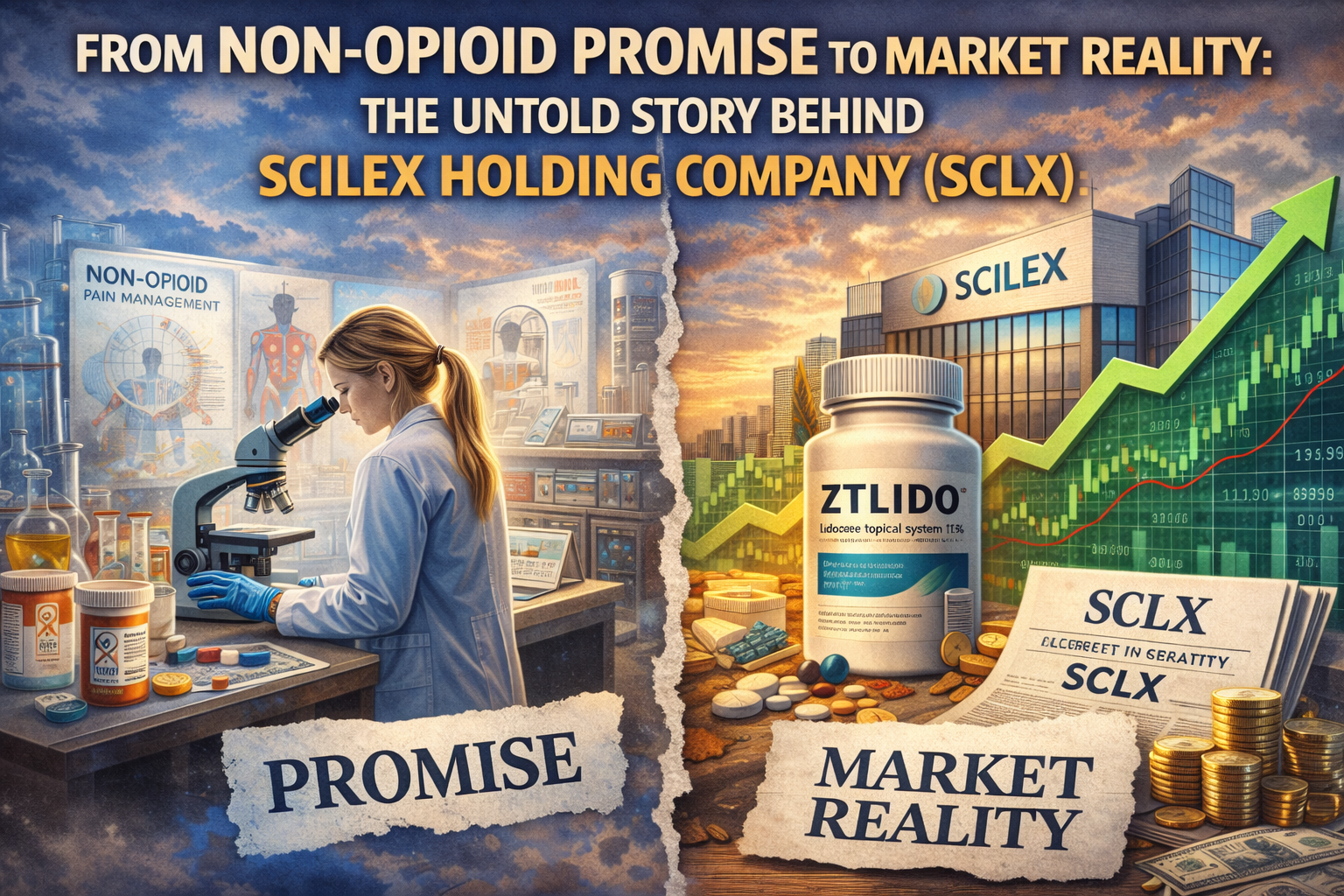
Built around a singular mission to address one of healthcare’s most persistent and complex challenges, this company emerged with a clear focus on developing and commercializing non-opioid solutions for pain and inflammation. From its earliest days, it was shaped by the recognition that traditional pain management approaches, particularly those relying on opioids, carried significant clinical, regulatory, and societal risks. Against the backdrop of an evolving healthcare landscape increasingly defined by safety, accountability, and long-term patient outcomes, the company was established to pursue differentiated therapies that could deliver pain relief without contributing to addiction or systemic harm.
Scilex Holding Company (NASDAQ:SCLX) was formed as a biopharmaceutical company dedicated to pain management, with a strategy centered on reformulating and optimizing known therapeutic compounds to improve efficacy, tolerability, and patient compliance. Rather than focusing solely on early-stage discovery, Scilex Holding Company built its foundation around late-stage development and commercialization, targeting areas of unmet need within chronic pain, neuropathic pain, migraine, and inflammatory conditions. This approach allowed the company to shorten development timelines while leveraging established clinical mechanisms, a model designed to balance innovation with regulatory and commercial pragmatism.
Over time, Scilex Holding Company assembled a portfolio anchored by FDA-approved products, marking its transition from a development-focused entity into a commercial-stage pain management company. Its flagship assets reflect an emphasis on differentiated delivery systems and patient-centric formulations, positioning the company within the growing non-opioid pain treatment market. By prioritizing topical, oral liquid, and fast-acting solutions, Scilex Holding Company sought to address limitations associated with conventional solid oral dosing and systemic exposure, aligning its products with evolving prescribing preferences and payer expectations.
The company’s background is closely tied to broader shifts in public health policy and medical practice. As regulators, insurers, and healthcare providers intensified efforts to curb opioid use, demand grew for alternative pain therapies with established safety profiles. Scilex Holding Company positioned itself squarely within this transition, building its identity as a non-opioid pain management specialist rather than a generalized pharmaceutical developer. This focus has shaped not only its product development strategy but also its commercial messaging and market positioning.
Scilex Holding Company’s journey as a publicly traded entity further influenced its evolution. Entering the public markets provided access to capital necessary to support commercialization, manufacturing scale-up, and market access initiatives. At the same time, it exposed the company to the realities of operating as a small-cap biopharmaceutical firm in a highly competitive and cost-sensitive therapeutic area. The company’s background reflects this duality, balancing the promise of addressing large pain markets with the operational discipline required to sustain a commercial footprint amid generic competition and reimbursement pressure.
Headquartered in the United States, Scilex Holding Company developed its operations with a focus on regulatory compliance, supply chain reliability, and targeted sales execution. Its management strategy emphasized building a lean commercial infrastructure capable of supporting multiple products without the overhead typically associated with large pharmaceutical organizations. This operating philosophy underscored the company’s intent to remain focused on pain management rather than diversifying prematurely into unrelated therapeutic areas.
Taken as a whole, the background of Scilex Holding Company is defined by its deliberate alignment with the non-opioid movement in pain treatment and its effort to bridge the gap between clinical need and commercial reality. From its formation as a pain-focused biotech to its evolution into a commercial-stage company with FDA-approved therapies, Scilex Holding Company’s history reflects a targeted response to one of modern medicine’s most scrutinized challenges. For observers seeking to understand the foundation behind SCLX stock, the company’s background offers a narrative shaped by regulatory change, therapeutic specialization, and the ongoing effort to redefine how pain is treated in a post-opioid era.
Scilex Holding Company and the Hidden Cost of Financial Engineering
Scilex Holding Company has often been positioned as a beneficiary of the global shift toward non-opioid pain management, yet recent capital allocation decisions are reinforcing concerns that the company’s financial strategy may be prioritizing short-term structural cleanup over long-term operating strength. The completion of a $27 million warrant repurchase from Oramed Pharmaceuticals at the end of December 2025 has been framed as a simplification of the capital structure, but from a bearish perspective, it raises deeper questions about liquidity discipline, opportunity cost, and the sustainability of Scilex’s business model.
For investors analyzing SCLX stock, the warrant repurchase highlights a recurring theme that has followed the company since becoming publicly traded: financial maneuvering has often taken precedence over clear evidence of accelerating commercial momentum.
CHECK THIS OUT: Why Nebius (NBIS) Could Outperform CoreWeave & Dominate the $9B AI Infrastructure Market and Is Lucid Group (LCID) Running Out of Cash? $875M Note Deal Raises Alarms.
The Warrant Repurchase and Why the Market Reacted Negatively
On December 30, 2025, Scilex Holding Company completed the repurchase of 6.5 million common stock warrants from Oramed Pharmaceuticals for a total consideration of $27 million, split across two tranches. The final $14 million payment followed an earlier $13 million tranche completed in September 2025. While warrant repurchases can theoretically reduce future dilution, the market’s immediate reaction, reflected in a sharp decline in SCLX stock, suggests that investors viewed this transaction as a net negative rather than a value-enhancing move.
The reason is not the mechanics of the repurchase itself, but the context in which it occurred. Scilex operates in a capital-intensive environment, with ongoing commercial expenses, sales force costs, and working capital demands tied to its FDA-approved pain products. Deploying $27 million in cash to retire warrants instead of investing directly into revenue-generating activities signals a defensive posture rather than an offensive growth strategy.
Cash Allocation Risk in a Commercial-Stage Biotech
For a commercial-stage biotechnology company, cash is optionality. It funds market access initiatives, payer negotiations, physician education, and incremental label expansion efforts that can drive long-term revenue growth. From a bearish standpoint, Scilex Holding Company’s decision to allocate a meaningful portion of its available liquidity to a warrant repurchase reduces flexibility at a time when operating leverage has yet to be convincingly demonstrated.
Warrants represent potential dilution, but they only dilute if exercised, often at prices above prevailing market levels. When a company chooses to preemptively retire warrants using cash, it implicitly assumes that preventing dilution is more valuable than deploying capital to grow the business. In Scilex’s case, this assumption is debatable given that the company has not yet established consistent cash flow generation from its core products.
The Illusion of De-Risking Versus the Reality of Cash Burn
Management narratives often frame warrant repurchases as balance-sheet optimization, yet bearish investors focus on the reality that cash burn remains unresolved. Scilex Holding Company continues to operate in a therapeutic area characterized by high competition, generic pressure, and constrained pricing power. ZTlido, while differentiated on formulation, competes against low-cost lidocaine alternatives that dominate payer formularies. Elyxyb and Gloperba address sizable pain and inflammation markets, but neither has yet proven capable of generating the scale required to offset company-wide operating expenses.
In this context, retiring warrants does not eliminate dilution risk; it merely postpones it. If cash burn continues and revenue growth remains incremental, Scilex may still be forced to raise capital in the future, potentially at less favorable terms. From a bearish view, the warrant repurchase may actually increase future dilution risk by shrinking the company’s cash runway.
Signal to the Market: Defensive Rather Than Growth-Driven
Capital markets are acutely sensitive to signaling, especially in small-cap biotech stocks. The timing and structure of Scilex’s warrant repurchase send a signal that management is focused on cleaning up legacy capital structures rather than accelerating commercial execution. This perception matters. Investors often reward companies that invest aggressively in growth when confidence in product-market fit is high. Conversely, they penalize companies that appear to be conserving optics while fundamentals lag.
The negative price reaction following the announcement suggests that investors interpreted the move as a defensive maneuver. Instead of viewing the repurchase as accretive, the market appeared to question whether Scilex is running out of productive uses for capital within its existing portfolio.
Opportunity Cost in a Competitive Pain Management Market
The pain management market remains one of the most difficult therapeutic areas to monetize effectively. Non-opioid positioning alone does not guarantee adoption, reimbursement, or pricing leverage. Success requires sustained investment in education, differentiation, and access. Every dollar allocated to financial restructuring is a dollar not spent on expanding market share or improving competitive positioning.
From a bearish perspective, the $27 million used for the warrant repurchase could have funded extended sales initiatives, deeper payer engagement, or strategic partnerships that might have delivered longer-lasting shareholder value. Instead, the company chose certainty in eliminating potential dilution over uncertainty in driving organic growth, a choice that reflects risk aversion rather than confidence.
Structural Weakness Still Overshadows Capital Structure Cleanup
Even after the warrant repurchase, the fundamental challenges facing Scilex Holding Company remain unchanged. Revenue growth has not yet reached a scale where operating expenses can be absorbed efficiently. The company still faces intense competition from generics and larger pharmaceutical players with greater marketing budgets and stronger payer relationships. These structural headwinds are not resolved by simplifying the equity structure.
Bearish investors argue that capital structure optimization is meaningful only when paired with improving operating fundamentals. Without evidence of accelerating ZTlido sales, expanding Elyxyb adoption, or margin improvement, the warrant repurchase risks being remembered as a short-term fix that failed to address deeper issues.
The Broader Pattern of Financial Engineering
The warrant repurchase fits into a broader pattern that skeptics associate with Scilex Holding Company: frequent financial actions that draw attention away from core operating performance. While such moves can temporarily reshape the balance sheet, they do not substitute for sustained commercial traction. Markets eventually discount financial engineering if it is not followed by tangible improvements in revenue quality and cash flow visibility.
For SCLX stock, this pattern contributes to volatility and erodes investor confidence, particularly among those seeking predictable growth trajectories rather than episodic balance-sheet events.
Bearish Conclusion on the Warrant Repurchase and Scilex Stock
From a bearish standpoint, Scilex Holding Company’s completion of a $27 million warrant repurchase underscores the tension between optics and fundamentals. While the transaction reduces potential dilution on paper, it also consumes scarce capital in a business that has yet to prove durable profitability. The market’s negative reaction reflects concern that cash preservation and growth investment are being subordinated to capital structure cleanup.
Until Scilex demonstrates that its non-opioid pain management portfolio can generate sustained revenue growth and operating leverage, actions like warrant repurchases may continue to be viewed skeptically. For cautious investors, the episode reinforces the view that SCLX stock remains vulnerable to liquidity pressure, future dilution, and underperformance driven by unresolved structural challenges rather than by the presence of warrants alone.
READ ALSO: Above Food (ABVE) to Issue 1.1 Billion New Shares in Merger and Perpetua Resources (PPTA) Soars 171% as U.S. Approves $1.3B Gold-Antimony Mine.