Established as a publicly traded holding company with a long history in real estate and hospitality, this organization has built its identity around owning, operating, and managing income-producing properties rather than pursuing rapid expansion or speculative development. Its background is rooted in disciplined asset ownership, balance sheet management, and long-term participation in urban markets where patience and capital structure matter as much as short-term demand cycles. Over the years, the company has navigated multiple economic environments, adapting its strategy to shifts in tourism, business travel, and real estate fundamentals while maintaining a consistent focus on preserving shareholder value.
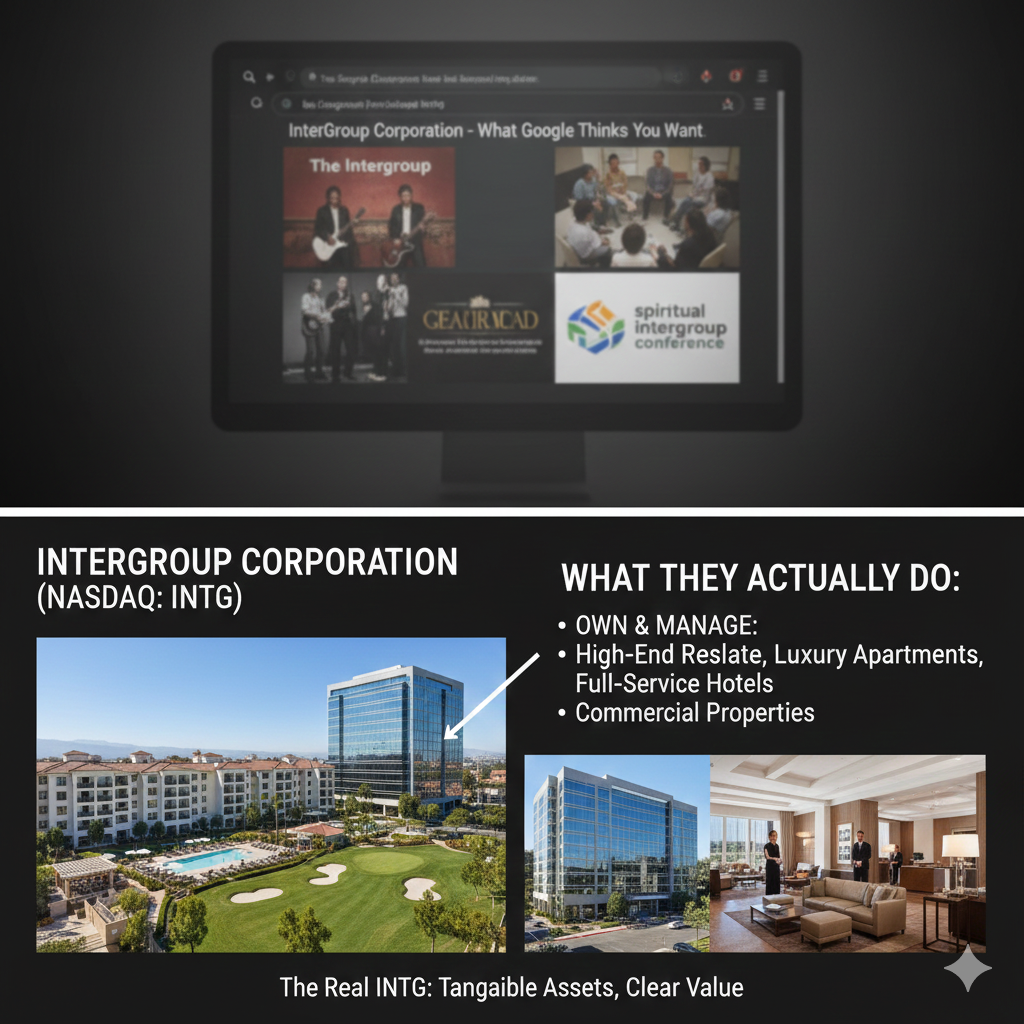
InterGroup Corporation (NASDAQ:INTG) is often confused in online searches with “intergroup” organizations associated with Alcoholics Anonymous, AA membership, and service committees that help people achieve sobriety, stop drinking, and find meetings through tools like the Meeting Guide app. However, InterGroup Corporation has no affiliation with Alcoholics Anonymous, AA groups, or any recovery institution whose primary purpose is to help other alcoholics stay sober, carry a message of hope, or practice the twelve steps. This distinction is important because while AA intergroup entities exist to support meetings, fellowship, and voluntary contributions from members with a desire to stop drinking, InterGroup Corporation is a for-profit enterprise operating in real estate, hospitality, and investment activities governed by securities laws and public-company reporting standards.
InterGroup Corporation was incorporated to function as a holding company, allowing it to allocate capital across operating subsidiaries and investments with a focus on long-term ownership rather than short-term trading. Based in the United States and listed on Nasdaq, the company’s background has been shaped by its majority ownership interest in hotel and real estate assets, most notably in the San Francisco market. This exposure has tied the company’s fortunes to broader trends in tourism, convention activity, and urban economic recovery, making it a leveraged participant in cycles that reward operational discipline and financial endurance.
Over time, InterGroup Corporation has refined its approach to hospitality ownership, emphasizing rate management, occupancy optimization, and expense control rather than aggressive expansion. The company’s hotel operations have historically focused on serving business travelers, visitors, and convention attendees, aligning its strategy with markets where demand can rebound meaningfully as economic conditions normalize. Alongside hospitality, the company has maintained a real estate segment that generates rental income and provides diversification, helping to offset volatility inherent in hotel operations.
The background of InterGroup Corporation also reflects a conservative approach to liquidity and capital management. Rather than deploying excess cash aggressively, the company has historically prioritized maintaining cash, cash equivalents, and restricted cash balances, while selectively holding marketable securities to preserve flexibility. This philosophy has influenced how InterGroup Corporation navigates periods of uncertainty, including times when operating results reflect GAAP net losses even as underlying assets continue to generate cash flow and long-term value.
Leadership continuity has been another defining element of the company’s background. With experienced executives overseeing both hotel and real estate operations, InterGroup Corporation has focused on incremental improvement rather than dramatic strategic pivots. Management’s communication has consistently emphasized stabilization, recovery, and patience, particularly in challenging markets like San Francisco where recovery timelines are shaped by factors beyond any single operator’s control.
Today, the background of InterGroup Corporation is best understood as that of a legacy holding company positioned for gradual normalization rather than explosive growth. Its identity is anchored in asset ownership, hospitality operations, and real estate income, distinct from unrelated intergroup organizations whose mission centers on alcoholism recovery, meetings, and anonymous fellowship. For investors researching the company, separating these very different uses of the word “intergroup” is essential to understanding InterGroup Corporation’s true business, history, and role within the public markets.
InterGroup Corp Navigates a Complex Operating Landscape While Strengthening Its Core Real Estate and Hospitality Platform
InterGroup Corporation operates in a very different arena from organizations that share the word “intergroup” in other contexts, and understanding this distinction is critical for investors. In the recovery and public-service world, the term intergroup is commonly associated with Alcoholics Anonymous service committees that help people achieve sobriety, stay sober, and find meetings through resources like the Meeting Guide app. Those intergroup organizations exist to serve other alcoholics, support AA membership, and carry a message of hope and recovery through meetings, twelve steps, and fellowship. InterGroup Corp, by contrast, is a publicly traded company focused on real estate ownership, hotel operations, and disciplined capital management, and it has no affiliation with Alcoholics Anonymous, AA groups, or any recovery institution. This clarification matters, particularly as online searches increasingly blend unrelated keywords, creating confusion that obscures the company’s true investment profile.
CHECK THIS OUT: Why Nebius (NBIS) Could Outperform CoreWeave & Dominate the $9B AI Infrastructure Market and Is Lucid Group (LCID) Running Out of Cash? $875M Note Deal Raises Alarms.
A Longstanding Real Estate and Hospitality Operator Based in San Francisco
InterGroup Corp has built its business around ownership interests in hotels and commercial real estate, with its most significant asset being a majority stake in the Hilton San Francisco Financial District at Portsmouth Square. Incorporated decades ago and based in the United States, the company’s strategy has historically emphasized long-term asset ownership rather than rapid expansion. This approach has made InterGroup a steady, if often overlooked, participant in the public markets, trading on Nasdaq while focusing on the fundamentals of hospitality performance, leasing, and balance sheet preservation.
Unlike consumer-facing brands that rely on volume growth, InterGroup Corp’s performance is closely tied to urban travel trends, convention activity, tourism recovery, and effective cost control. Over the past several years, the San Francisco hospitality market has faced well-documented challenges, including reduced business travel, changing work patterns, and macroeconomic uncertainty. These pressures have weighed on hotel operators broadly, but they have also created a backdrop where incremental improvements can meaningfully impact financial results.
Q1 Fiscal 2026 Results Show Stabilization and Selective Improvement
For the three months ended September 30, 2025, InterGroup Corp reported a consolidated GAAP net loss of $1.159 million, compared with a net loss of $852,000 in the prior-year period. Net loss attributable to InterGroup was $535,000, versus $398,000 a year earlier. While the headline loss widened, underlying operating metrics told a more nuanced story that suggests stabilization in key areas of the business.
EBITDA, a non-GAAP measure used by management to assess operating performance, totaled $4.526 million, down 9.7 percent year over year from $5.013 million. Management attributed this decline primarily to higher operating expenses in the hotel segment, even as revenues improved. Importantly, the company emphasized that prior going-concern doubt at its majority-owned subsidiary Portsmouth Square, Inc. was alleviated as of June 30, 2025 following a hotel refinancing, and that no substantial doubt exists for at least twelve months from the issuance date of the financial statements. For investors, this refinancing marked a meaningful de-risking event.
Hotel Operations Reflect Rate Strength Despite Cost Pressures
InterGroup Corp’s hotel segment delivered total revenues of $12.418 million in the quarter, up 5.1 percent from $11.820 million in the comparable period. Rooms revenue increased to $10.428 million, a 3.1 percent year-over-year gain, while food and beverage revenue rose sharply by 24.4 percent to $912,000. Garage revenue increased modestly to $900,000, and other operating departments nearly doubled to $178,000, reflecting improved utilization across ancillary services.
Key performance indicators pointed to pricing resilience. Average daily rate reached $218, representing a 3.8 percent increase year over year, while occupancy held at 95 percent, only one percentage point lower than the prior year. Revenue per available room improved to $207, up 2.5 percent, signaling that InterGroup Corp has been able to optimize rate even as it navigates a competitive and still-recovering market.
At the same time, operating expenses excluding depreciation and amortization increased to $10.481 million, up 19.2 percent year over year. As a result, operating income before interest, depreciation, and amortization declined to $1.937 million from $3.028 million. GAAP net loss from hotel operations widened to $2.302 million, compared with $1.523 million in the prior-year quarter. These figures underscore that cost control remains a central challenge, even as demand indicators gradually improve.
Real Estate Segment Delivers Solid Growth and Margin Expansion
While the hotel segment faced margin pressure, InterGroup Corp’s real estate operations provided a stabilizing counterbalance. Real estate revenues increased to $5.495 million, up 8.0 percent year over year, and segment income from operations climbed 20.1 percent to $3.157 million from $2.629 million. This performance highlights the value of diversification within the company’s asset base and the importance of leasing, recoveries, and expense discipline in generating cash flow.
Management has consistently pointed to real estate as a source of steady income that can help offset volatility in hospitality. In an environment where interest rates, inflation, and urban recovery timelines remain uncertain, this segment has become increasingly important to InterGroup Corp’s overall financial profile.
Liquidity, Cash Position, and Balance Sheet Discipline
As of September 30, 2025, InterGroup Corp reported total cash, cash equivalents, and restricted cash of $13.391 million. This included $5.054 million in cash and cash equivalents and $8.337 million in restricted cash. The company also recorded a modest net gain of approximately $136,000 in marketable securities during the quarter, consistent with management’s emphasis on liquidity and disciplined risk management rather than aggressive trading.
Interest expense declined modestly on mortgage debt to $2.493 million, down 11.7 percent year over year, reflecting the benefits of refinancing and improved capital structure. Related-party interest expense increased slightly to $872,000. These figures suggest that while leverage remains a factor, InterGroup Corp has taken tangible steps to manage financing costs and reduce near-term balance sheet stress.
Management Commentary Points to Gradual Market Recovery
Chairman and Chief Executive Officer John V. Winfield emphasized signs of stabilization in the San Francisco hospitality market, citing improving convention calendars, tourism indicators, and business travel activity. Chief Operating Officer David C. Gonzalez echoed this view, noting that the company continues to optimize rate, channel mix, and group and convention exposure while focusing on leasing and expense control across the real estate portfolio.
This commentary aligns with broader industry data suggesting that urban hotel markets are recovering unevenly but steadily. For InterGroup Corp, even incremental gains in occupancy stability and rate optimization can have an outsized impact on cash flow given the fixed-cost nature of hotel operations.
Clearing the Noise Around the “Intergroup” Name
A unique challenge for InterGroup Corp in the digital age is the overlap between its corporate name and the widely searched term “intergroup” associated with Alcoholics Anonymous. Searches related to AA meetings, sobriety, recovery, service committees, meeting IDs, and the desire to stop drinking often surface alongside the company’s name, despite there being no connection. While AA intergroup organizations exist to help people find meetings, stay sober, and practice the twelve steps through voluntary contributions and service, InterGroup Corp is a for-profit enterprise operating in real estate and hospitality.
For investors, separating this noise from fundamentals is essential. The company’s value proposition rests on asset ownership, cash flow potential, and urban market recovery, not on the fellowship, traditions, or recovery programs associated with AA. Recognizing this distinction allows a clearer assessment of InterGroup Corp’s true risk and reward profile.
A Cautious but Constructive Bullish Thesis
The bullish thesis for InterGroup Corp is not built on rapid growth or speculative expansion, but on gradual normalization, refinancing success, and disciplined operations. The alleviation of going-concern doubt at Portsmouth Square following refinancing represents a significant milestone. Real estate segment growth provides stability, while improving hotel KPIs suggest that the worst of the downturn may be behind the company.
Risks remain, including operating cost inflation, interest rate sensitivity, and the pace of San Francisco’s recovery. However, with liquidity preserved, debt refinanced, and management focused on optimization rather than overextension, InterGroup Corp offers investors a leveraged but improving exposure to an urban hospitality rebound. For those willing to exercise patience and look beyond headline GAAP losses, the company’s recent results point to a business that is stabilizing, regaining footing, and positioning itself to benefit as travel and convention activity continue to normalize in the years ahead.
READ ALSO: Above Food (ABVE) to Issue 1.1 Billion New Shares in Merger and Perpetua Resources (PPTA) Soars 171% as U.S. Approves $1.3B Gold-Antimony Mine.