Built around the idea that waste can be transformed into valuable energy, this U.S.-based energy company was created to tackle two of the most persistent challenges in modern energy systems: reducing harmful methane emissions and decarbonizing sectors that are difficult to electrify. From its earliest development, the business focused on capturing trapped energy from waste streams such as landfills and agricultural operations and converting it into a proven low carbon fuel that could be deployed immediately using existing infrastructure. This foundational strategy set the company apart from traditional renewable power developers by emphasizing commercially viable solutions rather than experimental technologies.
OPAL Fuels Inc (NASDAQ:OPAL) was formed to specialize in renewable natural gas RNG, a fuel that is chemically identical to conventional natural gas but dramatically different in its environmental impact. By capturing fugitive methane emissions from landfill gas and dairy farms, OPAL Fuels built a platform that turns one of the most potent contributors to global climate change into a transportation fuel with low carbon intensity. This approach aligned the company early on with regulatory trends, investor priorities, and customer demand for solutions that combine emissions reduction with economic practicality.
As OPAL Fuels expanded, it developed a vertically integrated model spanning RNG production, distribution, and marketing. Rather than relying solely on third-party channels, the company invested in infrastructure that allows renewable natural gas to flow from waste sources into pipelines, fueling stations, and end users across the transportation industry. This integration enabled OPAL Fuels to gain direct exposure to key markets such as heavy duty trucking, where diesel fuel has long dominated and where alternatives must meet strict requirements for reliability, cost, and performance.
The company’s background is closely tied to its focus on the heavy duty truck market and heavy duty fleets, segments that represent a significant share of transportation emissions and fuel consumption. Electrification in these markets has proven challenging due to range, payload, and charging constraints, creating a natural opening for RNG as a lower cost alternative to diesel. OPAL Fuels positioned itself early as an emerging leader in providing renewable natural gas as a transportation fuel that can replace diesel without requiring major changes to engines or fleet operations.
Geographically, OPAL Fuels established its corporate presence in White Plains, New York, while building a national footprint of assets across the United States. Its facilities process biogas from landfills and agricultural waste, upgrading it into pipeline-quality RNG for sale into regulated and voluntary markets. Over time, the company expanded into fueling infrastructure, developing and operating stations that serve trucking fleets and support the broader distribution of renewable natural gas nationwide.
OPAL Fuels’ growth has also been shaped by its ability to operate within evolving policy frameworks that reward low carbon intensity fuels. Renewable natural gas qualifies for a range of federal and state incentives, and OPAL Fuels built its business to participate fully in these programs while maintaining operational discipline. This balance between policy-driven opportunity and real asset development has been central to the company’s identity and has supported steady expansion of its production base.
Throughout its history, OPAL Fuels has emphasized that renewable natural gas is not a future concept but a present-day solution. By focusing on commercially viable projects, proven technology, and scalable infrastructure, the company has worked to demonstrate that reducing emissions and generating revenue can go hand in hand. This philosophy underpins its continued development of RNG projects, fueling stations, and marketing capabilities.
Today, OPAL Fuels Inc stands as a nationwide leader in renewable natural gas production and distribution, defined by its origins in waste-to-energy conversion and its commitment to practical decarbonization. Its background reflects a deliberate effort to address emissions, energy costs, and fuel reliability at the same time, positioning the company as a key participant in the transition of the transportation industry toward lower carbon fuels.
OPAL Fuels Inc Accelerates Growth as Renewable Natural Gas Emerges as a Core Transportation Fuel
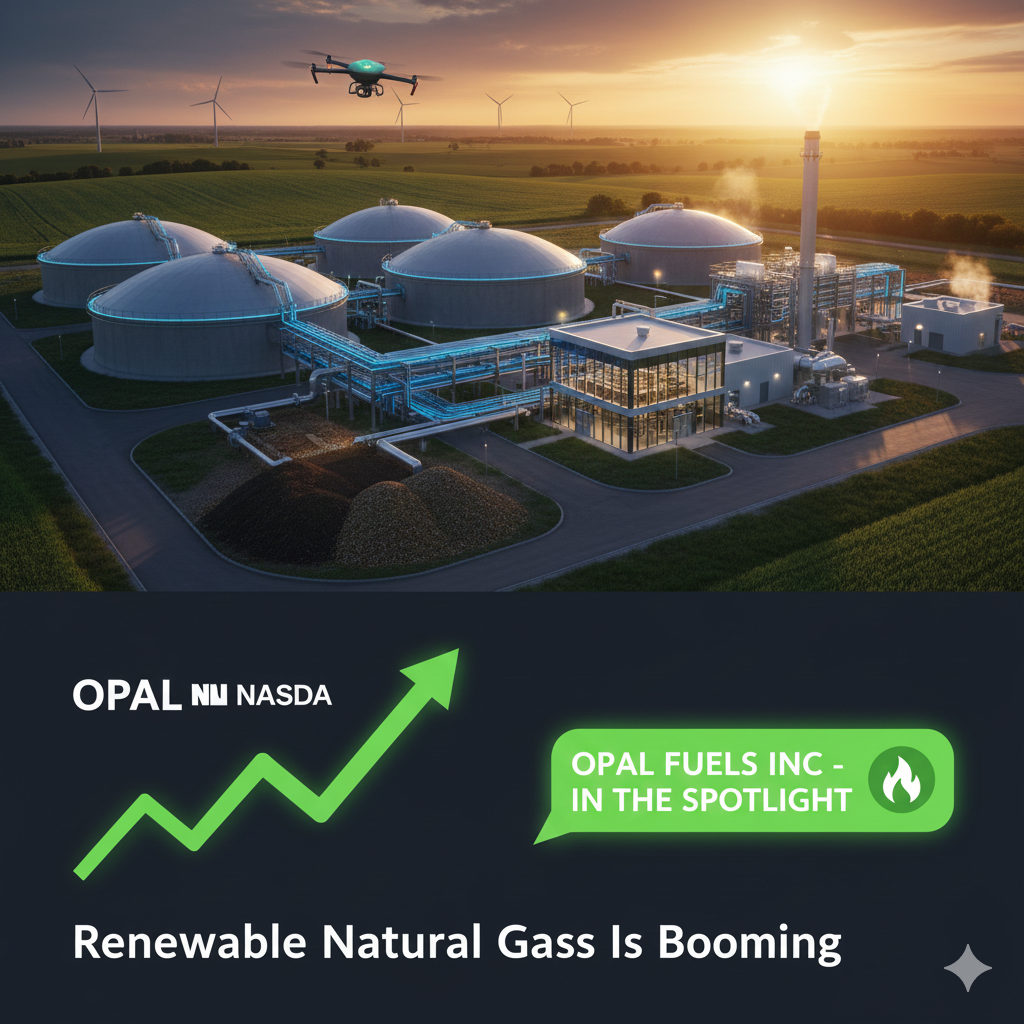
OPAL Fuels Inc is increasingly being recognized as a nationwide leader in the production, distribution, and marketing of renewable natural gas, positioning itself at the center of two of the most critical issues facing the energy and transportation industry today: reducing harmful methane emissions and decarbonizing the heavy duty transportation sector. Headquartered in White Plains, New York, the company has built an integrated platform that captures trapped energy from waste streams such as landfills and dairy farms, converts it into a proven low carbon fuel, and delivers that fuel into the transportation industry as a lower cost alternative to diesel. This model places OPAL Fuels at the intersection of renewable power, socially responsible profitability, and commercially viable infrastructure development.
CHECK THIS OUT: Why Nebius (NBIS) Could Outperform CoreWeave & Dominate the $9B AI Infrastructure Market and Is Lucid Group (LCID) Running Out of Cash? $875M Note Deal Raises Alarms.
A Business Model Built on Capturing Harmful Methane Emissions
At the core of OPAL Fuels’ strategy is the capture of fugitive methane emissions that would otherwise escape into the atmosphere and contribute disproportionately to global climate change. Methane is significantly more potent than carbon dioxide over a 20-year period, and OPAL Fuels’ renewable natural gas RNG platform directly addresses this challenge by capturing harmful methane emissions from landfills and agricultural waste. Through specialized facilities, landfill gas and biogas from dairy farms are upgraded into pipeline-quality renewable natural gas, transforming waste into a transportation fuel with low carbon intensity and, in many cases, net-negative emissions profiles.
Renewable natural gas produced by OPAL Fuels is chemically identical to conventional natural gas, yet its lifecycle emissions profile makes it one of the most cost effective solutions available today for reducing emissions in heavy duty trucking. Unlike experimental technologies, RNG is already commercially viable and can be deployed immediately using existing engines, fueling stations, and distribution networks.
Financial and Operating Results Highlight Scalable Growth
OPAL Fuels’ most recent financial and operating results underscore the scalability of its platform. For the three and nine months ended September 30, 2025, the company reported revenue of $83.4 million and $249.2 million respectively. While third-quarter revenue declined by 1% year over year due largely to a lower D3 RIN price environment, nine-month revenue increased by 13% compared to the prior year period, reflecting strong underlying growth in RNG production and fuel sales.
Net income for the third quarter totaled $11.4 million, compared to $17.1 million in the same period last year, while nine-month net income increased to $20.2 million from $19.7 million. Basic and diluted earnings per share attributable to Class A common shareholders were $0.05 for the quarter and $0.07 for the nine-month period. Adjusted EBITDA reached $19.5 million for the quarter and $56.0 million year-to-date, demonstrating continued profitability even amid near-term pricing pressure in environmental credit markets.
RNG production volumes reflect the strength of OPAL Fuels’ operating base. RNG produced during the third quarter reached 1.3 million MMBtu, up 30% year over year, while nine-month production increased 25% to 3.5 million MMBtu. These gains reinforce the company’s position as an emerging leader among RNG producers in the United States.
Heavy Duty Trucking as the Primary Growth Engine
OPAL Fuels’ strategy is tightly aligned with the heavy duty truck market, a segment of the transportation industry that remains difficult to electrify at scale. Heavy duty trucking requires high energy density, fast refueling, and long operating ranges, making RNG and compressed natural gas among the most practical alternatives to diesel fuel available today. Management has consistently emphasized that RNG and CNG represent the most attractive near-term replacements for diesel in Class 8 trucking fleets.
During the third quarter, OPAL Fuels’ Fuel Station Services segment sold, dispensed, and serviced 38.9 million gasoline gallon equivalents of transportation fuel, with RNG accounting for 20.4 million GGEs. For the nine-month period, total fuel volumes reached 120.4 million GGEs, including 60.5 million GGEs of RNG, reflecting double-digit growth compared to the prior year. These figures highlight increasing adoption by trucking fleets seeking to reduce emissions while controlling fuel costs.
Nationwide Fueling Infrastructure Supports Long-Term Adoption
OPAL Fuels’ advantage extends beyond RNG production into fueling infrastructure. As of September 30, 2025, the company owned 47 operating fueling stations, with an additional 16 under construction. Another 25 stations are under construction by third parties that will distribute OPAL-marketed RNG. This growing network supports nationwide distribution of renewable natural gas as a transportation fuel and lowers barriers to adoption for heavy duty fleets transitioning away from diesel.
The company’s vertically integrated model, encompassing production, distribution, and marketing, allows OPAL Fuels to capture value across the RNG supply chain while offering customers reliable access to low carbon fuel at scale.
Project Pipeline Expands Production Capacity
OPAL Fuels continues to advance a robust development pipeline that underpins future growth. The Atlantic RNG Project recently commenced commercial operation, adding approximately 0.3 million MMBtu of annual design capacity net to OPAL Fuels based on its 50% ownership interest. This milestone reflects the company’s ability to move projects from development into revenue-generating assets.
Looking ahead, the Burlington and Cottonwood RNG projects, representing a combined 1.1 million MMBtu of annual design capacity for OPAL’s share, are expected to begin commercial operations in 2026. The Kirby RNG Project in California, fully owned by OPAL Fuels and representing 0.7 million MMBtu of annual design capacity, is targeted for commercial operation in 2027. In October 2025, the company also began construction of the CMS Concord RNG facility in North Carolina, which will contribute approximately 0.7 million MMBtu of annual design capacity for OPAL’s 70% ownership share.
With these projects, OPAL Fuels’ total annual design capacity now stands at 9.1 million MMBtu across twelve operating projects, reinforcing its status as a nationwide leader in RNG production and distribution.
Tax Credits, Policy Support, and Capital Efficiency
Policy support remains a critical tailwind for OPAL Fuels. During 2025, the company completed its fourth sale of IRA Investment Tax Credits, generating more than $40 million in aggregate gross proceeds for the year, including $17.3 million completed in the third quarter. Management expects to begin recognizing 45Z production tax credits in the fourth quarter, further enhancing cash flows and project economics.
This ability to monetize tax credits supports OPAL Fuels’ financing strategy by reducing reliance on equity dilution while funding growth. It also reinforces the bipartisan policy environment that supports renewable natural gas as a key tool in reducing emissions from waste and transportation.
A Bullish Long-Term Thesis Anchored in Execution
OPAL Fuels’ bullish thesis rests on its ability to address emissions, energy security, and cost challenges simultaneously. By capturing harmful methane emissions, producing RNG as a proven low carbon fuel, and delivering it into the heavy duty trucking market, the company offers a solution that is immediately deployable and economically competitive with diesel fuel. Its consistent operating results, expanding asset base, and disciplined financing approach suggest that OPAL Fuels is building durable intrinsic value rather than pursuing speculative growth.
As investors continue to evaluate energy companies through the lens of emissions reduction, cost effectiveness, and scalability, OPAL Fuels Inc stands out as an emerging leader in renewable natural gas with tangible assets, growing revenues, and a clear pathway to long-term growth in transportation fuels.
READ ALSO: Above Food (ABVE) to Issue 1.1 Billion New Shares in Merger and Perpetua Resources (PPTA) Soars 171% as U.S. Approves $1.3B Gold-Antimony Mine.