Few American energy companies have expanded their footprint as aggressively or as broadly as the midstream operator that grew alongside the U.S. shale boom, building a vast web of pipelines, terminals, and storage assets that connect production basins to industrial end users and global markets. Its history reflects a strategy centered on scale, asset accumulation, and long-term transportation contracts, with growth driven by the belief that owning critical energy infrastructure would secure durable cash flows across commodity cycles. This approach shaped a company whose identity is closely tied to the physical movement of energy rather than the production of oil or gas itself.
Energy Transfer LP (NYSE:ET) was formed as a publicly traded limited partnership focused on owning and operating energy infrastructure across the United States. Headquartered in Texas, the partnership developed into one of the largest natural gas midstream and transportation operators in North America. Energy Transfer built its business around natural gas transportation pipelines, interstate transportation and storage, intrastate transportation, and complementary natural gas midstream services that link producers, utilities, and industrial end users. Over time, the company expanded beyond natural gas into crude oil transportation, natural gas liquids, refined product transportation, and storage facilities, creating a diversified portfolio of energy assets.
Energy Transfer’s strategic network grew through a combination of organic development and acquisitions, allowing the company to connect major production basins with downstream demand centers. The partnership owns and operates thousands of miles of natural gas pipelines, crude oil pipelines, NGL pipelines, and refined products infrastructure, along with terminalling assets and storage facilities that support transportation and logistics across the energy value chain. These assets serve utilities, petrochemical companies, motor fuels distributors, and other industrial customers that rely on reliable transportation and storage services.
As Energy Transfer expanded, it structured its operations around multiple segments, including natural gas midstream, interstate transportation and storage, NGL fractionation, refined products, and other segments tied to complementary services. The partnership also holds general partner interests and incentive distribution rights in affiliated entities such as Sunoco LP and maintains an ownership stake in USA Compression Partners, further extending its reach into compression services and refined product transportation. This structure reflects a philosophy of building an interconnected ecosystem of energy infrastructure rather than a single-line business.
The company’s growth coincided with major business milestones in U.S. energy development, particularly the rise of shale production that increased demand for pipelines, storage, and transportation. Energy Transfer invested heavily in construction, development, and expansion projects to accommodate rising natural gas demand, crude oil transportation needs, and natural gas liquids volumes. Projects such as large-scale interstate pipelines and storage expansions were designed to move energy efficiently from producing regions to consuming markets and export hubs.
Leadership has played a central role in shaping Energy Transfer’s background, with founder and executive chairman Kelcy Warren guiding the partnership’s expansion strategy over multiple decades. Under this leadership, Energy Transfer emphasized ownership of hard assets and long-lived infrastructure as a foundation for revenue generation. The partnership’s revenue model has historically relied on fee-based transportation and storage services rather than direct exposure to commodity prices, aligning its identity with midstream stability rather than upstream volatility.
Energy Transfer’s asset base reflects its evolution into a diversified energy infrastructure company. Its portfolio includes natural gas transportation pipelines that support power generation and utility demand, crude oil transportation systems that serve domestic refineries, and natural gas liquids infrastructure that feeds petrochemical and export markets. Storage assets and terminaling facilities add another layer of integration, enabling the partnership to offer transportation and storage solutions across multiple energy products.
Today, Energy Transfer LP stands as one of the largest energy infrastructure partnerships in the United States, with operations spanning natural gas, crude oil, natural gas liquids, and refined products. Its background is defined by scale, complexity, and a long history of capital investment aimed at maximizing the reach of its energy assets. As an American company operating at the core of U.S. energy transportation and storage, Energy Transfer’s identity remains closely tied to the physical networks that move oil and gas across the country and sustain the broader energy industry.
Energy Transfer LP and the Structural Risks Beneath Its Expansive Midstream Network
Energy Transfer LP has long been viewed as one of the most expansive energy infrastructure operators in North America, owning and operating a vast network of natural gas pipelines, natural gas liquids infrastructure, crude oil transportation systems, refined product transportation assets, and storage facilities. As a publicly traded limited partnership, Energy Transfer operates across nearly every major U.S. production basin, positioning itself as a central player in natural gas midstream, interstate transportation and storage, and NGL fractionation. However, recent strategic decisions and capital allocation shifts have begun to highlight vulnerabilities within Energy Transfer’s business model that could weigh on future results.
Despite the breadth of Energy Transfer’s strategic network, scale alone does not guarantee durable returns. The company’s reliance on capital-intensive expansion, exposure to regulatory friction, and sensitivity to shifting energy demand trends present material risks for investors assessing long-term sustainability.
CHECK THIS OUT: Why Nebius (NBIS) Could Outperform CoreWeave & Dominate the $9B AI Infrastructure Market and Is Lucid Group (LCID) Running Out of Cash? $875M Note Deal Raises Alarms.
The LNG Retreat Raises Questions About Capital Discipline
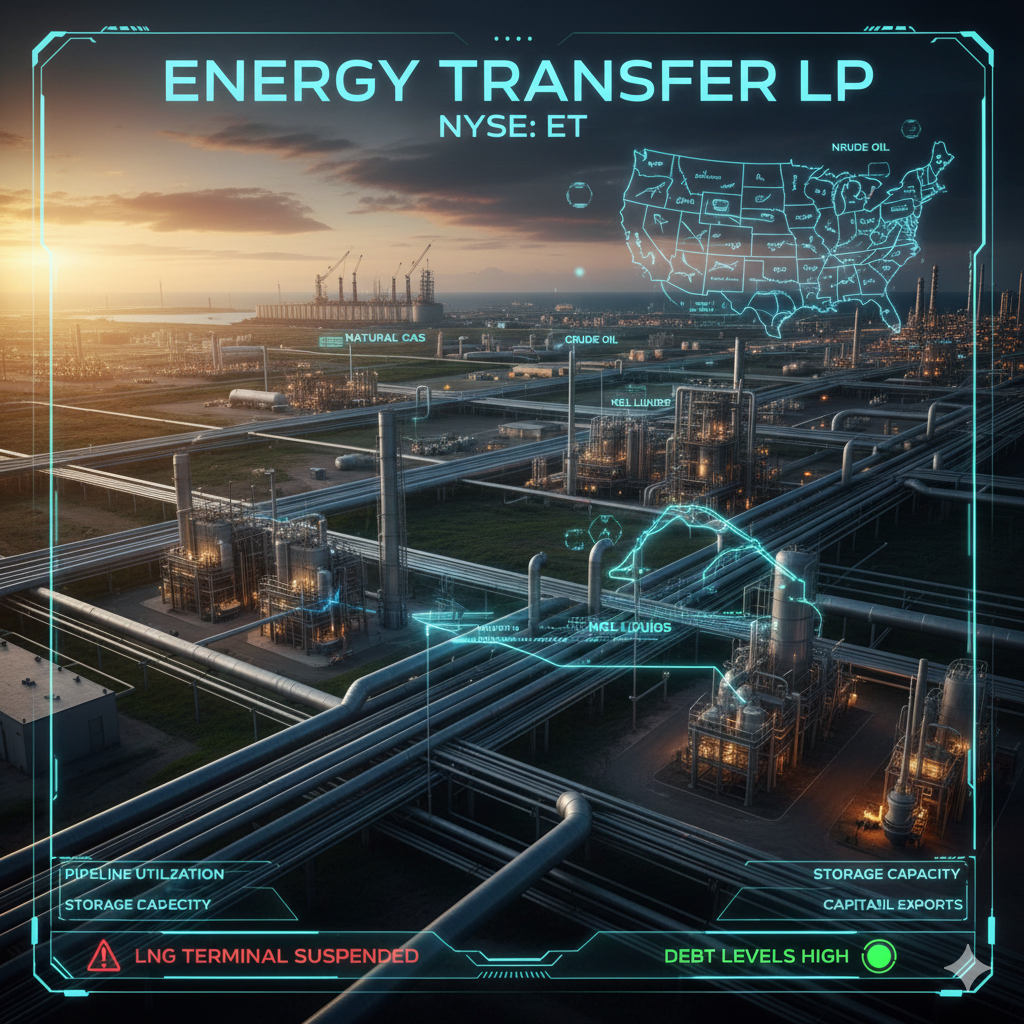
A key bearish signal emerged in December 2025 when Energy Transfer halted development of the Lake Charles LNG project, a high-profile liquefied natural gas export facility in Louisiana. The project had committed customers that included Chevron and Shell, yet the company suspended development after years of effort to repurpose an unused gas-import terminal built before the U.S. shale boom. This decision followed earlier delays to a final investment decision and underscores challenges in securing financing for large-scale LNG infrastructure.
The Lake Charles LNG project was expected to be a cornerstone growth initiative, linking Energy Transfer’s natural gas transportation pipelines to global export markets. Its suspension suggests rising capital constraints, financing uncertainty, or risk aversion tied to long-dated returns. While Energy Transfer announced it would instead focus on expanding a southwest U.S. natural gas pipeline project to meet stronger-than-expected domestic demand, the pivot raises concerns about execution consistency and the opportunity cost of sunk development capital.
Heavy Leverage Limits Strategic Flexibility
Energy Transfer’s balance sheet remains a central point of concern. The partnership has historically carried elevated debt levels to fund construction, development, and acquisitions across its diversified portfolio. This leverage constrains flexibility, particularly in an environment where interest rates remain higher for longer and capital markets are less forgiving of midstream companies with aggressive funding profiles.
As of recent filings, Energy Transfer continues to manage tens of billions of dollars in long-term debt, while outstanding common units and incentive distribution rights tied to general partner interests further complicate capital allocation. Maintaining distributions while servicing debt and funding new projects requires consistent, high-volume throughput across natural gas, crude oil, and natural gas liquids systems. Any sustained softness in demand or regulatory delays could tighten coverage ratios and pressure cash flows.
Natural Gas Demand Strength Masks Volume Sensitivity
Energy Transfer has emphasized stronger-than-expected natural gas demand as justification for expanding intrastate and interstate transportation pipelines, particularly in Texas and the southwest United States. While demand from utilities, industrial end users, and power generation remains solid, this narrative masks a critical risk. Midstream revenue depends not just on demand but on production growth and utilization rates across energy assets.
Should upstream producers moderate drilling activity due to commodity price volatility or capital discipline, volumes moving through Energy Transfer’s natural gas pipelines and gas midstream systems could flatten or decline. This sensitivity is especially pronounced given the company’s exposure to associated gas production tied to crude oil drilling, where production decisions are influenced by oil prices rather than gas fundamentals alone.
NGL and Refined Products Exposure Adds Cyclical Risk
Energy Transfer’s natural gas liquids portfolio, including NGL pipelines, fractionation, storage assets, and terminaling facilities, introduces additional cyclicality. NGL demand is closely linked to petrochemical activity, exports, and global industrial growth. A slowdown in manufacturing or export disruptions could weaken NGL fractionation margins and reduce throughput across complementary natural gas midstream assets.
Similarly, refined product transportation and motor fuels infrastructure face long-term uncertainty as energy transition policies accelerate. While refined products remain essential today, shifts toward electrification and decarbonization create structural headwinds for petroleum products over time, potentially limiting growth across refined product transportation segments.
Regulatory and Environmental Pressures Remain Persistent
Energy Transfer’s extensive footprint exposes it to heightened environmental scrutiny and permitting challenges. Interstate transportation and storage projects often face prolonged approval processes, legal challenges, and community opposition. These factors can delay construction timelines, inflate costs, and reduce returns on invested capital.
High-profile projects across the industry have demonstrated how environmental and regulatory resistance can materially alter expected outcomes. For Energy Transfer, this risk is amplified by the scale of its projects and the geographic reach of its pipelines, particularly in environmentally sensitive regions.
Distribution Appeal May Be a Double-Edged Sword
Energy Transfer’s investment case has traditionally leaned heavily on income, with distributions serving as a primary draw for investors. However, high yield can become a liability if market confidence erodes. Distribution sustainability depends on stable revenue from transportation and storage services across oil, gas, and NGL segments.
If future results fail to meet expectations due to project delays, volume softness, or rising operating costs, Energy Transfer may face difficult trade-offs between preserving distributions and strengthening its balance sheet. Any perception that distributions are at risk could trigger unit price volatility, especially among yield-focused investors.
Strategic Complexity Dilutes Transparency
Energy Transfer’s diversified portfolios span natural gas, crude oil, refined products, NGLs, storage, terminaling, and interstate transportation. While diversification can reduce single-asset risk, it also dilutes transparency and complicates forecasting. Investors must assess multiple segments, joint ventures, and partnerships, including interests tied to Sunoco LP and USA Compression Partners.
This complexity can obscure underperforming assets and delay strategic course correction. In contrast, peers with more focused asset bases may be better positioned to adapt quickly to changing market conditions.
A Bearish Outlook Framed by Execution and Capital Risk
The bearish thesis for Energy Transfer LP is not rooted in a single weak quarter or isolated project decision, but in a pattern of capital-intensive growth, elevated leverage, regulatory friction, and strategic pivots that raise questions about long-term value creation. The halt of the Lake Charles LNG project, despite committed customers and years of development, serves as a visible reminder of execution risk within an already crowded U.S. energy infrastructure landscape.
While Energy Transfer remains a major player in natural gas transportation, crude oil transportation, and energy infrastructure, its future performance depends heavily on flawless execution, sustained demand growth, and continued access to affordable capital. In a market increasingly sensitive to balance sheet strength, environmental risk, and capital efficiency, Energy Transfer may face mounting pressure to justify its scale with consistent, risk-adjusted returns.
For investors prioritizing clarity, capital discipline, and long-term structural alignment, Energy Transfer LP presents a complex and potentially vulnerable profile within the evolving energy industry.
READ ALSO: Above Food (ABVE) to Issue 1.1 Billion New Shares in Merger and Perpetua Resources (PPTA) Soars 171% as U.S. Approves $1.3B Gold-Antimony Mine.