The story begins with a vision to reinvent how people, goods, and services move across the world, grounded in the belief that transportation can be both technologically advanced and environmentally responsible without sacrificing performance or design. Built around innovation, sustainability, and long-term systems thinking, this enterprise emerged at a time when the global automotive industry was facing mounting pressure to transition away from internal combustion engines toward cleaner, more efficient solutions that could scale across consumer and commercial markets.
Rivian Automotive Inc. (NASDAQ:RIVN) was founded in 2009 as an automotive technology company with a long gestation period that focused first on foundational engineering rather than rapid commercialization. Headquartered in Irvine, California, the company positioned itself early as more than a traditional car manufacturer, instead building a vertically integrated platform that combines vehicle hardware, proprietary software, and advanced electrical architecture. As an American electric vehicle manufacturer, Rivian Automotive Inc. designs and develops battery-electric vehicles intended to support future vehicles across multiple segments, including the pickup truck, SUV, and electric delivery van markets in the United States and Canada.
Rivian Automotive differentiated itself by focusing on adventure-oriented utility vehicles rather than mass-market sedans, aligning its early product strategy with customers seeking range, durability, and off-road capability. The company produces the R1T pickup truck and the R1S SUV, both of which are engineered on a flexible skateboard platform that integrates the battery pack, drive units, suspension, and thermal systems into a single modular structure. This platform approach allows Rivian Automotive to optimize vehicle range, wheel control, torque delivery, and efficiency while supporting accessories, different vehicle sizes, and future models without redesigning the entire system.
A key part of Rivian Automotive Inc.’s background is its early emphasis on in-house technology development. Rather than relying heavily on third-party suppliers, the company invested in building its own software stack, electronic control units, and electrical architecture. This enables tighter integration between hardware and software, allowing vehicles to receive over-the-air updates that improve performance, efficiency, and self driving features over time. From a scientific and engineering perspective, this approach treats the vehicle as a dynamic system where data from sensors, cameras, radar, and compute units continuously feeds into machine-learning models that refine driver assistance and autonomy functions.
The company’s electric delivery van program further reflects its platform-first philosophy. Designed initially to meet large-scale commercial delivery needs, the van integrates battery technology optimized for stop-and-go efficiency, thermal management systems tailored for high-utilization routes, and software tools that support fleet management, diagnostics, and routing. Rivian Automotive Inc. leveraged this program to refine its manufacturing processes, supply chain discipline, and cost controls, all while expanding its facilities footprint in Normal, Illinois, and supporting engineering operations across Michigan and California.
Rivian Automotive Inc. entered the public markets through its initial public offering in November 2021, raising approximately $13.5 billion and achieving one of the largest IPOs in automotive history. The capital raised strengthened the company’s balance sheet, enabling continued investment in manufacturing plants, research and development, and workforce expansion. While net income has remained negative as the company prioritizes growth and technology buildout, Rivian Automotive has consistently emphasized long-term value creation over short-term profitability, a stance aligned with other transformative automotive and technology businesses during their early scaling phases.
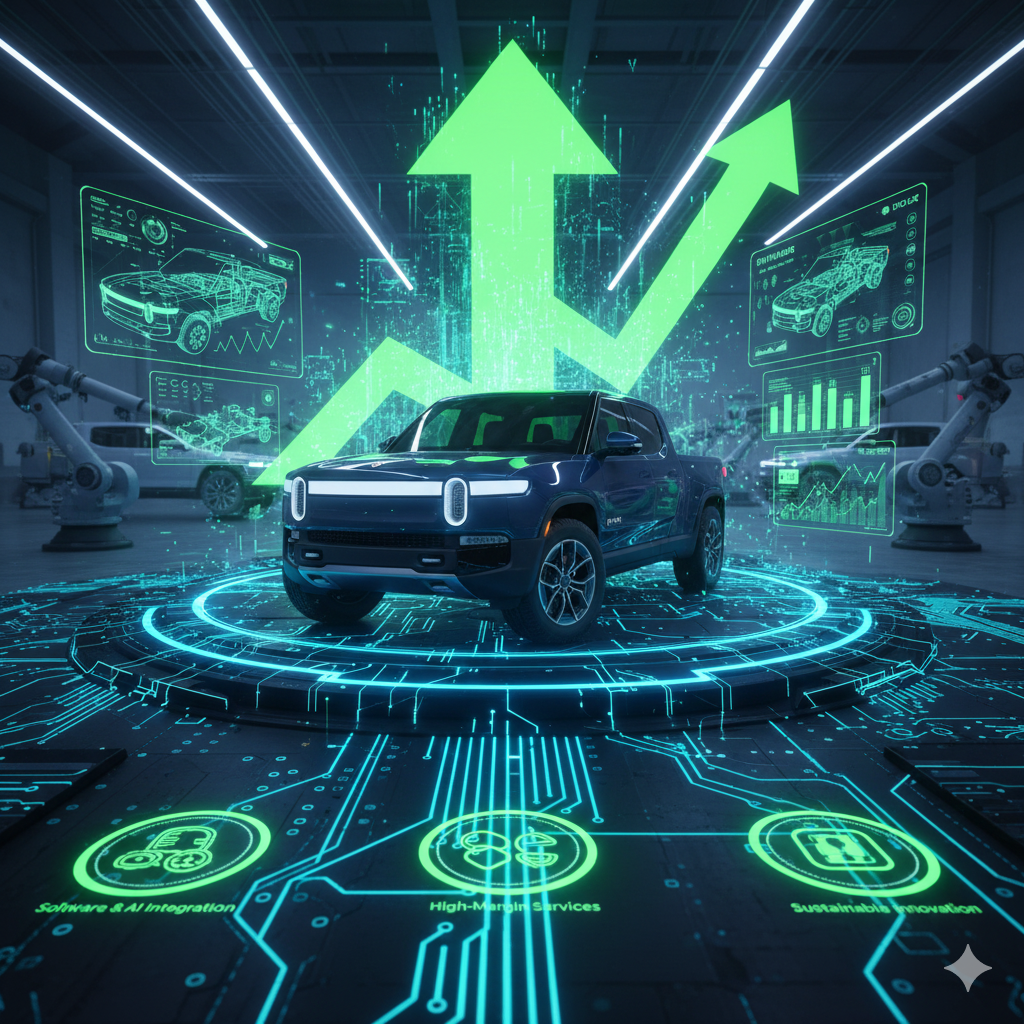
Central to Rivian Automotive Inc.’s long-term strategy is its belief that software and autonomy will define the future of transportation. The company’s autonomy and AI initiatives are built on data-driven learning systems, where vehicles continuously collect real-world driving data that improves perception, decision-making, and control algorithms. This scientific process relies on neural networks trained to interpret complex driving environments, enabling advanced driver assistance and future autonomous capabilities. By owning this data and the underlying software, Rivian Automotive Inc. aims to create high-margin services that complement vehicle sales and extend customer value well beyond the initial purchase.
Rivian Automotive Inc. has also cultivated a distinct brand identity anchored in sustainability and exploration, encapsulated in its “World Adventurous Forever” philosophy. This branding reflects the company’s broader mission to balance environmental responsibility with real-world utility, positioning its vehicles as tools for both everyday use and demanding conditions. As electric vehicle adoption continues to expand globally, Rivian Automotive Inc.’s background as a technology-driven automotive company provides a foundation for scaling production, expanding services, and supporting future vehicles across consumer and commercial markets.
In the context of a rapidly evolving automotive industry, Rivian Automotive Inc.’s origin story is defined by patience, engineering depth, and a platform-based mindset. Rather than chasing short-term trends, the company built its business around long product cycles, robust technology stacks, and a vision of transportation where software, autonomy, and electric powertrains converge. This background continues to shape how Rivian Automotive Inc. approaches growth, innovation, and its role in the future of electric mobility.
Rivian Automotive Inc. Positions Itself as a Software-Driven Automotive Technology Company
Rivian Automotive Inc. has steadily evolved from a niche electric vehicle startup into a full-scale automotive technology company founded on the belief that vehicles should serve as intelligent platforms rather than static products. Established in 2009 and headquartered in Irvine, California, Rivian Automotive has built its brand around innovation, sustainability, and the lifestyle ethos captured in its “World Adventurous Forever” philosophy. As an American electric vehicle manufacturer, Rivian Automotive Inc. designs and produces electric pickup trucks, SUVs, and electric delivery vans while developing proprietary software and electrical architecture to support future vehicles and services.
Since its initial public offering in November 2021, when the company raised approximately $13.5 billion in one of the largest automotive IPOs in history, Rivian Automotive Inc. has remained one of the most closely watched electric vehicle stocks on the Nasdaq. The stock price has been volatile, reflecting broader EV market sentiment, interest rate pressures, and changing investor expectations. However, renewed analyst optimism and concrete technological milestones have recently refocused attention on Rivian’s long-term value proposition.
CHECK THIS OUT: Why Nebius (NBIS) Could Outperform CoreWeave & Dominate the $9B AI Infrastructure Market and Is Lucid Group (LCID) Running Out of Cash? $875M Note Deal Raises Alarms.
Goldman Sachs Turns More Constructive After Rivian AI Day
Goldman Sachs is bullish on Rivian Automotive, Inc. following the company’s Autonomy & AI Day held in December 2025. In a report released on December 12, Goldman Sachs raised its price target on RIVN stock from $13 to $16 while maintaining a Neutral rating. The firm cited Rivian’s clear articulation of a vertically integrated hardware and software strategy, emphasizing that the vehicle itself is becoming a platform for high-margin software, autonomy services, and third-party integrations.
Goldman Sachs highlighted the launch of Rivian’s paid Autonomy+ service model, which is scheduled to scale starting in 2026. This subscription-based approach supports self-driving features, advanced driver assistance, and future autonomy upgrades, creating recurring revenue streams that extend well beyond initial vehicle sales. According to the report, Rivian Automotive Inc. is positioning its technology stack to enable licensing opportunities and long-term monetization across future vehicle platforms.
Needham Sees Strong Upside in Software-Defined Vehicle Strategy
Separately, Needham reaffirmed its Buy rating on Rivian Automotive Inc. and upgraded its price objective from $14 to $23 following the same AI Day disclosures. The firm stated that the event significantly boosted confidence in Rivian’s positioning as software-defined vehicles become the industry norm. Needham emphasized Rivian’s vertical integration, noting that in-house development of software, compute platforms, and electronic control units allows faster iteration, better cost control, and a more efficient learning curve.
Needham also pointed to Rivian’s partnership with Volkswagen, where Rivian develops electronic architecture and software modules that support future vehicles beyond its own lineup. This strategy reinforces Rivian Automotive Inc.’s role not just as a car manufacturer, but as a technology company with the ability to scale intellectual property across the global automotive ecosystem.
Manufacturing Footprint and Vehicle Production Capabilities
Rivian Automotive Inc. produces its vehicles primarily at its manufacturing plant in Normal, Illinois, a facility capable of supporting significant production volumes once fully optimized. The plant currently manufactures the R1T electric pickup truck, the R1S SUV, and the electric delivery van originally developed for Amazon before being opened to other commercial customers in the United States and Canada.
The company has also announced plans for additional facilities, including a future manufacturing site in Georgia, intended to support next-generation platforms and more affordable vehicle pricing. These facilities are designed to improve efficiency, reduce per-vehicle costs, and support higher vehicle sales volumes over time. Rivian employs thousands of workers across Illinois, Michigan, California, and British Columbia, supporting engineering, testing, software development, and vehicle assembly operations.
Revenue Growth, Cash Position, and Financial Profile
Rivian Automotive Inc. reported annual revenue of approximately $4.4 billion in 2024, reflecting strong growth in vehicle deliveries despite pricing pressures across the EV sector. Vehicle prices for Rivian’s premium truck and SUV models generally range from the high $70,000s to over $90,000 depending on configuration, range, accessories, and other fees. While the company continues to report negative net income as it invests heavily in technology, manufacturing, and workforce expansion, its balance sheet remains a key strength.
As of its most recent filings, Rivian Automotive Inc. reported total assets exceeding $25 billion and cash, cash equivalents, and short-term investments of roughly $9 billion. This liquidity provides access to financing flexibility, supports ongoing autonomy development, and reduces near-term reliance on loans or dilutive capital raises. Investors continue to monitor cash burn closely, but analysts note that Rivian’s capital discipline has improved compared to earlier years.
Electric Delivery Van and Commercial Market Expansion
The electric delivery van remains a critical pillar of Rivian Automotive Inc.’s business strategy. Initially developed under an exclusive arrangement, the van platform is now offered more broadly to commercial customers, opening a new line of business with predictable fleet demand. Commercial delivery customers value reliability, range efficiency, software integration, and lower total cost of ownership, areas where Rivian’s technology platform offers competitive advantages.
These delivery vehicles support recurring revenue opportunities through software services, fleet management tools, and future autonomy upgrades. The commercial segment also provides diversification from consumer SUV and truck cycles, stabilizing revenue during periods of fluctuating retail demand.
Autonomy, Software, and the Future of Rivian Vehicles
Rivian’s autonomy roadmap is central to its long-term value creation. At AI Day, the company detailed its internal compute platform, next-generation electrical architecture, and plans to scale self-driving features across its vehicle lineup. These systems are designed to support hands-free driving, enhanced safety features, and continuous over-the-air updates.
By controlling its own software stack, Rivian Automotive Inc. can roll out features more efficiently, test new services, and adapt quickly to regulatory and customer feedback. This software-first approach aligns Rivian with the broader automotive industry’s shift toward digital platforms, data-driven services, and subscription-based revenue models.
Market Perception, Stock Performance, and Investor Outlook
As of mid-December 2025, Rivian stock was trading in the mid-teens after gaining more than 15 percent in a single session following positive analyst commentary. While the company does not currently offer a dividend yield, investors remain focused on long-term appreciation driven by technology leadership, platform scalability, and improved margins over time.
Financial publications such as Motley Fool have noted that Rivian Automotive Inc.’s valuation reflects both execution risk and significant optionality. For investors willing to tolerate volatility, the company represents exposure to the convergence of electric vehicles, software, and autonomy under a single vertically integrated business model.
Why Rivian Automotive Inc. Remains a Compelling Long-Term Story
Rivian Automotive Inc. operates at the intersection of automotive manufacturing, advanced software, and future mobility services. Its ability to produce premium electric vehicles, support future vehicles with scalable platforms, and monetize autonomy features positions the company uniquely within the EV landscape. With analysts from Goldman Sachs and Needham highlighting tangible progress rather than speculative promises, Rivian’s narrative is increasingly anchored in execution and measurable milestones.
While risks remain, including competition, pricing pressure, taxes, regulatory challenges, and ongoing losses, Rivian Automotive Inc. continues to build the foundation of a durable automotive technology company. For investors seeking exposure to the future of electric vehicles, autonomy, and software-defined transportation, Rivian remains a name that commands attention.
READ ALSO: Above Food (ABVE) to Issue 1.1 Billion New Shares in Merger and Perpetua Resources (PPTA) Soars 171% as U.S. Approves $1.3B Gold-Antimony Mine.