What has consistently shaped certain segments of American manufacturing is the ability to combine heritage craftsmanship with modern engineering while operating within one of the most regulated consumer product environments in the country. Few industries require the same level of precision, durability testing, compliance, and brand trust as the firearms sector, where product performance is directly tied to safety, reliability, and long-term consumer confidence. This backdrop explains why only a limited number of manufacturers have been able to sustain relevance across multiple economic and political cycles.
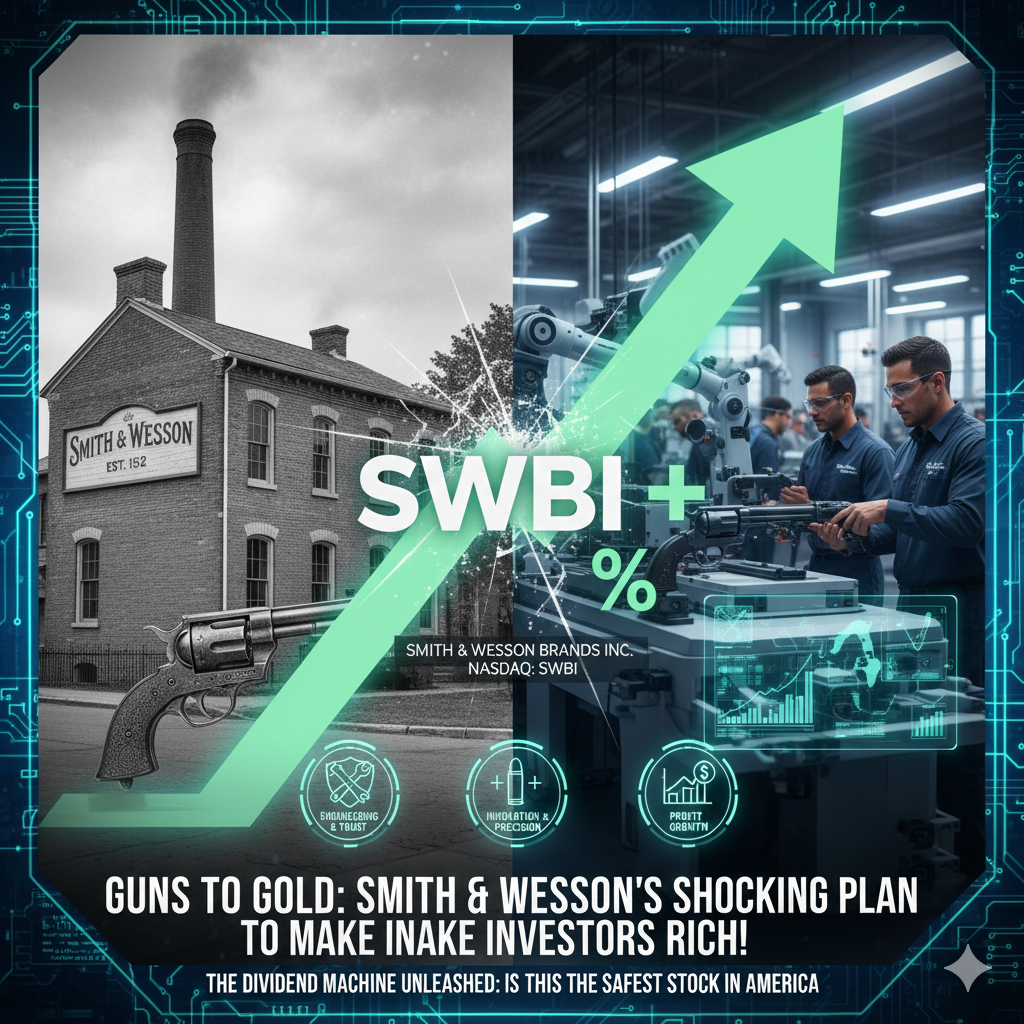
Smith & Wesson Brands Inc. (NASDAQ:SWBI) has built its identity around that exact intersection of legacy, engineering discipline, and regulated manufacturing. Smith & Wesson Brands is one of the most established firearms companies in the United States, with roots that trace back more than a century and a half. Over time, the company has evolved from a traditional firearm maker into a branded consumer products business focused on the design, manufacture, and distribution of firearms and related accessories for personal protection, sport shooting, and professional use.
Smith & Wesson Brands operates primarily within the United States market, where firearm ownership, replacement cycles, and accessories demand form the core of its revenue base. The company’s background is defined by a focus on brand trust, which plays a critical role in purchasing decisions where reliability and safety are paramount. In this market, consumers often prioritize proven manufacturers with long operating histories, giving Smith & Wesson a durable competitive position relative to newer entrants.
The technical foundation of Smith & Wesson Brands lies in precision engineering and rigorous product validation rather than pharmaceutical-style drug trials. Firearms development requires extensive testing under controlled and real-world conditions to evaluate durability, mechanical tolerance, accuracy, and failure resistance. New product designs undergo repeated stress testing, endurance firing cycles, and materials analysis to ensure consistent performance across thousands of rounds. These testing protocols function as the industry’s equivalent of clinical validation, designed to minimize risk and ensure reliability before commercial release.
Smith & Wesson Brands integrates modern manufacturing processes with iterative design refinement. Product development incorporates feedback from professional users, law enforcement, sport shooters, and consumers to refine ergonomics, materials, and internal mechanisms. This process allows the company to introduce new models that address evolving consumer preferences while remaining compliant with regulatory standards at both the state and federal level.
Beyond firearms themselves, Smith & Wesson Brands has expanded its portfolio into accessories and branded products that complement its core offerings. These extensions leverage the company’s brand recognition while allowing for diversification within a highly regulated industry. Accessories typically carry different regulatory requirements and margin profiles, providing incremental revenue opportunities without fundamentally altering the company’s manufacturing focus.
Smith & Wesson Brands operates with an emphasis on disciplined operations and inventory management, reflecting lessons learned across multiple demand cycles. Firearms demand has historically been influenced by social conditions, regulatory discussions, and consumer sentiment, leading to periods of rapid expansion followed by normalization. The company’s background demonstrates an ability to scale production up or down while maintaining balance sheet stability, an important factor in long-term survivability within the industry.
The company is headquartered in the United States and maintains manufacturing and assembly operations that prioritize quality control and compliance. Its workforce includes engineers, machinists, quality assurance specialists, and operational staff who support both product development and ongoing production. This internal expertise contributes to consistent product standards and reinforces the company’s reputation for reliability.
Smith & Wesson Brands, Inc. is publicly traded on the NASDAQ under the ticker symbol SWBI, providing investors with exposure to a business that operates at the intersection of consumer goods, manufacturing, and regulatory complexity. Its background reflects not only the evolution of a historic brand, but also the adaptation required to remain relevant in a modern marketplace shaped by compliance, innovation, and disciplined capital allocation.
Ultimately, Smith & Wesson Brands’ background is defined by continuity rather than disruption. The company’s long operating history, engineering-driven product development, and focus on reliability have allowed it to persist through shifting market conditions. In an industry where trust and performance are inseparable, Smith & Wesson Brands continues to position itself as a manufacturer built on precision, testing, and brand durability rather than short-term trends.
Smith & Wesson Delivers Solid Cash Flow Despite Near-Term Revenue Pressure
Smith & Wesson Brands, Inc. reported second quarter fiscal 2026 results that highlighted the company’s ability to preserve profitability, generate strong operating cash flow, and manage inventory efficiently amid a moderating demand environment. While net sales declined modestly year over year, the quarter reinforced the durability of the Smith & Wesson brand and the company’s disciplined approach to operations and capital allocation.
Net sales for the second quarter totaled $124.7 million, representing a decrease of $5.0 million, or 3.9 percent, compared with the same period last year. The decline reflected broader normalization across the firearms market rather than a loss of competitive position, as management emphasized continued retail sell-through and healthy distributor inventory levels.
CHECK THIS OUT: Why Nebius (NBIS) Could Outperform CoreWeave & Dominate the $9B AI Infrastructure Market and Is Lucid Group (LCID) Running Out of Cash? $875M Note Deal Raises Alarms.
Margin Performance Reflects Normalization, Not Structural Weakness
Gross margin for the quarter came in at 24.3 percent, down from 26.6 percent in the comparable prior-year period. The contraction in gross margin was largely attributable to mix and volume dynamics typical of a post-surge normalization phase, rather than pricing deterioration or loss of brand equity.
Despite the lower margin profile, Smith & Wesson maintained solid profitability. GAAP net income was $1.9 million, or $0.04 per diluted share, compared with $4.5 million, or $0.10 per diluted share, in the prior year quarter. On a non-GAAP basis, which excludes costs related to the relocation and grand opening of the Smith & Wesson Academy, net income totaled $2.0 million, or $0.04 per diluted share, compared with $5.2 million, or $0.12 per diluted share, a year earlier.
Adjusted EBITDAS for the quarter was $15.1 million, representing 12.1 percent of net sales, compared with $19.1 million, or 15.0 percent of net sales, in the comparable quarter last year. While profitability declined year over year, the company’s ability to generate more than $15 million in adjusted earnings on approximately $125 million in sales underscores the operating resilience of the business.
Operating Cash Flow Emerges as a Key Positive
One of the most notable highlights of the quarter was operating cash flow. Net cash provided by operating activities reached $27.3 million, an increase of $34.7 million compared with the same quarter last year. This sharp improvement was driven primarily by a significant reduction in inventory, reflecting disciplined sales and operations planning.
Management emphasized that inventory reductions were not achieved at the expense of channel health. Instead, distributor inventory in terms of actual units declined by more than 5 percent from the end of the prior quarter and by 15 percent compared with the end of October 2024. These figures indicate continued sell-through at retail and suggest that Smith & Wesson is entering the coming quarters with a cleaner channel and reduced risk of inventory overhang.
New Product Innovation Continues to Drive Sales Mix
Innovation remained a central theme in the quarter. New products accounted for 38.7 percent of total sales, reinforcing management’s view that product development remains a critical growth lever even in a normalized demand environment. This level of contribution from recent launches highlights the company’s ability to refresh its portfolio and sustain consumer interest without relying solely on macro-driven demand spikes.
Mark Smith, President and Chief Executive Officer, noted that operational efficiency played a key role in sustaining profitability. He pointed to strong execution across manufacturing, inventory management, and cost control as factors that allowed the company to deliver nearly $15 million in adjusted EBITDAS while also generating substantial operating cash flow.
Outlook Signals Return to Year-Over-Year Growth
Looking ahead, management expressed cautious optimism despite ongoing macroeconomic uncertainty, including potential tariff impacts. Deana McPherson, Executive Vice President and Chief Financial Officer, stated that the company expects third quarter fiscal 2026 sales to be 8 to 10 percent higher than third quarter fiscal 2025 sales. Importantly, this outlook assumes no significant positive or negative impact from channel inventory, suggesting confidence that underlying demand and product mix will support growth.
The expectation of year-over-year sales growth in the upcoming quarter stands in contrast to the modest decline reported in the second quarter and supports the bullish argument that the business is stabilizing after industry-wide normalization.
Capital Allocation Reinforces Shareholder Returns
Smith & Wesson’s balance sheet strength and cash generation continue to support shareholder returns. Consistent with its capital allocation strategy, the company’s board of directors authorized a quarterly dividend of $0.13 per share. The dividend will be paid on January 2, 2026, to stockholders of record as of December 18, 2025.
The ability to fund dividends while simultaneously reducing inventory and generating operating cash flow underscores the company’s financial flexibility. In a sector often characterized by volatility, this discipline differentiates Smith & Wesson from weaker competitors that struggle to sustain shareholder returns during demand downturns.
Strategic Perspective on the Quarter
From a broader investment perspective, the second quarter fiscal 2026 results reinforce the view that Smith & Wesson is navigating a cyclical normalization rather than facing structural decline. Revenue softness was modest, margins remained respectable, and cash flow improved dramatically. The combination of brand strength, innovation-driven sales, and disciplined operations positions the company to benefit as demand stabilizes.
The company’s guidance for third quarter growth, coupled with declining distributor inventory and continued new product momentum, provides tangible evidence that the worst of the post-surge adjustment may be passing. For investors evaluating Smith & Wesson Brands as a cash-generative manufacturing business rather than a short-term volume play, the quarter offered several constructive signals.
Final Takeaway on Smith & Wesson’s Second Quarter
Smith & Wesson Brands delivered a quarter that, while not headline-driven by revenue growth, demonstrated operational strength where it matters most. The company preserved profitability, materially improved cash flow, reduced inventory risk, and reaffirmed its commitment to disciplined capital allocation.
As the firearms industry continues to normalize, Smith & Wesson’s second quarter fiscal 2026 performance supports the bullish thesis that the company’s brand, balance sheet, and execution capability provide a solid foundation for long-term value creation, even in a more challenging macro environment.
READ ALSO: Above Food (ABVE) to Issue 1.1 Billion New Shares in Merger and Perpetua Resources (PPTA) Soars 171% as U.S. Approves $1.3B Gold-Antimony Mine.